Reasons for Global Mergers and Joint Ventures (Edexcel A-Level Business): Revision Notes
📚Revision Notes
Reasons for global mergers and joint ventures
Introduction to global business expansion
When businesses seek to expand internationally, they face a strategic choice about how to enter foreign markets. While exporting can work for some firms, it becomes less attractive when other countries can produce goods or services more cheaply. Similarly, arrangements like licensing or franchising may not always deliver the best commercial outcomes for ambitious businesses with global aspirations.
Licensing occurs when a firm enters into a licensing contract with another firm to use its brand, intellectual property or to produce its product or service in return for a fee. Disney licensing its brand for merchandise and inventors licensing patents to manufacturers are common examples.
Franchising involves a long-term co-operative relationship whereby one party, the franchisor, contracts with another, the franchisee, to run its business. McDonald's operates through this well-known franchise model.
Note
Rather than these contractual arrangements, many international companies choose joint ventures or cross-border mergers and acquisitions as their main foreign investment routes. These strategies involve taking an equity stake in or full ownership of businesses in other countries, providing greater control and integration than licensing or franchising alone.
The scale of cross-border mergers and acquisitions
Cross-border mergers and acquisitions represent a significant component of international business activity. The data from 2014 demonstrates the global nature of these transactions, with companies from both developed and emerging economies actively buying and selling businesses across borders.
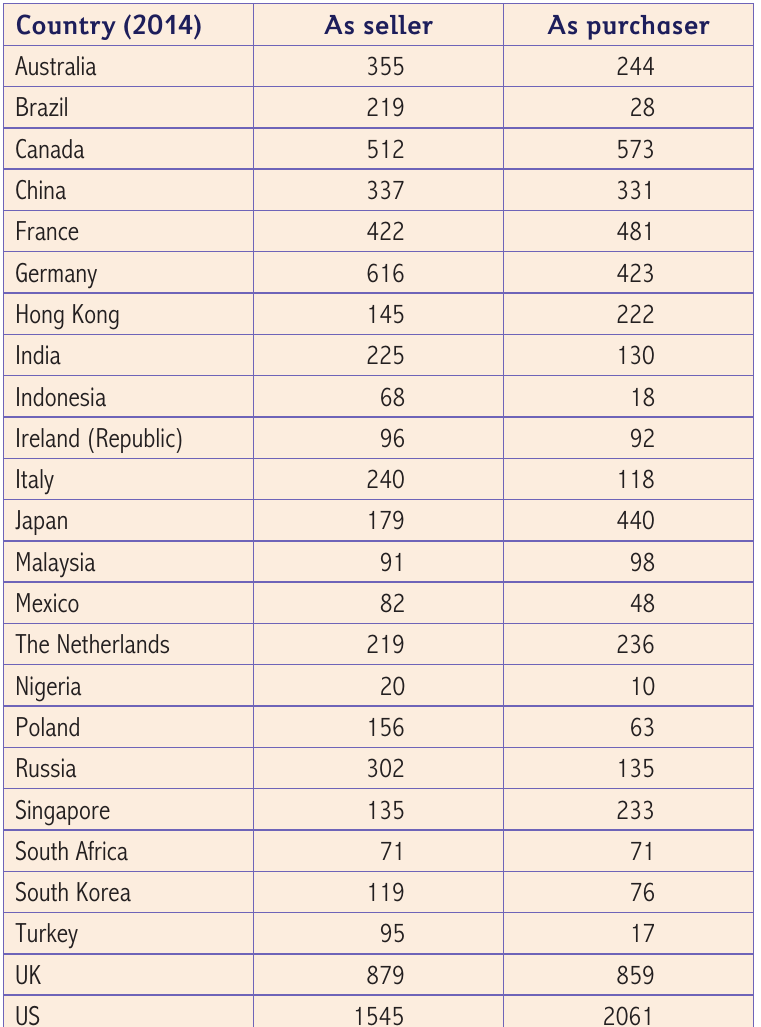
The data reveals several patterns. The United States leads both as a seller (1,545 deals) and purchaser (2,061 deals) of companies, reflecting its dominant position in global business. Germany (616 sales, 423 purchases) and the UK (879 sales, 859 purchases) show similarly high activity levels. Emerging economies like China (337 sales, 331 purchases) and India (225 sales, 130 purchases) demonstrate growing participation in international M&A activity.
Note
What's particularly interesting is the variation between countries. Japan shows a strong preference for acquiring foreign businesses (440 purchases) compared to selling Japanese companies abroad (179 sales), suggesting a strategy of international expansion. Conversely, Brazil shows heavy selling activity (219) but limited purchasing (28), possibly indicating foreign interest in Brazilian assets.
Important
Every investment decision reflects the specific circumstances facing individual firms and the personal judgment of senior managers, including their confidence levels and risk perceptions. The reasons for these deals often overlap – for instance, the desire to spread risk connects closely with entering new markets or trade blocs.
Five key reasons for global mergers and joint ventures
Spreading risk over different countries or regions
Economic downturns can devastate even financially strong companies with healthy balance sheets. During recessions or financial crises, demand falls, credit becomes scarce, and profitability suffers. To protect themselves, businesses strategically locate operations in multiple countries where these risks are less likely to occur simultaneously.
This geographic diversification works like an insurance policy. When one market experiences difficulties, operations in other regions can maintain revenue streams and support the overall business. The principle is simple: don't put all your eggs in one basket.
Example
Case Study: Pingo Doce
This Portuguese supermarket chain, with origins dating back two hundred years, began international expansion in the 1990s specifically to diversify away from dependence on the Portuguese market.
Although its first attempt in Brazil failed, the company succeeded in Poland by adapting its strategy. Instead of competing head-to-head with giants like Tesco and Carrefour through huge stores, Pingo Doce focused on small, local shops. It acquired the discount chain Biedronka, which became Poland's biggest food retailer.
By 2012, facing struggles in the European market, Pingo Doce again sought diversification into the growth markets of Latin America. This demonstrates how businesses continuously reassess and adjust their geographic risk profile.
Entering new markets and trade blocs
Growing organically through gradual expansion takes time and resources. Mergers and acquisitions offer a shortcut to international growth, providing instant market presence, established customer bases, and operational infrastructure. This route has become increasingly popular, particularly for firms from developing and transition economies seeking to compete globally.
China, Thailand, Mexico and India have been leading this trend, with businesses from these countries actively acquiring firms in developed markets. This represents a significant shift from historical patterns where investment predominantly flowed from developed to developing nations.
Market maturity often drives international M&A activity. When domestic markets become saturated with slow growth prospects, companies must look abroad for expansion opportunities. The international beer market exemplifies this perfectly. In developed markets, beer consumption growth has stagnated. Consequently, brewers pursued aggressive cross-border consolidation over the past decade. Four major brewers (AB-InBev, SABMiller, Heineken and Carlsberg) now control over 50 per cent of global market volume. These mergers delivered both access to new markets and substantial economies of scale, making the combined entities more competitive.
Example
Case Study: Tata Motors
Tata Motors purchased Jaguar Land Rover from Ford Motor Company, instantly transforming the Indian company into a global automotive player with premium brands and international manufacturing capabilities.
Important
Government restrictions sometimes make joint ventures essential for market entry. The Shanghai Automotive Industry Corporation (SAIC) operates factories with Volkswagen (VW) and General Motors (GM) precisely because Chinese government regulations limited foreign firms' independent access to the Chinese market.
To reach billions of Chinese consumers, VW and GM had to partner with SAIC through joint-venture arrangements. Both Western companies consider the partnership successful, and SAIC derives substantial profits from these joint ventures. However, some observers suggest SAIC should further develop its own technology and capabilities rather than remaining dependent on foreign partners.
Acquiring national and international brand names or patents
Becoming a global player requires more than just good products – it demands brand recognition and protected intellectual property. Developing these assets internally requires enormous investment and carries significant risk. Acquiring an established business with strong brands or valuable patents provides instant credibility and market position.

Benefits of brand acquisition include:
- Strong brand recognition in target markets
- Established brand loyalty among customers
- Reduced competition for products
- Avoiding the high risk, cost and uncertainty of launching new products from scratch
Important
However, brands can be fragile assets. Post-merger integration must carefully protect employee morale and customer satisfaction, otherwise brand value erodes quickly. Companies may adopt the strongest acquired brand while retiring weaker ones, or maintain a portfolio of brands as part of a differentiation strategy.
Example
Case Study: Lenovo-IBM
In 2004, Lenovo held 27 per cent of the Chinese PC market but dreamt of global leadership. The company faced a choice: create a foreign subsidiary from scratch or acquire an existing global player. With limited foreign market experience, no distribution channels, and no internationally recognized brand, Lenovo chose acquisition.
In 2005, Lenovo bought IBM's personal computer business for \£1.75 billion. This transaction delivered:
- Instant presence outside China
- Access to IBM's markets and sales channels
- Cutting-edge technology
- The well-known 'ThinkPad' and 'ThinkCentre' brands
- Cost savings through economies of scale
- Experienced researchers, technicians and managers
Overnight, Lenovo became one of the world's largest computer makers. The deal benefited IBM too, as its PC division had been losing money. Lenovo brought fresh thinking and an ambitious workforce to inject new energy into the established computer business.
Gaining access to intellectual property
Intellectual property encompasses creations of the mind – inventions, literary works, artwork – that law protects from unauthorised use. Developing intellectual property through internal research and development can take years and involve substantial financial risk. Acquiring it through mergers or joint ventures offers a faster, more certain route.
Legal protection mechanisms include:
- Patents for inventions (typically 20 years protection)
- Copyrights for literary works or computer programs (typically author's life plus 70 years)
- Trademarks for brand names or designs (renewable indefinitely)
Note
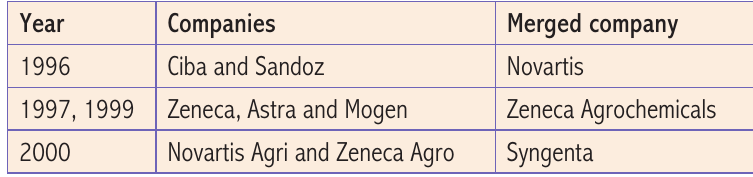
The agriculture and biotechnology sector shows how companies pursue intellectual property through M&A. In 1996, Ciba and Sandoz merged to form Novartis. Between 1997-1999, Zeneca, Astra and Mogen combined into Zeneca Agrochemicals. In 2000, Novartis Agri and Zeneca Agro merged to create Syngenta. These deals aimed to acquire scale in intellectual property portfolios, combining patents and research capabilities to dominate their sectors.
Securing resources or supplies
Firms may merge with suppliers to control resources or supplies further back in the supply chain. This strategy, called backward vertical integration, makes sense when:
- Resources used in production are scarce or difficult to acquire, requiring reliable sourcing
- The firm needs to ensure inputs meet specific quality or price standards
Example
Case Study: Starbucks
The company's rapid international expansion, combined with disease threats to coffee plants, created intense competition for high-quality coffee beans. To secure reliable supplies of the best beans, Starbucks bought its own coffee farm in Costa Rica.
This vertical integration guaranteed access to premium coffee meeting Starbucks' exacting standards, removing uncertainty from its supply chain.
Maintaining or increasing global competitiveness
Merging or acquiring another firm can create competitive advantages through bigger markets, economies of scale and scope, and cost savings. These benefits strengthen pricing power over both customers and suppliers. Where competition is fierce or a firm aspires to global market dominance, M&A can prove essential to strategy.
Scale economies drive many competitive mergers. A proposed merger between Applied Materials and Tokyo Electron demonstrates this clearly. Computer chip demand keeps rising, but the machines manufacturing chips are extremely expensive. The merger would give the combined entity a quarter of the market, strengthening its negotiating position against major customers (Intel, Samsung, Taiwan Semiconductor). The objective was acquiring scale and cutting costs, thereby resisting downward price pressure. The savings would fund long-term planning and hugely expensive research and development.
Note
Cross-selling opportunities arise when merged firms offer complementary product ranges or services. Banks and financial services firms have merged to provide customers with one-stop access to diverse financial products, increasing overall sales while potentially lowering internal costs through shared infrastructure.
Tax optimization represents another competitive benefit from geographic collaboration. Firms may select merger partners located in countries with lower overall taxation. The merged entity can then relocate headquarters to the lower-tax jurisdiction, legally reducing tax bills. While politically controversial, these savings can be reinvested to improve competitive position. Companies operating legally and ethically will naturally seek to minimize taxation where possible.
Example
Defensive Acquisitions
In 2014, Facebook spent $22 billion buying WhatsApp, a mobile messaging service. WhatsApp had earned only $10.2 million the previous year and was reportedly loss-making. Why pay so much?
- Partly to eliminate a competitor
- Partly to acquire WhatsApp's superior messaging technology
- Crucially, it may have been defensive: if Facebook hadn't bought WhatsApp, a competitor might have
Facebook couldn't risk letting rivals acquire such a valuable asset.
Important
A cautionary note: There's an old saying – "Two dogs do not make a tiger". This means combining two weak or mediocre businesses doesn't necessarily create a strong one. Poorly executed purchases might waste money, but at worst they can severely damage a firm's competitive position. M&A success depends on careful strategic analysis, thorough due diligence, and skilled post-merger integration.
Summary
Key Points to Remember:
- Five key reasons drive global mergers and joint ventures: spreading risk, entering new markets, acquiring brands/IP, securing resources, and maintaining competitiveness
- Risk diversification protects firms from single-market economic downturns by operating across multiple countries and regions
- Market entry through M&A provides faster international expansion than organic growth, particularly valuable in mature or restricted markets
- Brand and IP acquisition offers instant recognition and legal protection without the time, cost and risk of internal development
- Backward vertical integration secures reliable, quality supplies of scarce or critical resources
- Competitive advantages from mergers include economies of scale, enhanced market power, cost savings, cross-selling opportunities, and tax optimization
- Strategic decisions must consider specific circumstances, management judgment, and careful post-merger integration to realize potential benefits