Growing Economies (Edexcel A-Level Business): Revision Notes
📚Revision Notes
Growing economies
Introduction to the UK economy and emerging markets
The UK economy has undergone significant transformation over the past century and a half. While Britain once dominated global manufacturing as an industrial powerhouse, the modern economic landscape has shifted considerably. In 2014, UK manufacturing output showed positive momentum with average growth of 2.8%, and British products became more competitive than at any point in recent decades. However, the UK has developed a particularly strong service sector, and the majority of manufactured goods consumed globally now come from emerging economies rather than traditional developed nations.
Note
The shift from manufacturing to services represents one of the most significant economic transformations in developed economies. This transition has profound implications for trade patterns, employment, and international competitiveness.
Understanding emerging economies and markets
Emerging economies and markets refer to nations experiencing rapid economic growth accompanied by higher levels of investment risk. These markets attract investors precisely because they typically grow faster than mature, developed economies. This faster growth rate means businesses operating in these markets often have greater opportunities to increase profits and shareholder dividends compared to operating in more established economies.
Economists frequently group emerging economies into convenient categories for analysis. The two most commonly referenced groupings are:
- BRICS: Brazil, Russia, India, China and South Africa
- MINT: Mexico, Indonesia, Nigeria and Turkey
These groupings help analysts track trends and compare economic performance across similar developing nations. Both groups represent economies that have shown substantial growth potential and increasing global economic influence.
Important
The Risk-Return Trade-off
While emerging markets offer higher growth potential, they also carry significantly higher investment risks. These risks include political instability, currency fluctuations, regulatory changes, and economic volatility. Investors must carefully balance the potential for higher returns against these elevated risks.
Economic growth in emerging markets
When an emerging market experiences rising average incomes, this typically indicates an expanding middle class. Higher incomes enable consumers to increase spending on both imported products and domestically produced goods and services. This increased domestic consumption has a powerful multiplier effect - it encourages the growth of local firms, enhances their market power, and enables them to compete more effectively in international markets.
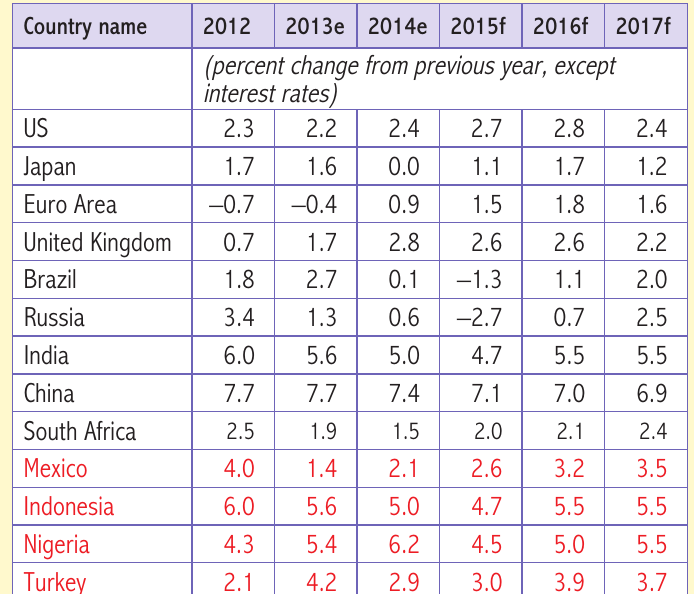
Simultaneously, consumers with higher disposable incomes purchase more imported goods and services from businesses in developed economies. This makes emerging markets increasingly attractive destinations for international companies seeking new customers. Many economists predict that growth rates in emerging market economies will consistently exceed those of developed economies, including the UK. The table below illustrates this trend clearly.
Note
Understanding Economic Growth Metrics
Economic growth represents the increase in a country's productive capacity and is typically measured using Gross Domestic Product (GDP). In the UK, the Office for National Statistics (ONS) provides official GDP data, allowing comparison with international economies.
The data reveals that emerging economies such as China, India, Indonesia and Nigeria frequently achieve growth rates of 5-7% annually, significantly outpacing developed nations like the UK, US and Japan which typically grow at 1-3% per year. However, it's crucial to remember that while the trend favors emerging markets, growth is not guaranteed. These economies face various risks that could substantially impact their economic performance, and different countries show varying degrees of vulnerability to specific challenges.
Growing economic power of Asian, African and other countries
China's economic dominance
Most BRICS and MINT countries have achieved strong economic growth over recent years, significantly increasing the collective economic power of nations in Asia, Africa and other regions. China's rise has been particularly remarkable. By some measures, China became the world's largest economy in 2015, overtaking the United States which had held this position since the late 1800s. China consistently ranks at or near the top globally as both an exporter and as a destination for foreign investment. Its growing economic strength has transformed it into one of the world's largest investors in other countries.
Example
China's Manufacturing Transformation
The scale of China's manufacturing transformation is extraordinary:
- 1990: China produced less than 3% of global manufacturing output by value
- Early 2015: This figure had soared to nearly 25% of all global manufacturing
This represents more than an eight-fold increase in global market share over just 25 years, fundamentally reshaping the world's manufacturing landscape.
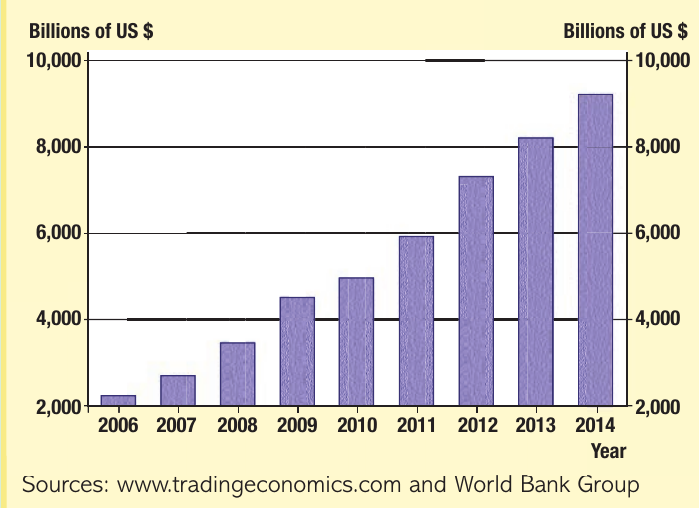
The following chart illustrates China's remarkable GDP expansion.
Factory Asia and regional trading blocs
China's industrial capabilities have had profound impacts across South East Asia through extensive supply chains and outsourcing arrangements. This phenomenon has become known as 'Factory Asia' due to the region's dominance of global manufacturing. The strength of the ASEAN regional trading bloc appears set to continue for several interconnected reasons.
First, China has developed highly efficient clusters of suppliers alongside excellent infrastructure, enabling further cost-effective expansion. Second, China maintains access to lower-cost labor throughout South East Asia, including countries like Myanmar (Burma) and the Philippines. Finally, Chinese and other Asian consumers are increasing their spending each year, driving higher demand and reinforcing local production and distribution networks.
Note
The Three Pillars of Factory Asia
Factory Asia's continued dominance rests on three key advantages:
- Infrastructure and efficiency: Established supplier networks and modern logistics systems
- Labor access: Availability of cost-effective labor across the region
- Growing consumer markets: Rising domestic demand creating self-reinforcing growth
Other emerging markets
Other emerging markets in Central and South America and Africa are creating large international companies that increasingly challenge the dominance of firms from developed regions. However, given China's overwhelming dominance in manufacturing, these other regions may find it difficult to follow the same development path. They may need to identify alternative strategies for growth and development in the future.
According to World Bank analysis, the largest economies globally include the US, Japan, Germany and the UK. However, the ranking of leading economies continues to evolve. Approximately 70% of world GDP growth is projected to come from emerging market economies, with China and India accounting for between 40-50% of this total. This means that roughly 20-30% of future global growth may originate from emerging markets outside these two economic giants.
Important
Future Growth Distribution
The balance of global economic power is shifting dramatically. With 70% of future GDP growth expected from emerging markets, businesses and policymakers in developed economies must adapt their strategies to engage effectively with these rapidly growing markets.
Implications of economic growth for individuals and businesses
Economic growth in emerging markets creates expanding opportunities for both domestic companies and international businesses from developed economies. This growth makes emerging markets increasingly attractive to new market entrants, generates trade opportunities, and transforms existing employment patterns.
Trade opportunities for businesses
Where an economy is growing, consumption typically grows alongside it, creating favorable conditions for firms seeking to invest or sell products and services. Economic growth usually correlates with rising disposable income, meaning individuals have more money available to spend. This increases overall demand for goods and services, and demand often becomes income elastic during growth periods, providing opportunities for increased revenues and profits.
These goods and services can be produced domestically within the growing economy or imported from abroad, creating numerous opportunities for international trade. Businesses in developed economies can export to growing markets, while emerging market businesses can expand their domestic operations. The interconnected nature of modern global trade means that economic growth in one region typically creates opportunities for businesses worldwide.
Note
Income Elasticity and Market Opportunities
When demand becomes income elastic, consumers increase their spending on products disproportionately as their incomes rise. This creates particularly strong opportunities for businesses selling discretionary goods and premium products in growing markets.
Employment patterns and their implications
Beyond examining growth rates, businesses considering investment in emerging markets need to assess employment patterns across an economy. Employment serves as one of the most important indicators of economic health. Firms typically require information on unemployment rates and trends, labor costs, productivity levels, and the educational qualifications of potential employees.
The employment rate provides a snapshot of job creation or loss across an economy. Unemployment levels reveal considerable information about economic conditions, though interpretation requires careful analysis. Disposable income levels indicate whether consumers can afford to purchase goods in the future. When unemployment is high, people generally lack money to spend or save. Consequently, high unemployment in a country might suggest poor market conditions for exporters.
Important
The Dual Interpretation of Unemployment
Unemployment data can be interpreted from two contrasting business perspectives:
Negative indicator: High unemployment suggests weak consumer demand and limited disposable income, potentially indicating poor market conditions for selling products.
Positive indicator: High unemployment may provide a ready pool of available labor for businesses planning direct investment through establishing manufacturing facilities.
The interpretation depends entirely on your business strategy - whether you're seeking consumers or workers.
However, unemployment can also be interpreted positively from a different business perspective. Unemployed individuals may be actively seeking work, potentially providing a ready pool of labor for businesses considering direct investment through establishing manufacturing facilities. In such cases, building a factory in a country with higher unemployment might represent a sound strategic decision.
Example
Comparing Unemployment Rates (2014)
United Kingdom: 5.8% (down from 8% peak in 2009)
- Represents substantial improvement and economic recovery
- According to Office for National Statistics
European Union: Persistent high unemployment with no clear improvement
- Greece: 25% or above
- Spain: 25% or above
- These figures indicate significant economic weakness
China: Approximately 3% (2.9% in 2012)
- Consistently low unemployment according to ILO data
- Indicates tight labor market conditions
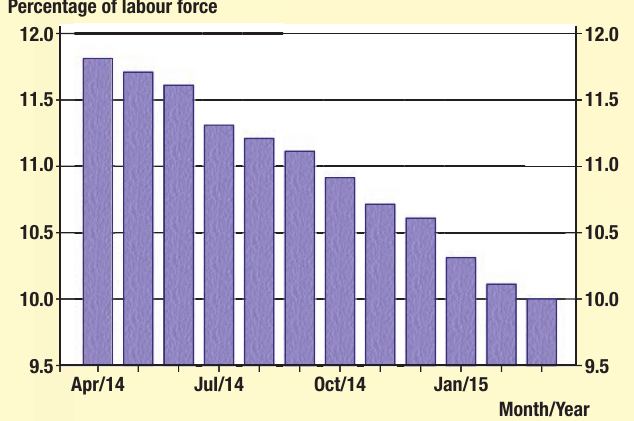
The unemployment rate in the UK reached 5.8% in 2014 according to the Office for National Statistics, representing substantial improvement from 2009 when unemployment peaked at 8%. The International Labour Organization (ILO) provides comparative data for other countries. The European Union experienced persistent unemployment challenges, with 2014 showing no clear signs of improvement. Greece and Spain faced particularly severe conditions with unemployment rates at or above 25%, indicating significant economic weakness. By contrast, China's unemployment rate has remained around 3% (2.9% in 2012) according to ILO data.
Future employment trends also warrant careful consideration. For example, advancing technology may reduce the number of workers required in manufacturing. As a consequence, having access to cheap labor may no longer represent as significant a comparative advantage for emerging economies as it once did. Automation and technological advancement could fundamentally alter the traditional development path followed by earlier industrializing nations.
Note
Technology's Impact on Employment Advantages
Automation and advanced manufacturing technologies are changing the traditional advantages of emerging economies. As robots and AI become more prevalent in manufacturing, the historical advantage of low-cost labor may diminish, potentially requiring emerging economies to develop new competitive strategies beyond simply offering cheaper workforce costs.
Summary
Key Points to Remember:
-
Emerging economies experience rapid growth but carry higher investment risk; BRICS (Brazil, Russia, India, China, South Africa) and MINT (Mexico, Indonesia, Nigeria, Turkey) are key groupings that help analysts track economic trends
-
China has become the world's dominant manufacturing power, producing nearly 25% of global manufacturing output by 2015, up from less than 3% in 1990
-
Growth rates in emerging economies (5-7% annually) typically exceed those in developed nations like the UK (2-3%), though this trend is not guaranteed and various risks remain
-
Factory Asia describes South East Asia's dominance of global manufacturing, driven by efficient supply chains, lower labor costs and growing consumer demand
-
Trade opportunities expand in growing economies as rising disposable incomes increase demand for both domestic and imported goods and services
-
Employment patterns provide crucial economic indicators - high unemployment may signal weak consumer demand but also potential labor availability for direct investment
-
Approximately 70% of world GDP growth is projected to come from emerging market economies, fundamentally shifting the balance of global economic power