Government Intervention (Edexcel A-Level Economics A): Revision Notes
📚Revision Notes
Government intervention
Why governments intervene in markets
Governments intervene in markets for several important reasons. The main purpose is to correct market failures where the free market fails to allocate resources efficiently. This happens when the price mechanism doesn't reflect the true costs or benefits to society. Interventions are also necessary to raise revenue to finance government activities and public services.
When markets fail, it means that producing or consuming at the market equilibrium leads to an inefficient outcome for society. The price may not equal the marginal cost of production, or the marginal social benefit may not equal the marginal social cost. In such situations, government intervention can potentially improve social welfare.
Important
While government intervention aims to correct market failures and improve outcomes, interventions can sometimes produce unintended consequences that make situations worse rather than better. It's crucial to consider how markets will respond to policy measures.

Approaches to correcting market failure
There are two main approaches governments can use to address market failures:
Market-based policy involves working with the market mechanism to influence the behaviour of producers or consumers. Rather than telling people what to do, the government changes incentives so that people voluntarily adjust their behaviour. Examples include taxes and subsidies that alter the prices people face.
Regulation involves direct government control through commands and rules. This means telling economic agents specifically what they can and cannot do. Examples include environmental standards, bans on certain products, or quotas limiting production.
Note
The government must also intervene to ensure adequate provision of public goods. Because of the free-rider problem, private markets won't provide the socially optimal quantity of non-excludable and non-rivalrous goods. Therefore, some government action is needed, whether through direct provision or subsidies to encourage private sector supply.
Information problems provide another justification for intervention. When consumers or producers lack information or cannot process available information effectively, the government may need to step in. This could involve information campaigns, regulations requiring disclosure, or other measures to address asymmetric information issues.
Sales taxes (indirect taxes)
An indirect tax is a tax levied on expenditure on goods or services, as opposed to a direct tax which is charged directly to individuals based on income. These taxes are paid by sellers, so they affect the supply curve rather than the demand curve.
How indirect taxes work
When the government imposes an indirect tax, it increases the cost of supplying each unit of a good. This means that at any given price, firms are prepared to supply less than before. Alternatively, for any given quantity, firms need to receive a higher price to cover both their production costs and the tax. The effect is to shift the supply curve vertically upward by the amount of the tax.
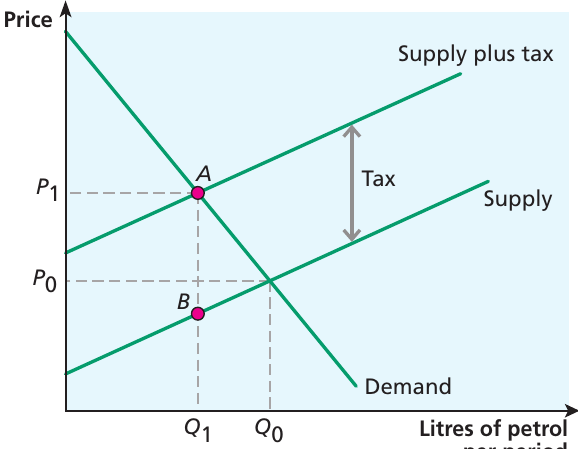
The diagram above shows the effect of a specific tax on petrol (a fixed amount per litre). Without the tax, equilibrium occurs at point B with price and quantity . The tax shifts the supply curve upward to "supply plus tax". The new equilibrium is at point A, with a higher price paid by consumers and a lower quantity traded.
Important
Notice that the vertical distance between the two supply curves at quantity equals the tax amount. However, the price increase (from to ) is less than the full tax. This shows that the tax burden is shared between consumers and producers. Consumers pay more, but producers effectively receive less per unit after paying the tax to the government.

Effects on society
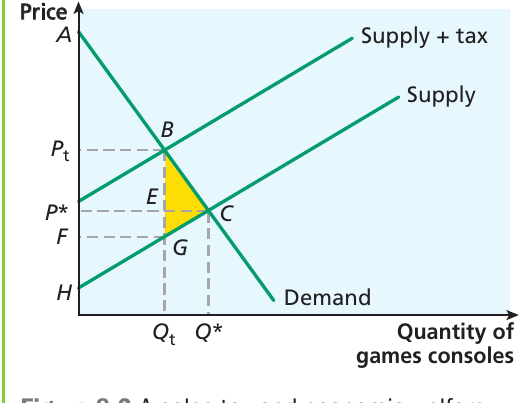
While sales taxes raise government revenue, they also create economic costs. The tax moves the market away from its original equilibrium where price equalled marginal cost. This creates a misallocation of resources.
The total welfare effect can be analysed by looking at changes in consumer surplus, producer surplus, and government revenue. The key finding is that there is a deadweight loss - a loss of total welfare that cannot be recovered by anyone. This triangular area represents economic inefficiency created by the tax.
Note
Even when government uses tax revenue wisely, society still bears this welfare loss. This represents the distortion to resource allocation caused by moving away from the free market equilibrium. Both subsidies and taxes create deadweight losses - they are the cost of government intervention even when it serves useful purposes.
Dealing with externalities
Externalities occur when the price mechanism fails to reflect the true costs or benefits associated with a product. This imposes costs on (or provides benefits to) third parties who are not involved in the transaction. One approach to dealing with this problem is to internalise the externality - bringing the external effects into the price system so that decision-makers face the true social costs and benefits.
Imposing a pollution tax
The polluter pays principle argues that firms causing pollution should face the full external costs they inflict on society. One way to achieve this is through taxation.
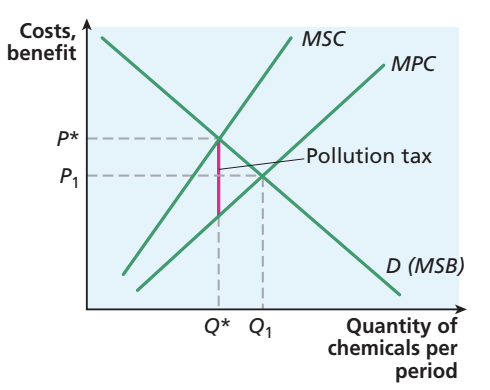
The diagram shows a market where production creates pollution. Firms face marginal private costs (MPC) which are less than the marginal social costs (MSC) that society bears. Without intervention, the free market produces at where price equals MPC. However, the socially optimal output is where marginal social benefit equals marginal social cost.
To reach the optimal position, the government can impose a pollution tax equal to the vertical distance between the MPC and MSC curves. This tax forces firms to internalise the externality. Facing the higher costs, they reduce output to and charge price to consumers. At this point, society achieves the optimal amount of pollution reduction - not zero pollution, but the level where the marginal benefit of further reduction equals the marginal cost.
Emissions reduction approach
An alternative way to view this problem is through the marginal benefit and marginal cost of emissions reduction.
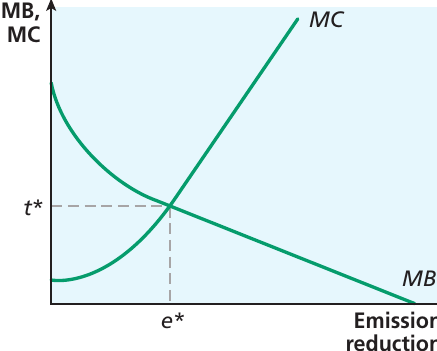
The marginal benefit (MB) curve shows society's benefit from reducing emissions. This decreases as more pollution is eliminated - the first reductions eliminate the worst pollution and provide the greatest benefits. The marginal cost (MC) curve shows the cost to firms of reducing emissions. This increases as more reductions are required - the easiest reductions happen first.
The optimal point occurs where MB equals MC. At this level, the marginal benefit of further emission reduction exactly equals the marginal cost. The optimal tax rate achieves this outcome. Setting the tax too low would result in insufficient emission reduction, while setting it too high would impose excessive costs on firms for little additional benefit.
Measuring benefits and costs
A major practical difficulty with these approaches is measuring the marginal benefits and costs accurately. Several problems arise:
Important
The Challenge of Valuation
The marginal social benefits of pollution reduction are extremely hard to quantify. While we know pollution causes health problems and premature deaths, putting a monetary value on these effects is controversial. How do we value improvements to quality of life? Should we consider international effects when setting domestic policy? What discount rate should we use for future benefits?
Different stakeholders may arrive at completely different valuations. Environmentalists and industrialists will have very different views on pollution control benefits. This makes it difficult for authorities to determine the correct tax level or emissions standard.
Measurement of costs also presents challenges. Firms vary in their efficiency and technology. Some firms using modern equipment face lower costs of emission reduction than firms with old capital. Should the government try to set firm-specific taxes to account for these differences? If not, a flat-rate tax creates inappropriate incentives - modern firms may reduce emissions too little while old-technology firms face excessive burdens.
Prohibition
Rather than taxing pollution, the government can prohibit emissions beyond a certain level. This means controlling quantity directly rather than working through prices. Firms would be required to meet environmental standards, with penalties for exceeding permitted emission levels.
If the government has complete information about marginal costs and benefits, taxation and prohibition can produce equivalent results. However, in practice, authorities lack this information. The choice between using taxes (price-based approach) or quotas (quantity-based approach) depends on the relative uncertainties about costs versus benefits.
Tradable pollution permits
A tradable pollution permit system offers a market-based approach to controlling pollution. The government sets a limit on total emissions and issues permits allowing firms to pollute up to that limit. Crucially, these permits can then be traded between firms.
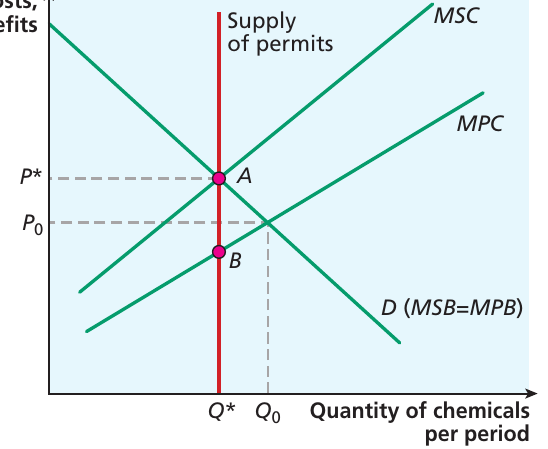
The diagram shows how this system operates. The government sets the supply of permits at , the socially optimal level of pollution. The supply curve is vertical at this quantity because the total number of permits is fixed. The demand for permits comes from firms that want to pollute.
In equilibrium, the market price of permits settles at . This occurs where the demand curve (representing marginal benefit to firms of being allowed to pollute) intersects the vertical supply curve. This price is equivalent to imposing a pollution tax of AB in the earlier diagram - if authorities correctly identify the optimal pollution level , both approaches achieve the same outcome.
How the permit trading works
Firms that pollute using relatively inefficient production methods face high costs and will want permits. These firms find it cheaper to continue polluting and buy permits rather than invest in cleaner technology. Conversely, firms using cleaner production methods don't need their full allocation of permits. They can sell their excess permits to polluting firms and make a profit.
This creates market incentives for pollution reduction. Rather than continuing to purchase expensive permits, polluting firms have an incentive to reduce their emissions. Meanwhile, the permit system addresses the externality problem by making firms face the costs of their pollution through the permit market price, rather than imposing those costs on society.
Advantages of tradable permits
The permit system offers several benefits compared to direct regulation:
-
The scheme uses market incentives rather than overriding the market. Firms that find it expensive to reduce pollution can continue operating while paying for permits, whereas firms that can reduce pollution cheaply have incentives to do so and profit from selling permits. This is more efficient than uniform regulations that ignore cost differences between firms.
-
The government maintains control over total pollution through the number of permits issued. Authorities can gradually reduce the cap over time to decrease total emissions. The mixture of clean and dirty firms may produce the same total emissions as uniformly slightly unclean firms, but with lower total abatement costs.
Disadvantages of tradable permits
However, the permit system faces significant challenges:
Note
Enforcement Challenges
Enforcement is crucial for effectiveness. There must be sanctions for firms that pollute beyond their permitted levels. The authorities need an operational and cost-effective method to monitor emission levels. Without proper enforcement, firms may simply ignore the permit requirements.
Determining the appropriate number of permits to issue presents difficulties. This requires authorities to measure the extent to which marginal private and social costs diverge - the same information problem that makes taxation difficult. Some alternative regulatory systems share this problem of uncertainty about costs and benefits.
A unique concern with permit systems is that different pollution levels produced by different firms may seem unfair. Firms that can afford to buy permits can pollute as much as they like, while smaller firms may be unable to compete. However, this criticism may be outweighed by the advantage that it strengthens incentives for polluting firms to improve their production methods. Heavy polluters may face reputational damage that encourages them to clean up their operations.
Real-world example: EU Emissions Trading System
Example
Real-World Application: EU ETS
The EU Emissions Trading System (EU ETS) has operated since 2005 as a large-scale example of cap and trade. It now covers all EU countries plus Liechtenstein, Iceland and Norway, limiting carbon emissions from over 11,000 energy-using installations such as power plants, factories and aviation.
The system sets a cap on total greenhouse gases that can be emitted, with this cap reducing over time. Companies receive or buy emission allowances which can then be traded. The scheme has achieved success in reducing emissions. After Brexit, the UK ceased participation in the EU ETS but remained supportive. From January 2021, the UK Emissions Trading System replaced the UK's EU ETS participation to maintain continuity for UK businesses.
Global warming and international cooperation
Climate change demonstrates the difficulty of tackling externalities that cross international borders. The 1997 Kyoto summit laid foundations for international action, with almost all developed nations agreeing to reduce emissions of carbon dioxide and other greenhouse gases. While virtually every country had signed the Paris Agreement by 2018, the USA announced withdrawal until it could negotiate a more favourable deal. This demonstrates the challenge of securing cooperation when effects cross national borders. However, once in power, President Biden quickly announced the USA would rejoin the Paris Agreement.
Important
International cooperation is essential because global warming affects all countries regardless of where emissions occur. Individual nations have insufficient incentive to reduce emissions if other countries continue polluting. Only coordinated international action can effectively address climate change.
NIMBY syndrome
The NIMBY (not in my back yard) syndrome describes situations where people support a facility in principle but object to it being located near them. For example, many would agree that society needs wind farms for sustainable energy development or landfill sites for waste disposal. However, people are reluctant to have these located in their neighbourhood because they would be the ones to suffer any negative effects.
This syndrome illustrates why tackling externalities is difficult. Costs and benefits are distributed unevenly - those living near the facility bear most of the costs while benefits spread across society. This creates political pressure against building necessary infrastructure even when the overall social benefit is positive.
Government expenditure and state provision
Taxes serve purposes beyond correcting market failure. Governments need revenue to finance their expenditure, including:
- Administration costs of running government
- Transfer payments that redistribute income to protect vulnerable people and address poverty
- Public goods that the private sector would underprovide due to the free-rider problem
Public goods were discussed in previous chapters. The free-rider problem prevents the private sector from providing the socially optimal quantity of non-excludable, non-rivalrous goods in a free market. Therefore, government intervention is needed to ensure adequate supply, though this doesn't necessarily mean direct government provision - subsidies to private providers can also work.
Balancing public and private sectors
Finding the appropriate balance between public and private sectors represents a fundamental dilemma for government. Private firms need access to public goods such as transport infrastructure and communications networks to operate effectively and compete internationally. Without sufficient government investment in roads, railways or broadband networks, domestic firms face higher costs and disadvantages compared to international competitors.
Note
The Opportunity Cost Trade-off
However, over-investment also creates problems. Using more resources for infrastructure means fewer resources available for other purposes - this is the opportunity cost. If government spending on rail networks (such as HS2) absorbs substantial resources, less funding remains available for improving the NHS or other priorities.
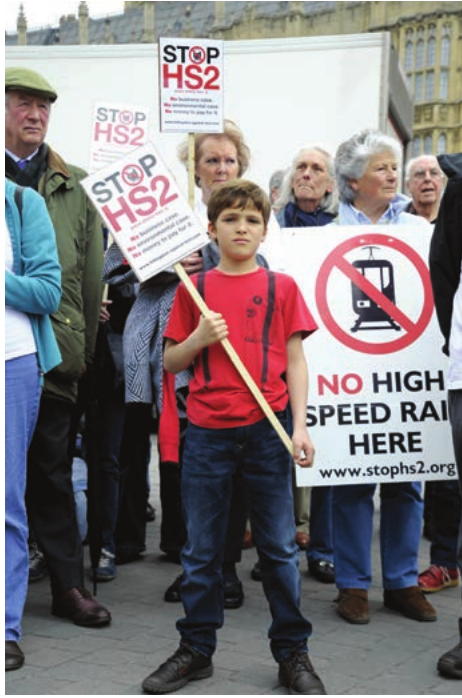
Government infrastructure projects often face opposition from those who will be negatively affected, even when the overall social benefit is positive. This makes difficult decisions about resource allocation even more challenging.
Price controls
In some markets, governments regulate prices directly rather than working through market incentives. This represents a response to market failure - for example, when prices don't equal marginal costs. Price controls have been used in various contexts, including food prices during civil unrest in developing countries, housing markets, and efforts to control alcohol consumption.
Minimum prices for alcohol
Some governments have attempted to tackle problems from excessive alcohol consumption by setting minimum prices for alcoholic drinks. This is an example of government viewing alcohol as a demerit good and trying to discourage consumption.
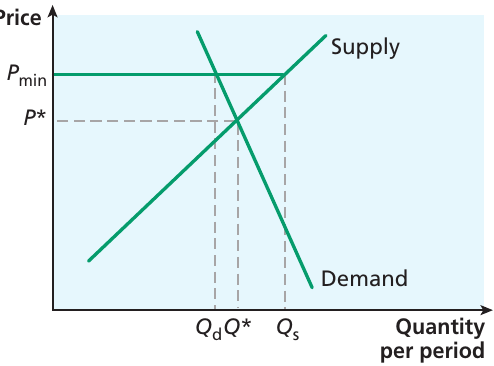
Without intervention, market equilibrium occurs where demand and supply intersect at price and quantity . If the government believes this consumption level causes excessive social costs (health problems, antisocial behaviour), it might introduce a minimum price that sellers cannot charge below.
At this higher price, two effects occur. First, consumers want to buy less - quantity demanded falls to . Second, suppliers are willing to supply more at the higher price - quantity supplied increases to . However, with consumers buying less, the actual quantity traded falls to . The result is excess supply - the distance between and .
Effectiveness of minimum alcohol pricing
Note
Whether this policy successfully reduces harmful drinking depends critically on the price elasticity of demand for alcohol. If demand is relatively inelastic (as studies suggest), the price increase results in only a small decrease in quantity consumed. The policy would be more effective if demand were elastic.
Example
Case Study: Scotland's Minimum Pricing
Scotland implemented such a policy in May 2018, setting a minimum price per alcoholic unit of £0.50. The government viewed low-price alcohol as encouraging health-damaging behaviour. However, because people can exceed recommended alcohol consumption limits relatively cheaply even at this minimum price, and because demand is fairly inelastic, the impact on consumption may be limited.
Rent controls
Another market where governments have intervened through price controls is rental housing. Free market equilibrium would occur where rental market supply and demand intersect, producing equilibrium rent and quantity of accommodation .
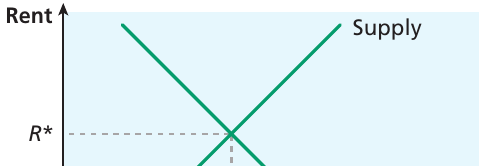
If government regards rent level as excessive and potentially exploitative (especially for low-income households who need housing as a basic necessity), it might be tempted to impose a maximum rent level that landlords cannot exceed.
At this lower rent, two effects follow. First, more people want to rent accommodation - quantity demanded increases to . Second, landlords find it less profitable to supply rental accommodation, so they reduce supply to . The result is excess demand - the distance between and means there is a shortage of available accommodation.
Unintended consequences
Important
When Good Intentions Go Wrong
The well-meaning rent control policy, intended to protect low-income households from exploitation, has exactly the opposite effect of what was intended. Less accommodation is available ( instead of ), and more people are homeless or unable to find housing (the gap between and ). The policy reduces the amount of rental accommodation available rather than making it more accessible to those who need it.
This illustrates how government intervention, even with good intentions, can produce unintended distortionary effects that make situations worse rather than better. It demonstrates the importance of considering market responses when designing policies.
Legislation and regulation
In some markets, governments choose to intervene directly through legislation and regulation rather than working through price signals. The aim is to influence the quantity of a good supplied or consumed. Legislation can make production or consumption of certain goods illegal, while regulation limits supply without banning it completely or, in some cases, encourages more supply.
Types of regulatory intervention
Regulation can take several forms:
- Limiting market power of large firms to protect consumers from excessive prices or reduced choice
- Placing direct controls on emissions of pollutants, perhaps by imposing limits or ensuring appropriate output levels
- Imposing quotas on production and sale of certain goods
- Preventing supply of a good entirely, or encouraging greater supply in other cases
Note
Legislation declaring goods illegal is an extreme form of intervention. Consider situations where the consumption of a good creates substantial social harms. For example, hard drugs produce significant negative externalities, and potential users may lack information to make informed decisions. One response is to ban sales entirely to prevent consumption.
Effects of banning goods
The economic effects of legislation and regulation are similar - both move markets away from free market equilibrium positions. Banning a product may establish a black market where sales continue hidden from authorities. This means the policy objectives aren't fully achieved, but policymakers may consider this preferable to allowing open market sales.
Regulation can limit the quantity of a good supplied by imposing quotas. Alternatively, it may limit market power of large firms that might otherwise exploit consumers by raising prices or increasing profits. These possibilities are explored in later chapters on competition policy.
Tackling information gaps
Market failure can arise from information problems, particularly when there is asymmetric information or when economic agents lack information or capacity to process available information. The solution involves finding ways to provide the needed information.
Asymmetric information
When information is distributed unevenly between buyers and sellers, markets may fail to function efficiently. Examples include:
Example
Second-Hand Car Market
Dealers may be unable to find buyers for good-quality cars at fair prices because potential buyers cannot distinguish quality. Solutions include AA inspection schemes or warranties that improve information flow about car quality, giving buyers confidence they aren't purchasing a lemon.
Example
Insurance Markets
Asymmetric information explains why insurance companies insist on comprehensive health histories for those taking health insurance. Companies include exclusion clauses allowing them to refuse payment if past illnesses weren't disclosed. Similarly, banks insist on collateral to back up loans because they cannot fully assess borrowers' ability or willingness to repay.
These measures help overcome information asymmetries by requiring disclosure or providing guarantees that reduce risks from hidden information.
Government information provision
Information problems may also exist regarding certain goods. Consider tobacco as an example. Government views tobacco as a demerit good because smokers underestimate the damaging health effects of smoking. Negative externalities also arise from passive smoking affecting others.
Example
Tackling Tobacco Consumption
Initially, governments tried using taxes to discourage smoking. However, given the relatively inelastic demand for tobacco, this proved ineffective - consumption fell only slightly despite price increases. Taxes were then reinforced by extensive information campaigns to spread awareness about the damaging effects of smoking.
When even this combination didn't fully solve the problem, government introduced regulation by prohibiting smoking in public buildings. The spread of e-cigarettes has added a new dimension to this situation, creating fresh challenges for policymakers trying to balance harm reduction with concerns about new products.
Remember!
Summary
Key Points to Remember:
-
Governments intervene in markets primarily to correct market failures, though well-intentioned interventions can sometimes produce unintended consequences.
-
Market-based policies (like taxes, subsidies and tradable permits) work with the market mechanism, while regulation involves direct command and control through laws and standards.
-
Indirect taxes shift the supply curve upward, raising prices and reducing quantities traded. They create deadweight loss even when revenue is used wisely, representing the efficiency cost of moving away from free market equilibrium.
-
Dealing with externalities can involve pollution taxes (making polluters pay), prohibition (setting environmental standards), or tradable pollution permit systems (cap and trade). Each approach has advantages and disadvantages, with measurement of costs and benefits being particularly challenging.
-
Price controls create market distortions: minimum prices (like for alcohol) create excess supply, while maximum prices (like rent controls) create excess demand and shortages, often producing effects opposite to policy intentions.