The Balance of Payments (Edexcel A-Level Economics A): Revision Notes
📚Revision Notes
The Balance of Payments
What is the balance of payments?
The balance of payments is a comprehensive record that tracks all economic transactions between residents of one country and the rest of the world over a specific time period. This accounting system captures a wide range of international activities, including the trade of goods and services, flows of investment income, purchases and sales of assets, and various transfers between countries.
Note
Monitoring these international transactions has become increasingly important as economies have become more interconnected through globalisation. This process of growing economic integration involves deeper international trade relationships, improved communications and transport technology, and the gradual removal of barriers to trade and capital flows.
Major developments like Brexit have highlighted how crucial these international economic relationships are, as the UK has had to renegotiate trading arrangements with both EU member states and countries worldwide.
Understanding credits and debits
Every transaction in the balance of payments can be classified as either a credit or a debit, depending on the direction of money flow:
-
Credit items represent incoming payments to the UK. When money flows into the country as a result of a transaction, this creates a credit entry.
-
Debit items represent outgoing payments from the UK. When money flows out of the country to pay for something, this creates a debit entry.
Example
Worked Example: Credits and Debits in Action
Credit transaction: When a UK manufacturer exports a car and receives payment from an overseas buyer, this is recorded as a credit because money is flowing into the UK economy.
Debit transaction: When UK residents purchase Italian wine and send payment to Italian producers, this is recorded as a debit because money is leaving the UK economy.
Understanding this distinction is fundamental to interpreting balance of payments data, as all international economic activity can be categorised using this framework.
The three main accounts
The balance of payments is organised into three distinct categories, each capturing different types of international transactions:
Current account
The current account tracks transactions involving goods, services, income payments, and transfers. It comprises:
-
Trade in goods and services: This measures the difference between what a country exports and imports. Trade in physical products (like cars or machinery) is sometimes called visible trade, while trade in services (like financial services or tourism) is known as invisible trade.
-
Primary income: This category includes income flows from investments and employment. It records earnings that UK residents receive from assets they own abroad, minus the income that overseas residents earn from UK-based assets.
-
Secondary income: This covers transfers such as taxes and benefits paid to or from non-resident workers, international aid payments, and contributions to international organisations.
Note
The current account receives the most attention from economists and policymakers because it provides important insights into a country's trading relationships and international competitiveness.
Capital account
The capital account records transactions involving physical capital assets, such as the purchase or sale of fixed assets like land and buildings. It also tracks capital transfers, including debt forgiveness and migrants' transfers of assets when they move between countries. In practice, the capital account is relatively small compared to the other accounts and typically has minimal impact on the overall balance of payments.
Financial account
The financial account captures transactions involving financial assets and liabilities. This includes:
- Direct investment flows (when companies establish operations or acquire significant stakes in foreign businesses)
- Portfolio investment (purchases of shares, bonds, and other securities)
- Official intervention in foreign exchange markets by central banks
- Changes in foreign exchange reserves
When UK residents purchase assets abroad, money flows out of the country, creating a debit on the financial account. Conversely, when overseas investors buy UK assets, money flows in, creating a credit.
Components of the balance of payments
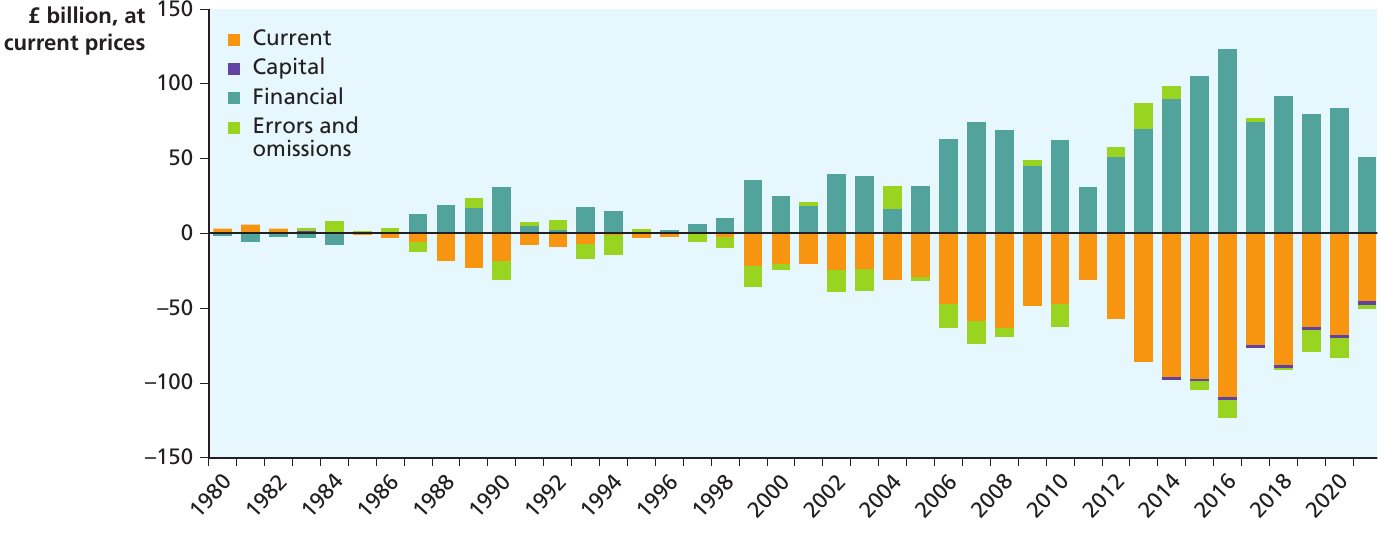
Historical data reveals important trends in the UK's international economic position. The chart below shows how the different components of the balance of payments have evolved since 1980.
Note
The data shown in the chart uses current prices, which means the figures are expressed in nominal terms without adjusting for inflation. This presentation method has limitations when comparing values across different years, as it doesn't account for changes in the general price level over time.
To better understand the relative magnitude of these flows, economists often express balance of payments figures as a percentage of GDP.
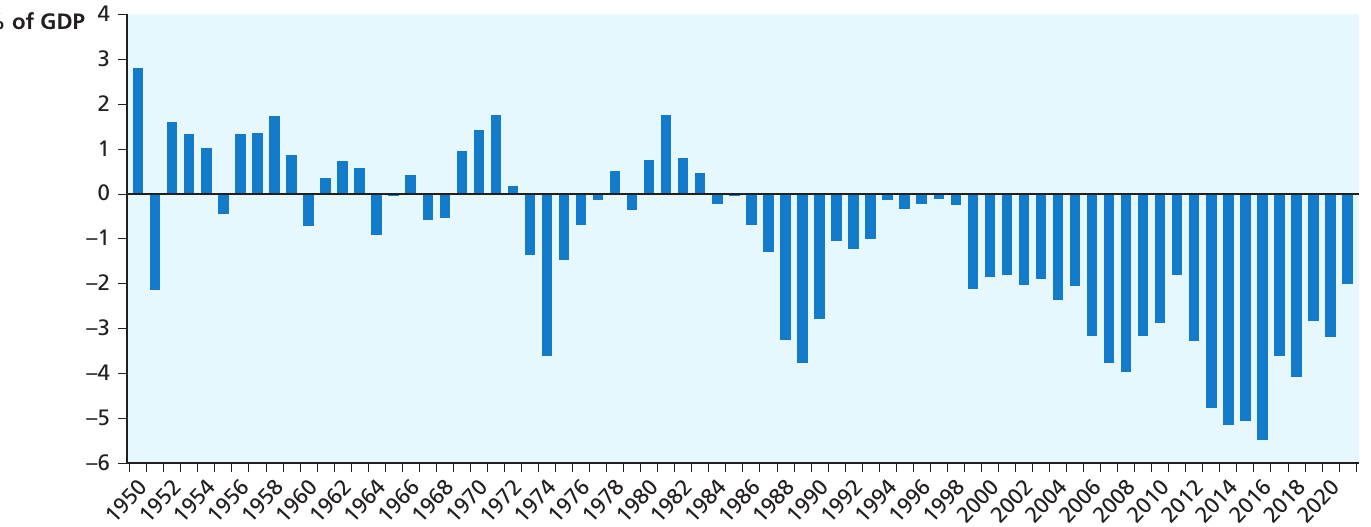
This historical perspective reveals a striking pattern: the UK's current account was generally in surplus or close to balance during the 1950s and 1960s, but has shown persistent deficits since the 1970s. The deficit has been particularly pronounced since 2000, often reaching between 2% and 6% of GDP in recent years. These sustained deficits have been offset by corresponding surpluses on the financial account, as foreign investors have purchased UK assets.
The current account in detail
Trade in goods
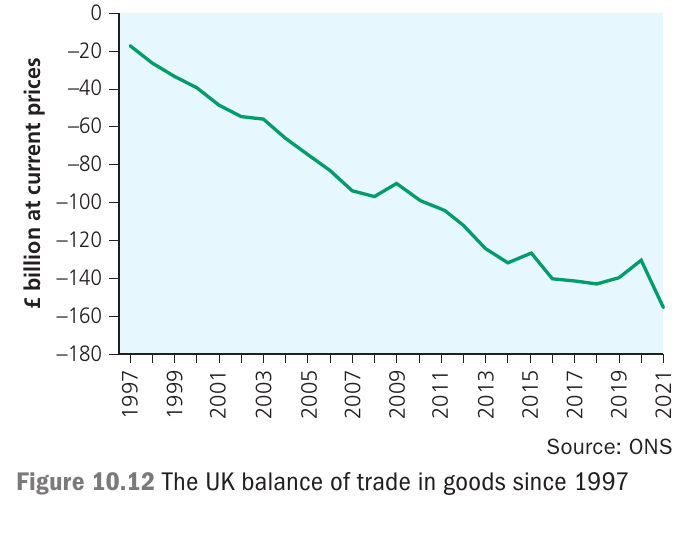
Trade in physical products has historically been a source of deficit for the UK economy. In fact, the UK has recorded a surplus in goods trade in only 6 years since 1950. Several factors help explain this pattern:
- The decline of North Sea oil production, which previously helped offset the deficit in manufactured goods
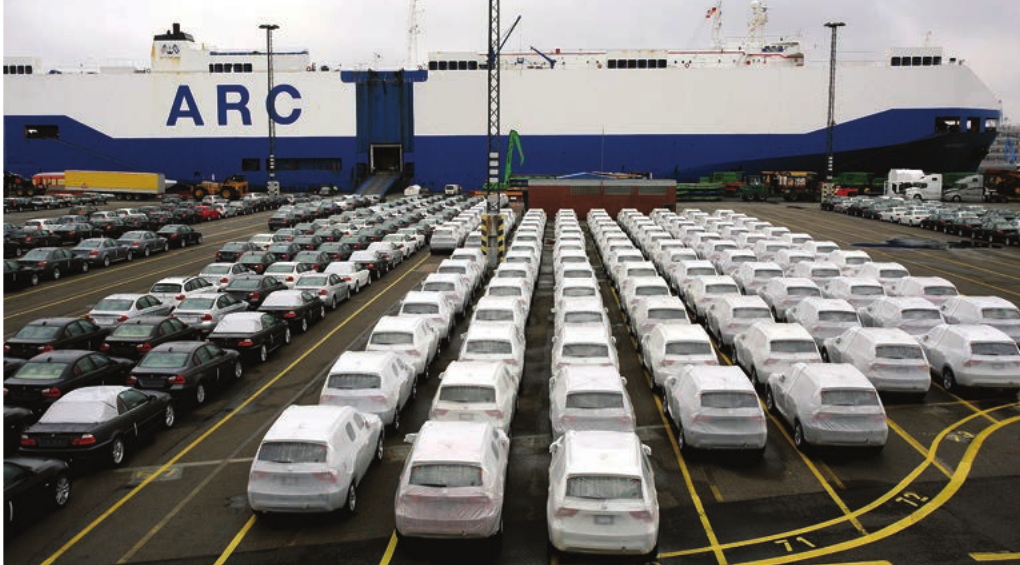
- Rising imports of consumer goods, particularly cars and other manufactured items
- A shift in the UK's economic structure away from manufacturing and towards service industries
By 2016, the goods trade deficit had grown to approximately 7% of GDP (around $140 billion). In 2020, UK goods exports totalled $308.9 billion while imports reached $438.3 billion, resulting in a deficit of $129.4 billion for that year alone.
Trade in services
In contrast to goods, the UK has maintained a consistent surplus in services trade since 1966. The 2019 figures (pre-pandemic) showed surpluses across most service categories:
- Financial services generated a surplus of $45.9 billion
- Other business services contributed $43.7 billion
- Insurance and pension services added $16.3 billion
Travel was the main deficit item, as UK residents' spending abroad exceeded what overseas tourists spent in the UK. The services surplus helps partially offset the large deficit in goods trade. In 2020, trade in services produced a surplus of $141.1 billion.
Primary income (investment income)
Primary income represents earnings from overseas investments. When UK residents own foreign assets (such as shares in overseas companies or property abroad), any profits, dividends, or rental income they receive counts as a credit on the current account. Conversely, income earned by foreign investors from their UK-based assets represents a debit.
The largest component is typically income from direct investment - for example, when UK companies own overseas subsidiaries. Portfolio investment (income from shares and bonds) and earnings from other financial investments also contribute to this category.
Important
When foreign companies acquire UK businesses, future profits from those operations will flow abroad, creating a debit on the current account. This has important long-term implications for the UK's international income flows.
Example
Worked Example: Impact of Foreign Acquisition
When Anheuser-Busch acquired SABMiller (a company headquartered in the UK) in 2016:
Step 1: The initial acquisition generated a credit on the financial account as money flowed into the UK to purchase the company.
Step 2: However, subsequent profits from SABMiller's UK operations now flow out of the UK to the new owners, representing a debit on the current account.
This illustrates how financial account surpluses can have ongoing implications for primary income flows.
Data shows that primary income has recorded deficits in most years since 2006, indicating that overseas residents are earning more from their UK investments than UK residents earn from their foreign holdings.
Secondary income (current transfers)
Secondary income encompasses various types of transfers between countries, including:
- Taxes paid by non-resident workers to the UK government, and benefits they receive
- International aid payments made by the UK government
- Social contributions paid to the EU (before Brexit)
- Private remittances sent by workers to family members abroad
- Bilateral and multilateral aid flows
These transfers represent money moving between countries without a corresponding exchange of goods, services, or assets.
Understanding the overall balance
Important
The Fundamental Principle: Overall Balance Must Equal Zero
A crucial principle of the balance of payments is that the overall balance must always equal zero. This occurs because of the fundamental accounting identity: we must ultimately pay for everything we consume, and we receive payment for everything we sell. The accounts use double-entry bookkeeping principles, ensuring that every transaction generates both a debit and a credit entry somewhere in the system.
However, because data collection can never be perfectly accurate, the accounts include a category called "net errors and omissions". This balancing item ensures that when all components are summed, the total equals zero despite inevitable measurement inaccuracies and misreported transactions.
While the overall balance must equal zero, individual components can show significant imbalances. The key insight is that a deficit in one account must be matched by a surplus elsewhere. For the UK, this has typically meant that current account deficits are balanced by financial account surpluses.
| Component | 2020 Value (£ million) |
|---|---|
| Trade in goods | -133,530 |
| Trade in services | +141,087 |
| Primary income (investment income) | -47,390 |
| Secondary income (including transfers) | -27,677 |
| Current balance | -67,510 |
| Capital account | -3,016 |
| Financial account | +83,747 |
| Net errors and omissions | -13,221 |
| Overall balance of payments | 0 |
This table illustrates how the 2020 current account deficit of £67.5 billion was balanced by the financial account surplus of £83.7 billion, with small contributions from the capital account and the errors and omissions category.
The balance of payments and exchange rates
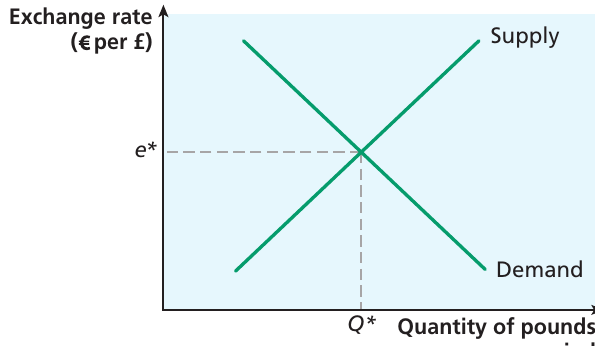
The balance of payments has important connections to exchange rate determination. International transactions create demand for and supply of different currencies, which influences their relative values.
Consider the foreign exchange market for pounds sterling. When overseas residents want to purchase UK goods, services, or assets, they need to obtain pounds, creating demand for the currency. This demand comes from sources such as:
- Eurozone businesses buying UK products
- Foreign tourists visiting Britain
- Overseas investors purchasing UK financial assets
Conversely, the supply of pounds arises when UK residents need foreign currency to:
- Purchase imported goods from abroad
- Travel overseas
- Invest in foreign assets
The interaction of these forces determines the exchange rate - the price of one currency in terms of another.
Note
The balance of payments accounts track these international transactions, which directly influence currency flows. For example, if the UK runs a persistent current account deficit, this means British residents are buying more goods and services from abroad than they are selling. This creates net demand for foreign currency (and net supply of pounds), which would tend to put downward pressure on the pound's value, all else being equal.
However, the relationship is more complex because the financial account can offset this pressure. If the UK attracts substantial foreign investment (creating a financial account surplus), this generates demand for pounds that can counterbalance the current account deficit. In recent decades, high UK interest rates relative to other countries have sometimes attracted what economists call "hot money" - short-term financial flows seeking the best returns. While this can maintain the exchange rate, it involves selling UK assets to foreign investors, which may have long-term economic implications.
Significance and concerns
The persistent current account deficit in the UK has generated debate among policymakers and economists. While the overall balance of payments must always equal zero, the way this balance is achieved matters for the economy's long-term prospects.
Why deficits occur: One country's deficit necessarily means another country is running a surplus. In principle, if data were perfectly accurate and all countries were included, the sum of all trade balances worldwide should equal zero. The UK's position reflects both domestic economic conditions and developments in its trading partners' economies. Demand for UK exports depends partly on economic growth rates in other countries.
Potential concerns about persistent deficits:
- They may indicate competitiveness problems in UK industries
- Financing deficits through asset sales means foreign investors accumulate UK assets
- Future income flows from these assets will leave the country
- Over-reliance on financial account surpluses may not be sustainable long-term
- Large deficit countries may be vulnerable to sudden shifts in investor confidence
Potential benefits of deficits:
- They allow higher consumption than would otherwise be possible
- Foreign investment through the financial account can support economic growth
- Deficits may reflect strong domestic demand and economic growth
- Countries can run persistent deficits if they remain attractive to foreign investors
Note
Exam tip: When discussing balance of payments issues, always consider both components - a current account deficit must be matched by a capital and/or financial account surplus. Focus on whether the current position is sustainable and what factors might cause it to change.
Summary
Key Points to Remember:
-
The balance of payments records all economic transactions between UK residents and the rest of the world, including trade in goods and services, income flows, and asset purchases.
-
The balance of payments has three main components: the current account (goods, services, income, and transfers), the capital account (transactions in fixed assets), and the financial account (transactions in financial assets).
-
Credit items represent money flowing into the country, while debit items represent money flowing out. The overall balance of payments must always equal zero due to double-entry accounting principles.
-
The UK has experienced persistent current account deficits since the 1970s, which have been balanced by surpluses on the financial account as foreign investors purchase UK assets.
-
Balance of payments transactions influence the exchange rate through their effect on the supply of and demand for currency in foreign exchange markets.
-
A deficit in one account must be matched by a surplus elsewhere - understanding this relationship is crucial for analysing a country's economic position.