National Income and Macroeconomic Equilibrium (Edexcel A-Level Economics A): Revision Notes
📚Revision Notes
National Income and Macroeconomic Equilibrium
Introduction
Understanding how an economy functions requires examining the relationships between income, expenditure and output. This note explores these connections through the circular flow model and examines how economies reach equilibrium through the interaction of aggregate demand and aggregate supply. We'll also investigate the multiplier effect, which explains how changes in spending can have magnified impacts on national income.
The circular flow of income, expenditure and output
The circular flow model provides a simplified framework for understanding how an economy operates. It illustrates the connections between different sectors and how resources, goods, services and money move through the economic system.
The basic circular flow model
In its simplest form, the circular flow model considers just two economic agents: households and firms. This simplified version assumes there is no government sector and no international trade.
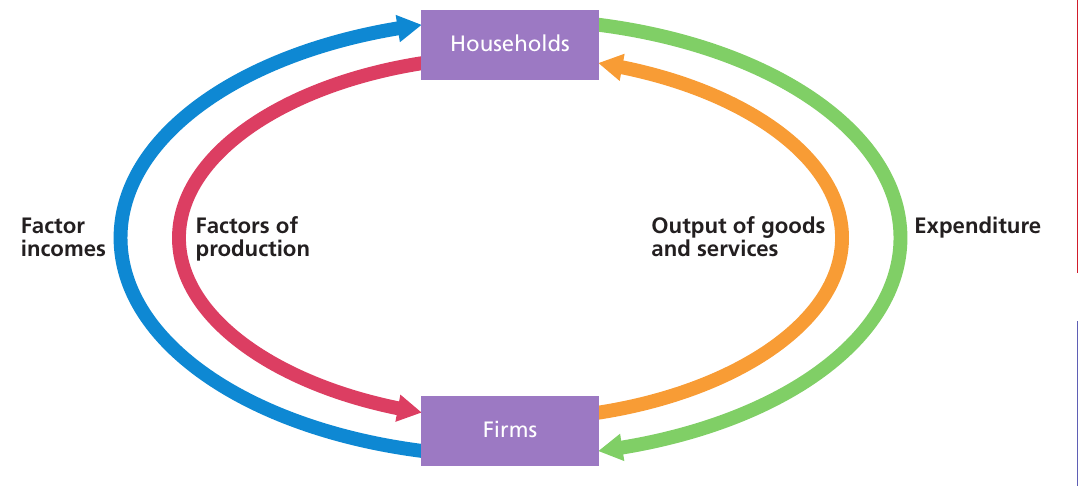
The model shows four key flows between households and firms:
- Factors of production flow from households to firms (labour, capital, land, enterprise)
- Factor incomes flow from firms to households (wages, interest, rent, profit) in return for these productive resources
- Goods and services flow from firms to households as output
- Expenditure flows from households to firms as consumers purchase goods and services
This creates a continuous loop where households supply productive resources to firms, receive income in return, then spend that income on the output produced by firms.
Note
The circular flow represents a closed system where what flows out of one sector must flow into another. This fundamental principle underlies why income, expenditure, and output are three ways of measuring the same economic activity.
The three measures of economic activity
Because the circular flow represents a closed system, the flows must balance. This means economic activity can be measured in three equivalent ways:
- Income method - measuring the total incomes paid out by firms to households (wages, salaries, interest, rent, profits)
- Expenditure method - measuring the total spending on goods and services in the economy
- Output method - measuring the total value of goods and services produced
Important
In principle, these three approaches should give identical results because what is produced must equal what is spent, which must equal the income generated. However, in practice, measurement difficulties mean the Office for National Statistics (ONS) calculates GDP as an average of all three methods.
What each measure tells us
Each measurement approach reveals different information about the economy's structure:
The expenditure-side estimate shows how society's resources are being allocated. It reveals what proportion is devoted to consumption, investment, government spending, and net trade (exports minus imports).
The income-side estimate provides insight into the distribution of income between different factors of production. It shows the balance between:
- Labour income (wages and salaries)
- Capital income (interest)
- Land income (rents)
- Enterprise income (normal profit)
The output-side estimate focuses on the economic structure, showing the balance between:
- Primary production (agriculture, mining)
- Secondary activity (manufacturing)
- Tertiary activity (services)
Note
In the UK, service activity has grown significantly in recent years, with financial services becoming a particularly important component of the country's comparative advantage. This structural shift reflects how developed economies increasingly rely on knowledge-based and service-oriented activities.
Injections and withdrawals
The simple circular flow model has limited applicability to real-world economies because it represents a closed system. In reality, money both enters and exits the circular flow through various channels.
Understanding injections and withdrawals
Withdrawals (also called leakages) represent money flowing out of the circular flow. Injections represent money flowing into the system. These arise from three sources each:
Withdrawals consist of:
- Savings (S) - household income not spent on consumer goods
- Taxation (T) - money collected by government from households and firms
- Imports (M) - spending on goods and services from abroad
Injections consist of:
- Investment (I) - spending by firms on capital goods and productive capacity
- Government spending (G) - expenditure on public goods and services
- Exports (X) - foreign spending on domestically produced goods and services
The expanded circular flow
When we incorporate injections and withdrawals, the circular flow becomes more realistic. Total expenditure now includes not just household consumption, but also investment by firms (I), government expenditure (G), and export revenues (X).
Note
The importance of investment deserves particular emphasis. When firms purchase machinery, buildings and other productive resources, they increase the economy's productive capacity. This enables economic growth over the long run. Changes in the balance between investment and consumption therefore affect the economy's growth trajectory.
The multiplier effect
An important consequence of the circular flow is that increases in spending can trigger rounds of further expenditure. For example, when firms increase investment spending, they hire additional workers to expand production. These workers then spend their wages on consumer goods, generating income for shopkeepers and other businesses. This creates a second round of expenditure, leading to what economists call the multiplier effect.

The multiplier explains why government spending on infrastructure projects, such as road construction, can have impacts on the economy exceeding the initial expenditure.
Income and wealth
Students often confuse income and wealth, but these represent fundamentally different economic concepts.
Important
Income is a flow concept - it measures the amount earned during a specific time period. Your monthly salary or weekly wages are examples of income flows.
Wealth is a stock concept - it represents the accumulated value of assets built up from past income. Property ownership, share holdings, and pension funds are examples of wealth.
Distribution of income and wealth
In the UK, wealth is distributed much less evenly than income. The wealthiest 10% of households hold approximately 43% of total wealth, while the least wealthy half of households hold just 9%. In contrast, the top 10% by income receive 27% of disposable income.
Wealth is strongly influenced by:
- Changes in house prices
- The value of pension funds
- Inheritance patterns

The link between wealth and income
Although wealth and income differ, they are interconnected. Inequality in wealth can generate inequality in income because wealth creates income flows. Property ownership generates rental income, while share ownership produces dividend income. These income streams flow back into household budgets, potentially widening income inequality.
Note
Recent decades have seen significant changes in asset ownership patterns in the UK. Rising home ownership rates and increasing house prices have been major sources of growing inequality, particularly affecting those who continue to rent their homes.
Macroeconomic equilibrium
The circular flow model demonstrates that total expenditure, income and output should be equal when measured accurately. However, this doesn't mean the economy is always in equilibrium in the sense that all economic agents are satisfied with the outcome.
What is macroeconomic equilibrium?
Macroeconomic equilibrium occurs when planned expenditure equals planned output. This differs from the accounting identity that actual expenditure always equals actual output. The distinction matters because unplanned changes in inventories (stock levels) bridge the gap between planned and actual figures.
Important
When firms produce more output than subsequently gets purchased, their inventory holdings increase. While after-the-event expenditure equals output (because inventory changes count as investment), this reflects disequilibrium - firms didn't plan to build up these stocks.
Short-run equilibrium using AD/AS analysis
To properly analyse macroeconomic equilibrium, we need to bring together aggregate demand and aggregate supply. The equilibrium position is found where these curves intersect, determining both the economy's real output level and overall price level.
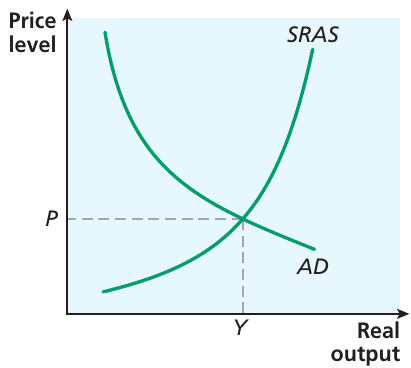
In this diagram:
- The vertical axis shows the price level
- The horizontal axis shows real output
- The SRAS (short-run aggregate supply) curve slopes upward
- The AD (aggregate demand) curve slopes downward
- Equilibrium occurs at price level P and output level Y
This represents an equilibrium because, at this price level, aggregate supply matches aggregate demand. Firms have no reason to change their behaviour in the next period, and households will continue their current spending patterns.
Changes in aggregate demand
When market conditions change, the equilibrium position shifts. Consider what happens if government expenditure increases, shifting the aggregate demand curve rightward.
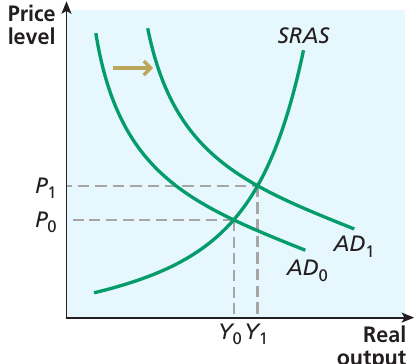
The economy moves from its initial equilibrium (with aggregate demand at AD₀) to a new equilibrium position (with aggregate demand at AD₁). This results in:
- Higher equilibrium output (Y₁ instead of Y₀)
- A higher price level (P₁ instead of P₀)
Sustainability of the new equilibrium
An important question concerns whether this new equilibrium can be sustained. Suppose the original output level Y₀ represented full employment. In the short run, firms can increase output by raising prices and employing more workers. However, they may eventually face capacity constraints - perhaps needing to pay workers overtime or hire additional office space.
Note
If suppliers also raise their prices, firms' costs increase. They realise their costs are rising faster than they'd expected and become less willing to supply the same output at any given price. The short-run aggregate supply curve shifts back leftward. The higher output level Y₁ proves unsustainable, and real output falls back. This illustrates why short-run equilibrium analysis has limitations.
The effect of a supply shock
The AD/AS model can also analyse external shocks affecting aggregate supply. For example, consider what happens when oil prices rise sharply due to supply disruptions. This increases firms' costs and reduces aggregate supply.
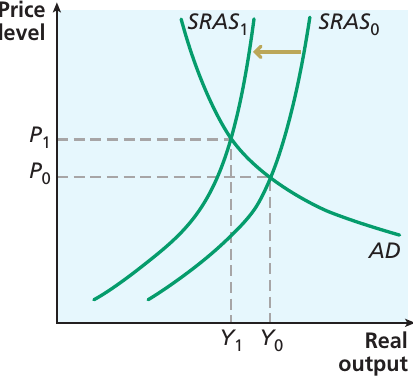
The economy begins in equilibrium with output at Y₀ and price level at P₀. The oil price increase causes the aggregate supply curve to shift from SRAS₀ to SRAS₁. After the economy adjusts to its new equilibrium:
- Real output has fallen to Y₁
- The price level has increased to P₁
Important
This combination of falling output and rising prices is sometimes called stagflation - a particularly challenging situation for policymakers because the economy experiences both recession and inflation simultaneously.
Long-run equilibrium
Long-run equilibrium is analysed using the long-run aggregate supply (LRAS) curve alongside aggregate demand.
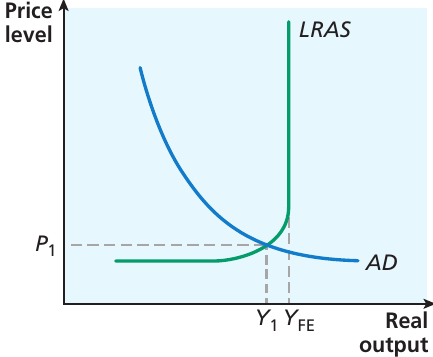
The LRAS curve shows the relationship between aggregate supply and price level in the long run. In the classical/monetarist view, the LRAS is vertical at the full employment level of output (Y_FE). This reflects the view that, in the long run, the economy naturally gravitates toward full employment regardless of the price level.
Equilibrium occurs where AD intersects LRAS. The figure shows equilibrium at:
- Price level P₁
- Full employment output Y_FE
Can equilibrium occur below full employment?
Keynesians would argue that macroeconomic equilibrium can occur at output levels below full employment. Figure 13.7 (shown in the source material) presents this view using a Keynesian LRAS curve that has both a horizontal section (at low output levels) and a vertical section (at full employment).
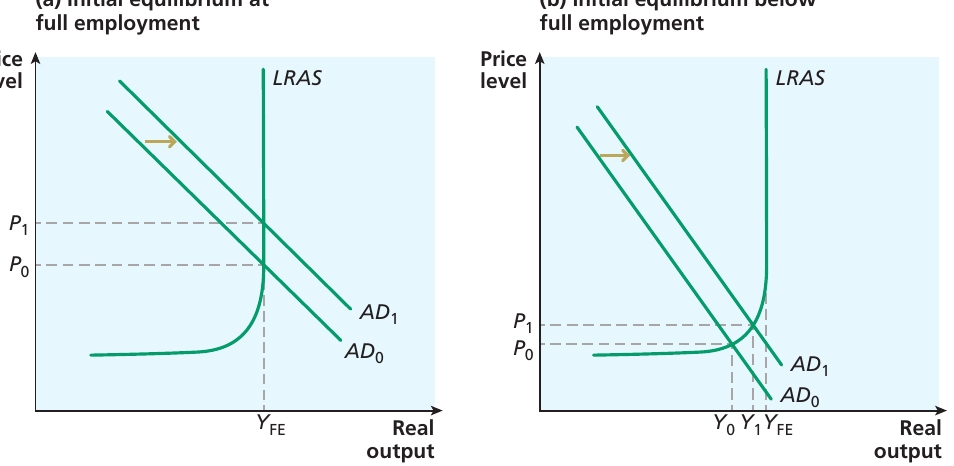
These diagrams compare two scenarios:
Panel (a): Initial equilibrium at full employment
When the economy starts at full employment (Y_FE) and aggregate demand increases (from AD₀ to AD₁), the only effect is a rise in the price level (from P₀ to P₁). Real output remains at Y_FE because the economy cannot sustainably produce beyond full employment capacity.
Panel (b): Initial equilibrium below full employment
When the economy starts below full employment, an increase in aggregate demand (from AD₀ to AD₁) has different effects. Both price level and real output increase. The economy moves closer to full employment, rising from Y₀ toward Y_FE, but may not reach it fully.
Important
The key insight from the Keynesian perspective is that the impact of changes in aggregate demand depends on the economy's starting position. Near full employment, demand increases primarily cause inflation. With significant spare capacity, demand increases can boost real output with only modest price increases.
The multiplier
John Maynard Keynes identified that certain types of spending can have multiplied effects on equilibrium output through successive rounds of expenditure.
How the multiplier works
Suppose the government increases its expenditure by $1 billion, perhaps through a road-building programme. This initial spending generates income for construction workers and contractors. These workers then spend a portion of their additional income on consumer goods, creating income for shopkeepers and café owners. They, in turn, spend part of their additional income, generating a third round of spending.
This process continues through multiple rounds, with each round of spending generating the next. The total increase in equilibrium output can therefore exceed the original $1 billion increase in government spending. This is the multiplier effect.
The multiplier is defined as the ratio of the change in equilibrium real income to the autonomous change that brought it about. Mathematically:
Withdrawals and the multiplier
The size of the multiplier depends critically on withdrawals from the circular flow. These withdrawals determine how much of each round of additional income gets spent in the next round versus leaking out of the system.
Three types of withdrawal affect the multiplier:
Marginal propensity to save (mps) - the proportion of additional income that households save rather than spend.
Marginal propensity to import (mpm) - the proportion of additional income spent on imported goods and services. This spending benefits foreign producers rather than domestic firms, so it leaks from the UK circular flow.
Marginal propensity to tax (mpt) - the proportion of additional income collected by government as taxation.
Together, these determine the marginal propensity to withdraw (mpw):
The marginal propensity to consume (mpc) represents the proportion of additional income spent on domestic goods and services:
Calculating the multiplier
The multiplier formula is:
The formula varies depending on which sectors we include in our model:
| Economic model | Multiplier formula |
|---|---|
| Closed economy with no government sector | |
| Open economy with no government sector | |
| Closed economy with government sector | |
| Open economy with government sector |
Example
Worked Example: Calculating the Multiplier
Suppose:
- Marginal propensity to save = 0.25
- Marginal propensity to import = 0.10
- Marginal propensity to tax = 0.15
Step 1: Calculate the marginal propensity to withdraw
Step 2: Apply the multiplier formula
Conclusion: This means a $100 million injection into the circular flow would increase equilibrium output by $200 million ($100 million × 2).
The multiplier and aggregate demand
The existence of the multiplier has important implications for the aggregate demand curve. When autonomous expenditure increases (such as government spending or investment by firms), the initial rightward shift of the AD curve is augmented by further shifts as successive rounds of additional expenditure work through the system.
This suggests that government spending could be a powerful tool for managing aggregate demand. However, several considerations limit this power:
1. Position relative to full employment - The closer the economy operates to full employment, the smaller the elasticity of supply. Increases in aggregate demand near full employment have larger effects on the price level and smaller effects on real output. The multiplier simply means greater upward pressure on the equilibrium price level.
2. Domestic supply flexibility - If domestic supply is inflexible and cannot meet increased demand, more of the increased income spills over into purchasing imports. This dilutes the multiplier effect.
3. Time lags - The successive rounds of spending take time to work through the economy. The full multiplier effect may not materialize for many months.
Note
The multiplier concept applies to all forms of autonomous spending that inject money into the circular flow:
- Government expenditure
- Investment spending by firms
- Export demand from overseas
Each pound of autonomous spending generates multiple pounds of total economic activity through the multiplier mechanism, provided the economy has spare capacity to respond.
Summary
Key Points to Remember:
-
The circular flow model illustrates the connections between income, expenditure and output, showing how these three measures of economic activity are fundamentally linked through the interactions between households, firms, government and the foreign sector.
-
Injections (investment, government spending, exports) add spending power to the economy, while withdrawals (savings, taxation, imports) remove it. When injections exceed withdrawals, the economy tends to grow; when withdrawals exceed injections, it tends to contract.
-
Income and wealth are different concepts. Income is a flow measuring earnings over time, while wealth is a stock representing accumulated assets. Inequality in wealth can generate inequality in income.
-
Macroeconomic equilibrium occurs at the intersection of aggregate demand and aggregate supply curves, determining both the price level and real output. Short-run equilibrium (AD/SRAS) may differ from long-run equilibrium (AD/LRAS).
-
The multiplier effect means that autonomous increases in spending can have magnified impacts on equilibrium national income. The size of the multiplier depends on the marginal propensity to withdraw - the larger the withdrawals, the smaller the multiplier.