Modelling with Exponentials & Logarithms (Edexcel A-Level Mathematics): Revision Notes
📚Revision Notes
6.3.3 Using Log Graphs in Modelling
Logarithmic and Exponential Graphs
Important Graph Shapes to Learn:
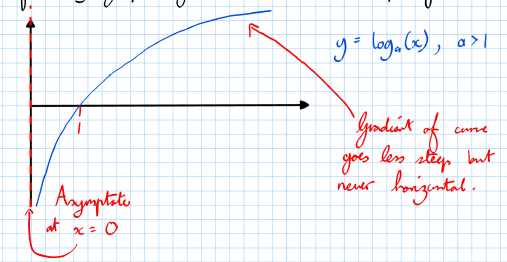
- Logarithmic Graph: , where
- The curve starts steep and becomes less steep as increases, but it never becomes horizontal.
- Asymptote at .
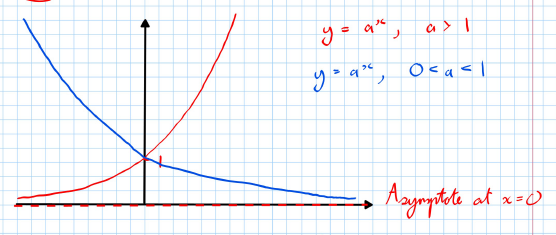
- Exponential Graphs:
- The curve rises or falls exponentially depending on the value of .
- Asymptote at .
Note
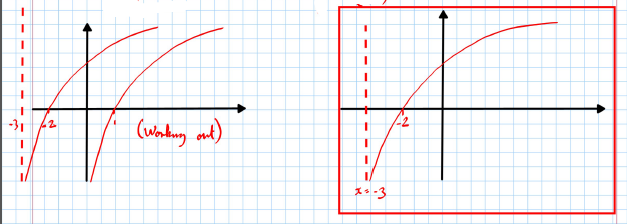
Example: Sketching the graph of
- Start by recognizing the base graph: .
- To sketch , perform a translation of on the base graph. The graph will shift 3 units to the left, moving the asymptote to .
Note
Example: Sketch the graph of
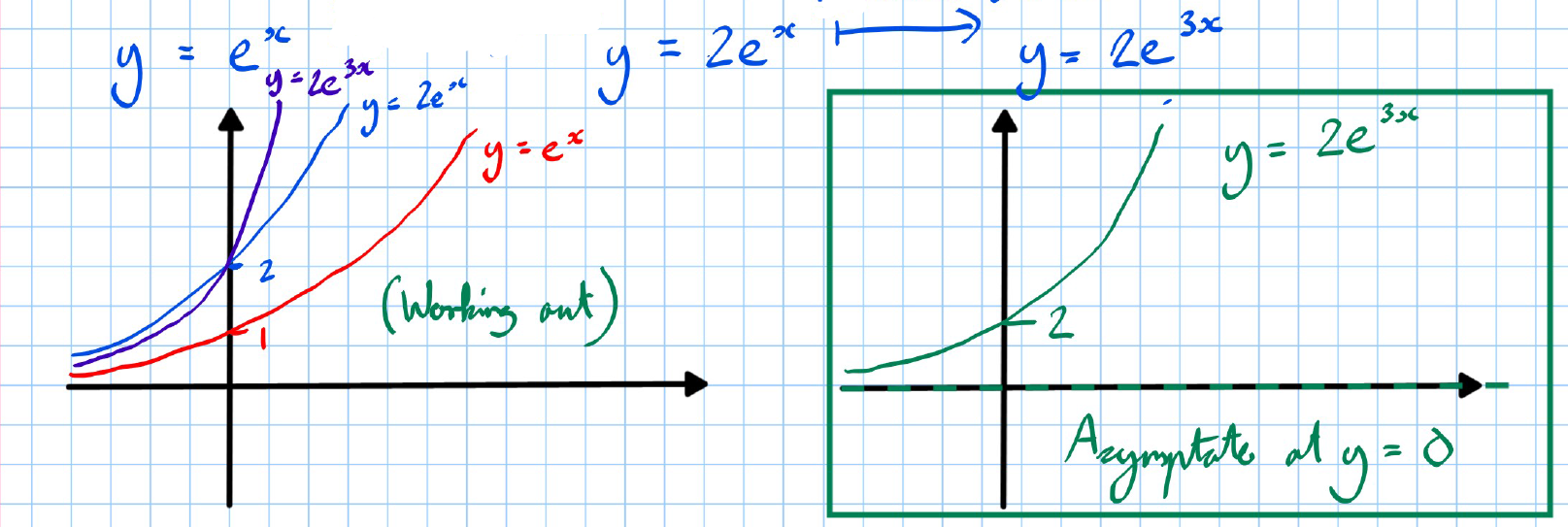
- Always a good idea to have a "start graph" then apply transformations to it.
- Start with the graph of (in red).
- Apply the following transformations:
- Stretch by scale factor 2, parallel to the -axis: This gives us the graph of (in blue).
- Stretch by scale factor parallel to the -axis: This gives us the graph of (in green).
- The final graph is (shown in green on the right-hand side).
- Key feature: The asymptote of the graph is at .
Note
Q3. (OCR 4722, Jun 2008, Q8)
(i) Sketch the curve , stating the coordinates of any intersections with the axes.
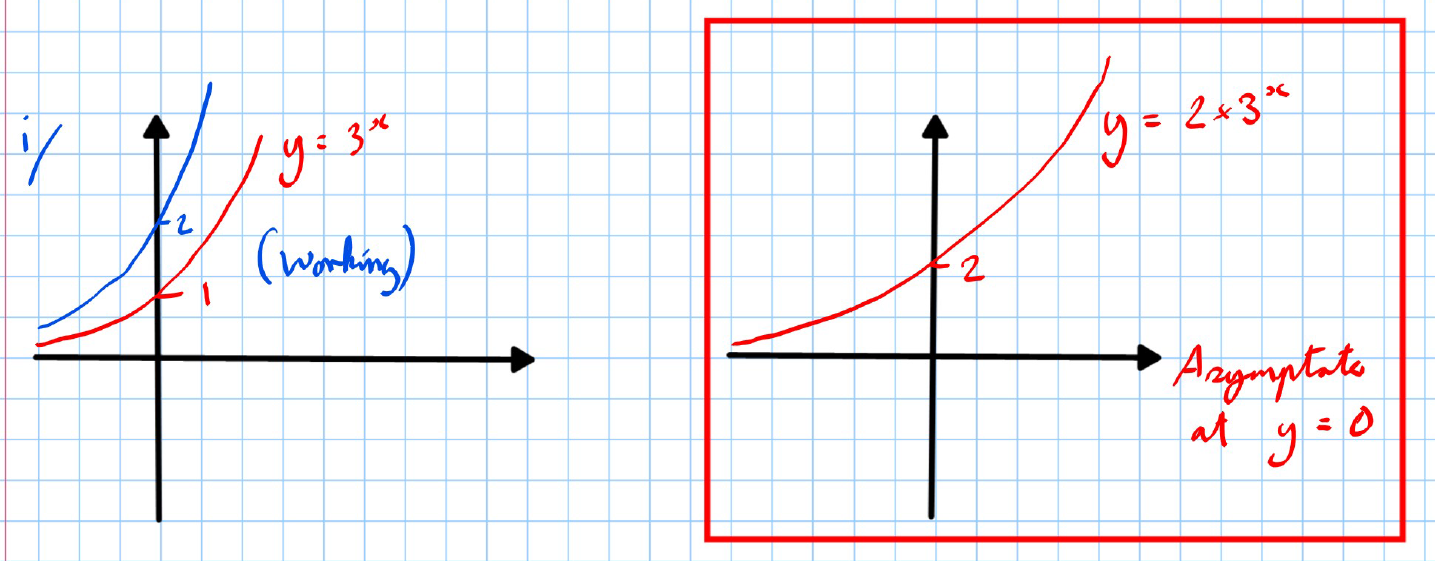
Sketch:
- The curve intersects the -axis at .
- There is no intersection with the -axis as the curve approaches zero asymptotically but never actually touches the -axis. (ii) The curve intersects the curve at the point . Show that the -coordinate of may be written as:
Solution:
Given:
Set the two equations equal to find the intersection point:
Take the logarithm of both sides (base 2):
Apply the logarithm rules:
Simplify using the power rule:
Rearrange to solve for :
Thus,
This is the required -coordinate of the intersection point .