Area Under a Curve (Edexcel A-Level Mathematics): Revision Notes
📚Revision Notes
8.1.4 Area Under a Curve
The area under a curve is a fundamental concept in calculus, often used to calculate the total accumulation of a quantity, such as distance travelled over time or the total revenue generated by sales over a period. The area under the curve from to can be found using definite integration.
1. Understanding the Area Under a Curve:
Note
The area under a curve between and is represented by the definite integral:
This integral computes the net area between the curve and the -axis over the interval .
2. Significance of the Area Under a Curve:
- Positive Area: If for all in , the integral gives the total area under the curve above the -axis.
- Negative Area: If for all in , the integral gives the negative of the area above the -axis but below the curve.
- Net Area: If changes sign (i.e., the curve crosses the -axis), the integral computes the net area, which is the positive area minus the negative area.
3. Steps to Calculate the Area Under a Curve:
Note
- Set Up the Integral: Identify the function and the interval over which you want to calculate the area.
- Integrate: Find the antiderivative of .
- Evaluate the Definite Integral: Use the Fundamental Theorem of Calculus to evaluate the integral:
4. Examples of Calculating Area Under a Curve:
Note
Example 1: Area Under from to
- Step 1: Set up the integral:
- Step 2: Find the antiderivative:
So,
- Step 3: Evaluate the integral from to :
Note
Example 2: Area Under
- Step 1: Set up the integral:
- Step 2: Find the antiderivative:
So,
- Step 3: Evaluate the integral from to
5. Special Cases:
Note
- Area Between the Curve and the x-Axis: If the curve lies below the x-axis (i.e., over the interval), the definite integral gives a negative value. To find the actual area, take the absolute value of the integral:
Note
- Area Between Two Curves: To find the area between two curves and over [a, b], where for all in , subtract the integral of the lower curve from the integral of the upper curve:
Note
Example: Area Between and from to
- Step 1: Set up the integral:
- Step 2: Integrate:
- Step 3: Evaluate from to :
Summary:
Note
- The area under a curve between two points is found using definite integration.
- The area represents the accumulated quantity, such as distance, revenue, or probability, depending on the context.
- The definite integral gives the net area between the curve and the -axis from to .
- Special cases like the area between curves or regions below the x-axis are handled by modifying the basic integration process.
Area Between a Curve and the x-Axis
Definite integration can be used to find the area between a curve and the -axis.
Note
Example: Find the area of the shaded region in the following diagram.
-
-
-
Area is
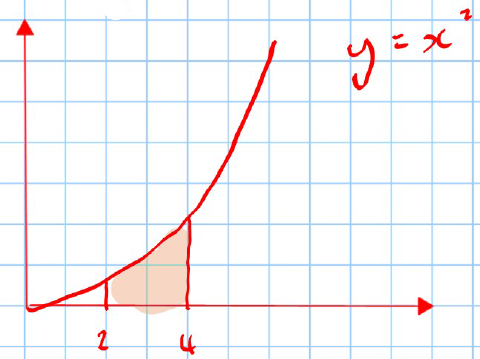
However, such integrals will not always give the area between a curve and the -axis.
Note
Example:
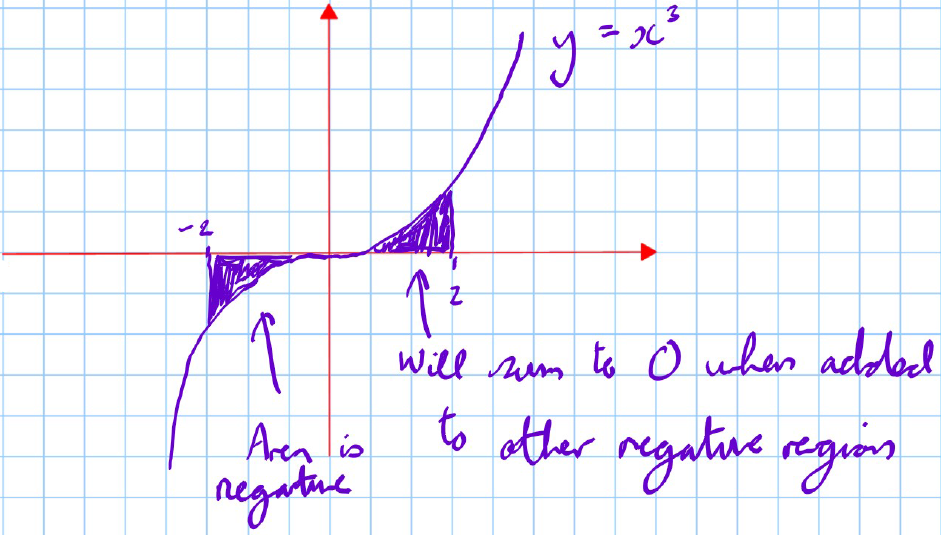
If we want to know the area and we know part of the curve lies under the -axis, we should integrate this separately from any positive areas.
Thus,
is the modulus/magnitude/length of a quantity (i.e., distance from ).
Note
Examples: 4. 5.