Geometric Sequences & Series (Edexcel A-Level Mathematics): Revision Notes
📚Revision Notes
4.4.2 Geometric Series
Infinite Geometric Series
So far we have only dealt with the sum of a finite number of terms of a geometric sequence. If certain conditions are fulfilled, then it is possible to sum an infinite number of terms of a geometric sequence.
Note
e.g. Consider the sequence If we try to sum an infinite number of terms, the following happens:
The more terms we add, the bigger the sum gets without any upper bound.
As the no. of terms increases, the sum of these terms approaches .
In such circumstances, we say the series diverges.
e.g. Consider the series
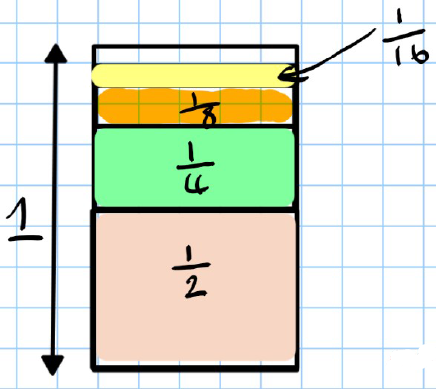
Consider filling a glass of capacity with the quantities in the above series. We see that the glass will get closer and closer to being full but never quite get there.
i.e.,
As the no. of terms gets bigger, the sum of these terms approaches .
In such circumstances, the series is said to converge.
Sum to Infinity
Note
exists for a converging geometric sequence. The sequence doesn't necessarily converge to as the above example showed, but could converge to any .
Conditions for convergence (This is a formula)
Note
Proof: For a geometric sequence,
If ,
e.g. Find the sum of
The sequence converges since
In a geometric progression, the sum to infinity is four times the first term.
(i) Show that the common ratio is .
(ii) Given that the third term is , find the first term.
(iii) Find the sum of the first twenty terms.