Trigonometric Equations (Edexcel A-Level Mathematics): Revision Notes
📚Revision Notes
5.3.4 Strategy for Trigonometric Equations
Solving trigonometric equations can be challenging, but with a systematic approach, you can tackle them efficiently. Here's a general strategy to help you solve a wide range of trigonometric equations:
1. Understand the Equation
- Identify which trigonometric function(s) are involved (e.g., ).
- Determine whether the equation is linear (e.g.,), quadratic (e.g., ), or involves multiple trigonometric functions.
2. Simplify the Equation
- Isolate the trigonometric function: Get the trigonometric function (e.g.,) by itself on one side of the equation.
- Factor or Simplify: If the equation is quadratic or more complex, try factoring, expanding, or simplifying using trigonometric identities.
- Substitution: If multiple trigonometric functions are involved (e.g., ), consider substituting using identities to reduce the equation to one trigonometric function.
3. Use Trigonometric Identities
- Apply identities such as the Pythagorean identities, double-angle identities, sum-to-product identities, or half-angle identities to simplify the equation.
- Common identities include:
4. Solve the Simplified Equation
- Linear Equations:
- Solve for the angle by taking the inverse trigonometric function (e.g.,).
- Consider all solutions within the given interval by accounting for the periodic nature of the trigonometric functions.
- Quadratic Equations:
- Factor if possible, or use the quadratic formula:
- Back-substitute to solve for the angle.
- Check for extraneous solutions, especially if you square both sides of the equation.
5. Consider the General Solution
- Trigonometric functions are periodic, meaning they repeat their values at regular intervals.
- For
- n) where n is any integer.
- Include both primary solutions
- For
6. List All Solutions in the Given Interval
- Ensure that all solutions are within the specified interval, typically or radians.
- Adjust the general solution accordingly to fit within this range.
7. Verify Solutions
- Substitute each solution back into the original equation to ensure it satisfies the equation.
- Discard any extraneous solutions that might have arisen from squaring both sides or other manipulations.
Note
Example Strategy Application:
Problem: Solve
- Identify: This is a quadratic trigonometric equation in
- Substitute: Let u =, so the equation becomes
- Factor: Factor the quadratic: So, u =
- Back-substitute: Replace with
- Solve:
- For
- For
- List All Solutions: The solutions in the interval are:
- Verify: Substitute these angles back into the original equation to ensure they are correct.
Summary:
- Simplify the trigonometric equation using identities or substitution.
- Solve the resulting equation for the variable.
- Consider the periodic nature of trigonometric functions to find all solutions within the given interval.
- Verify the solutions to ensure correctness.
Solving Trig Equations Involving Compound Angles
By "compound angle," we mean "an angle more complicated than just "
Note
- Example: Solve .
- Notice we are solving for , but the angle is within the function.
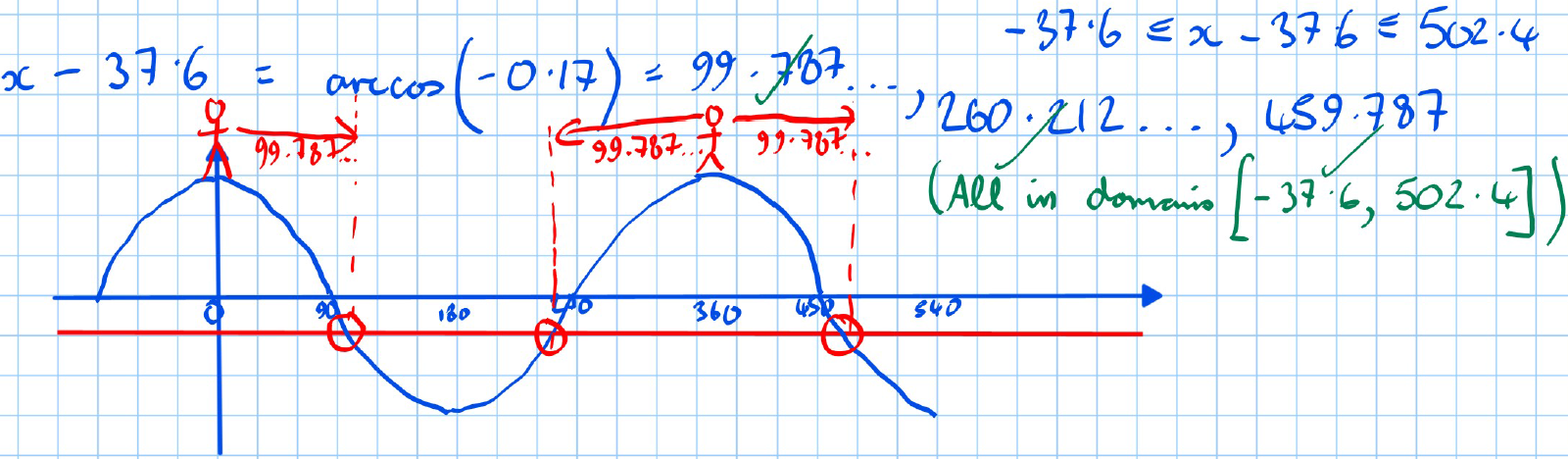
- Modify the domain to find limits for the compound angle in the bracket.
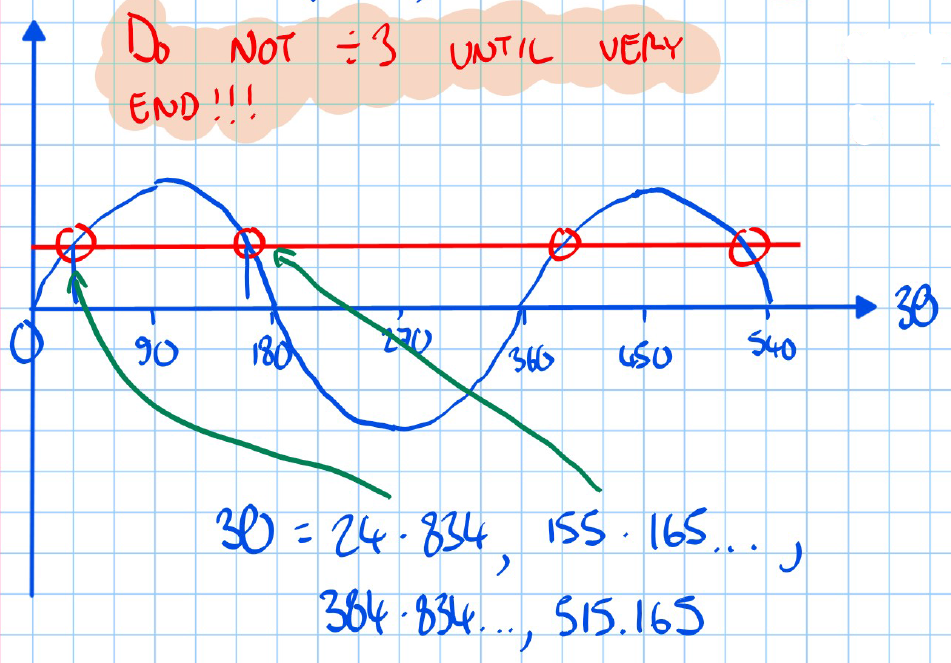
- Find all solutions for our compound angle (in this case, it's )
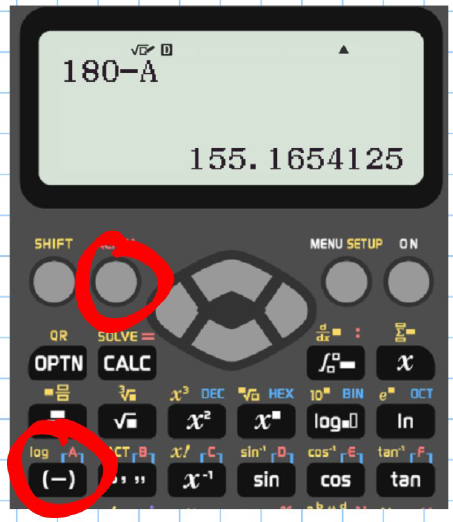
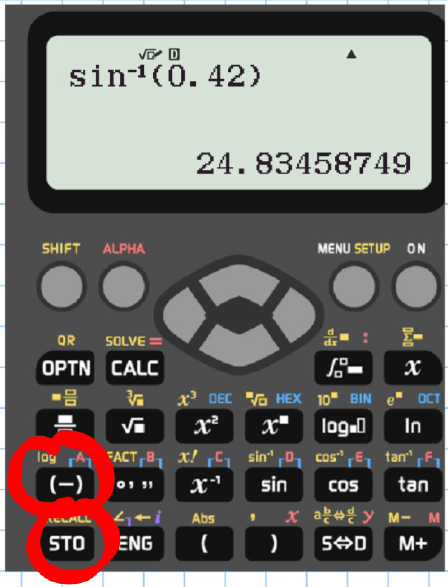
- Calculator Steps:
- Press [ ] then the letters to recall this number.
- Store long numbers by pressing then a letter with a red letter.
- Solutions:
- Find for each intermediate solution (in this case, divide all by ):
Note
Example: Solve .