Inverse trigonometric functions are the inverse operations of the basic trigonometric functions (sine, cosine, tangent, etc.). They are used to find the angle that corresponds to a given trigonometric value. These functions are important in many areas of mathematics, including calculus, geometry, and solving trigonometric equations.
1.Definitions of Inverse Trigonometric Functions:
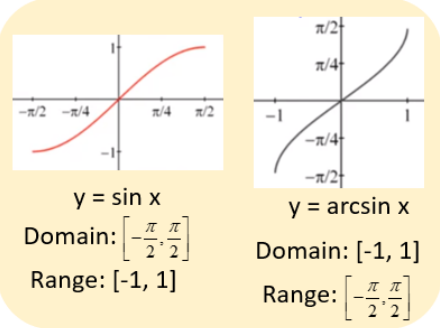
Inverse Sinesin−1xor(arcsinx):
sin−1x=θif and only ifsinθ=x
The inverse sine function returns the angle whose sine is x.
Domain: −1≤x≤1
Range: −2π≤θ≤2π (or −90∘≤θ≤90∘)
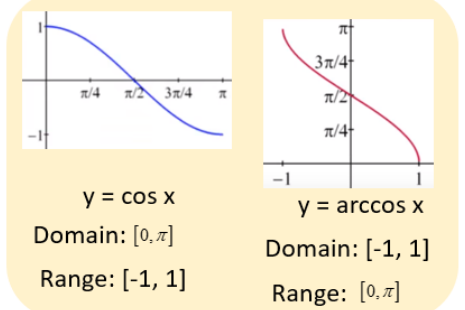
Inverse Cosine (cos−1xor(arccosx):
cos−1x=θif and only ifcosθ=x
The inverse cosine function returns the angle whose cosine is x.
Domain: −1≤x≤1
Range: 0≤θ≤π (or 0∘≤θ≤180∘)
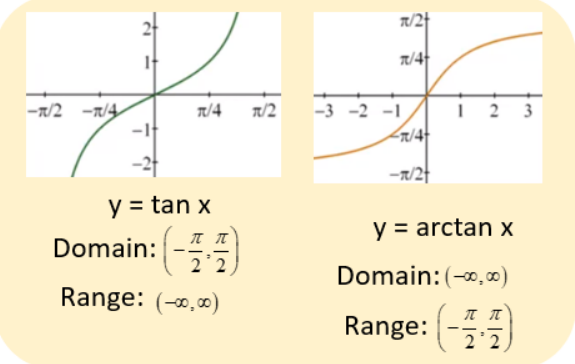
Inverse Tangent (tan−1xor(arctanx):
tan−1x=θif and only iftanθ=x
The inverse tangent function returns the angle whose tangent is x.
Domain: −∞<x<∞
Range: −2π<θ<2π (or −90∘<θ<90∘)
Inverse Cosecant (csc−1xorarccscx):
csc−1x=θif and only ifcscθ=x
Domain: x≤−1 or x≥1
Range: −2π≤θ≤2π,θ=0 (or −90∘≤θ≤90∘,θ=0∘)
Inverse Secant(sec−1xorarcsecx):
sec−1x=θif and only ifsecθ=x
Domain: x≤−1 or x≥1
Range: 0≤θ≤π,θ=2π (or 0∘≤θ≤180∘,θ=90∘)
Inverse Cotangent (cot−1xorarccotx)):
cot−1x=θif and only ifcotθ=x
Domain: −∞<x<∞
Range: 0<θ<π (or 0∘<θ<180∘)
2.Graphs of Inverse Trigonometric Functions:
Inverse Sine(arcsinx):
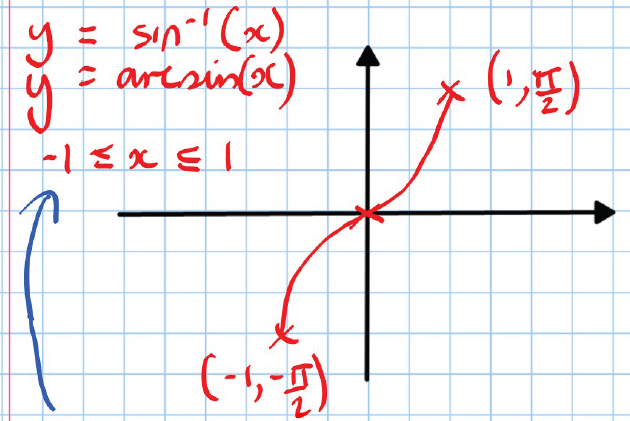
The graph of y=arcsinx is a smooth curve that starts at (−1,−2π) and ends at (1,2π).
Inverse Cosine (arccosx):
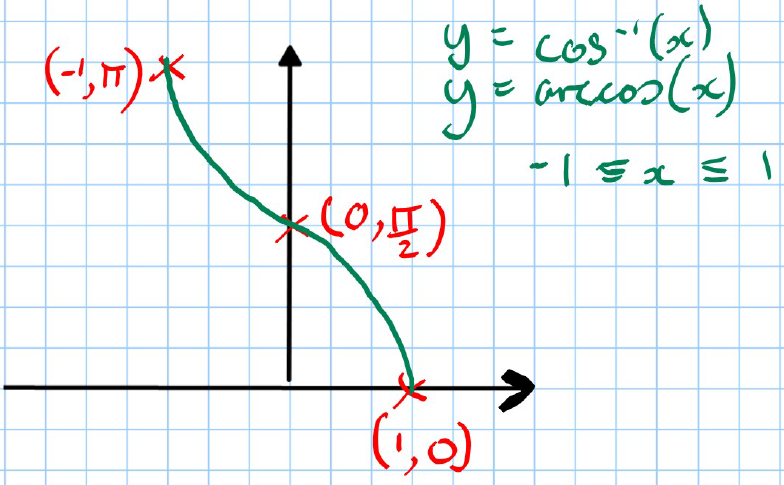
The graph of y=arccosx is a decreasing curve that starts at (−1,π) and ends at (1, 0).
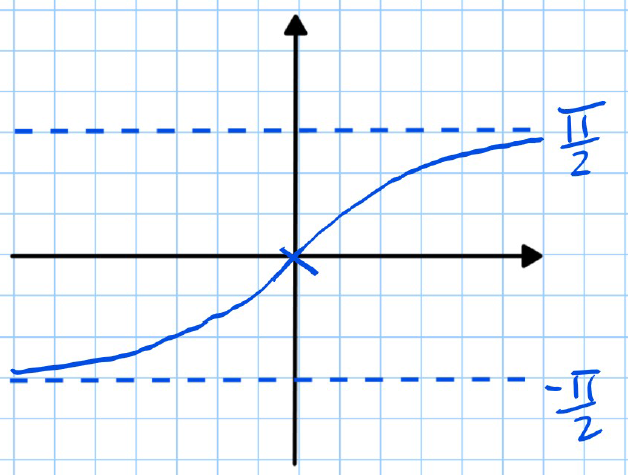
Inverse Tangent(arctanx):
The graph of y = arctanx is an increasing curve that approaches horizontal asymptotes at y=−2π and y=2π as x approaches negative and positive infinity, respectively.
3.Key Properties and Identities:
Inverse Function Property:
sin(arcsinx)=x,cos(arccosx)=x,tan(arctanx)=x
These are true for all x within the domain of the inverse function.
Composite Function Property:
arcsin(sinθ)=θfor−2π≤θ≤2πarccos(cosθ)=θfor0≤θ≤πarctan(tanθ)=θfor−2π<θ<2π
Pythagorean Identity:
arcsinx+arccosx=2π
This identity shows the relationship between the inverse sine and inverse cosine functions.
4.Example Problems Using Inverse Trigonometric Functions:
Note
Example 1:Solvesin−1(21).
Solution:
sin−1(21)=θwheresinθ=21
The angle θ=6π (or 30∘) is the solution because sin30∘=21.
Note
Example 2:Solvecos−1(−23).
Solution:
cos−1(−23)=θwherecosθ=−23
The angle θ=65π (or 150∘) is the solution because cos150∘=−23.
Note
Example 3:Simplifyarctan(1).
Solution:
arctan(1)=θwheretanθ=1
The angle θ=4π (or 45∘) is the solution because tan45∘=1.
Summary:
Inverse trigonometric functions allow you to find angles from given trigonometric values.
These functions have specific domains and ranges, which correspond to the possible values of the angle.
Understanding the graphs, properties, and key identities of these functions is crucial for solving trigonometric equations and simplifying expressions involving angles.
Inverse Trig Functions
Only 1-to-1 functions have inverses.
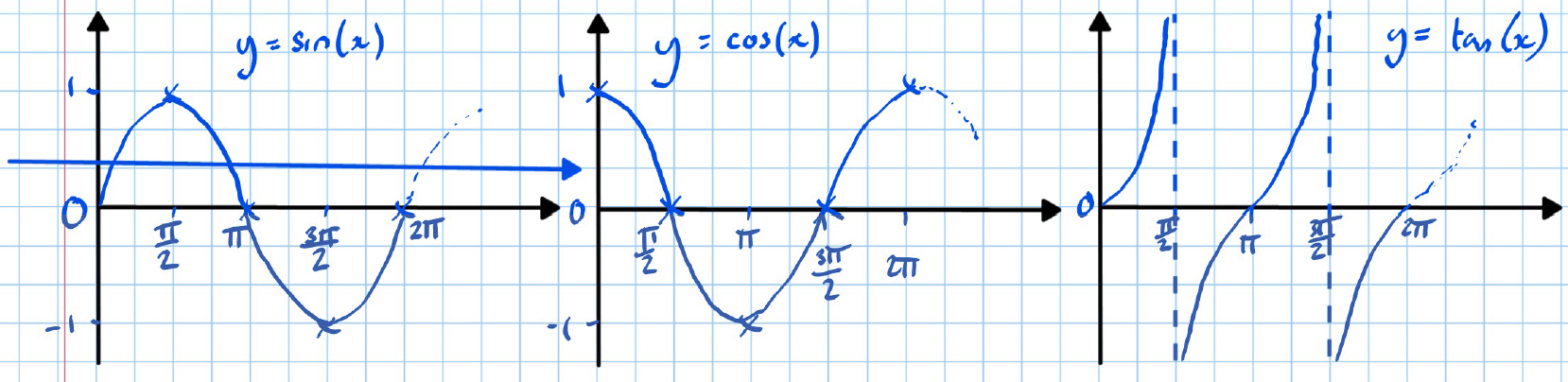
yyy=sin(x)=cos(x)=tan(x)
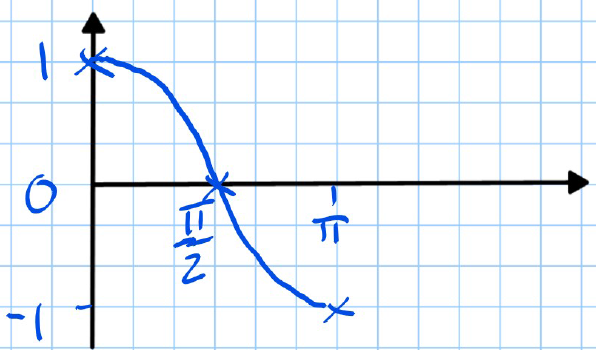
As they stand, these functions are not 1 to 1, therefore do not have an inverse. We must restrict the domain of these functions for an inverse to exist.
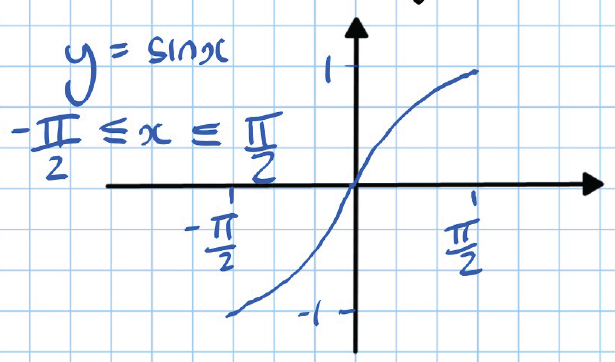
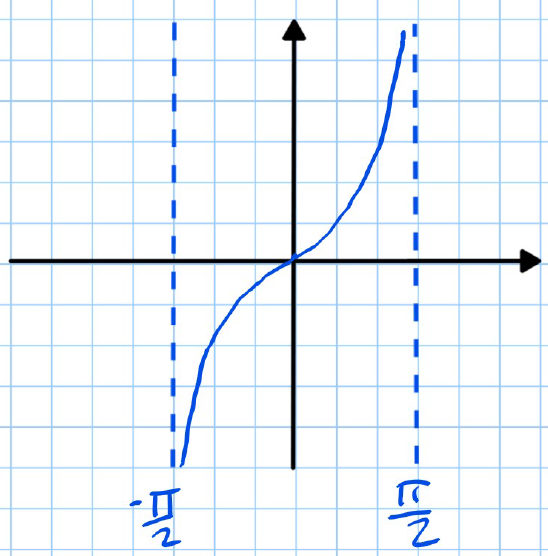
y=sin(x)−2π≤x≤2π
This version of the sine function when its domain is restricted to −2π≤x≤2π is 1 to 1, so has an inverse.
yy−1=sin−1(x)=arcsin(x)≤x≤1
Note: The domain of the inverse function is the range of the original.
To draw an inverse trig function, we reflect the original function through y=x.
(Hint: Look at the key points of the original graph and swap x and y coordinates.)