Federalism. (Edexcel A-Level Politics): Revision Notes
📚Revision Notes
17.2.1 Federalism.
Federalism and the Distribution of Power in the US Constitution
Note
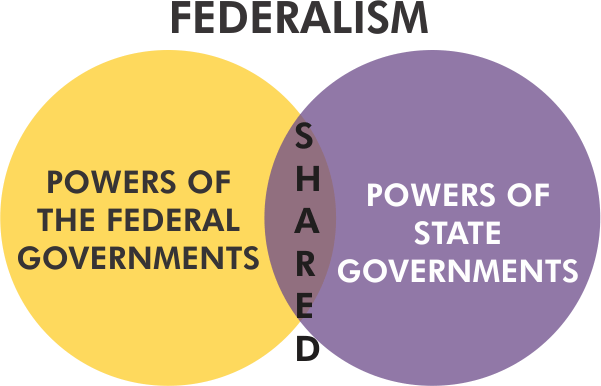
Federalism is a system of government in which power is constitutionally divided between a central (federal) government and regional (state or provincial) government.
- In a federal system, each level of government has its own distinct areas of authority, with some powers shared (concurrent powers) and others reserved exclusively to either the federal or state governments.
Note
- This structure is designed to balance the power between different levels of government, preventing any one level from becoming too powerful, and allowing for governance that is responsive to both national and regional needs.
Power Sharing Between States and Federal Government
- Equal Power and State Autonomy:
- Power in the US is shared between the federal government and the states, with each state having equal power and influence. This means that states are as powerful as the federal government in certain areas.
- State Law-Making:
- States have the authority to create their own laws through their legislatures, as seen in areas like gun laws where state regulations can differ significantly. The federal government cannot impose its will on states due to the reserved rights of the states.
- Constitutional Protection:
- The power of the states is protected from federal encroachment by the Constitution and the amendment process. This ensures that the federal government cannot easily override state decisions, preserving the autonomy of each state.
- Equal Decision-Making Power:
- All states have the same level of decision-making power, ensuring that no state is subordinate to another or to the federal government in terms of influence and authority.
Implied Federalism in the Constitution
- Federalism Not Explicit but Implied:
- While federalism is not directly stated in the Constitution, it is implied through the way the Constitution sets out the powers of the federal government and the limits on those powers.
- Constitutional Articles:
- The Articles of the Constitution explicitly state the powers of different branches of government and outline the concurrent powers shared by both the federal government and the states, such as the power to raise taxes.
- 10th Amendment:
Note
- The 10th Amendment further limits the federal government by reserving all powers not explicitly stated in the Constitution to the states. This amendment is a key aspect of federalism, reinforcing the idea that any powers not given to the federal government remain with the states.
| **Federal Government Powers ·** | Concurrent (Shared) Powers | State Powers |
|---|---|---|
| • Declare war • Maintain armed forces ·• Regulate interstate and foreign trade • Admit new states • Establish post offices • Set standard weights and measures • Coin money • Establish foreign policy • Make all laws necessary for carrying out enumerated powers (implied powers) • Make treaties • Tax imports/exports | • Maintain law and order • Levy taxes • Borrow money • Charter and regulate banks • Establish courts • Provide for public welfare | • Establish and maintain schools • Establish local governments • Regulate business within the state • Make marriage laws • Provide for public safety • Conduct elections • All other powers not delegated to the national government or prohibited to the states (10th Amendment) |