Constitutional Development: Key Historical Documents Overview (Edexcel A-Level Politics): Revision Notes
📚Revision Notes
8.1.1 Constitutional Development: Key Historical Documents Overview
1. Magna Carta (1215)
Definition and Context
Note
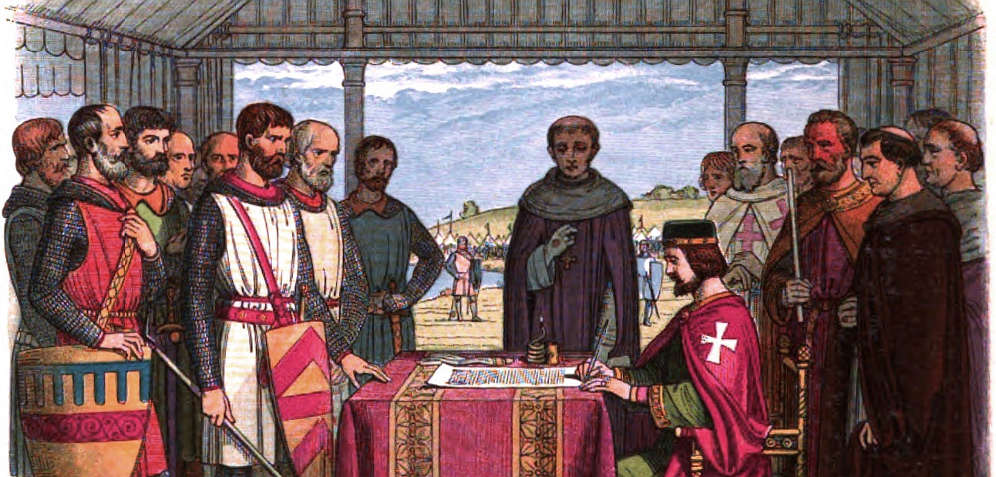
- Magna Carta: A charter agreed by King John of England at Runnymede, near Windsor, on 15 June 1215.
- Context: King John's arbitrary rule and heavy taxation led to a revolt by the barons, who demanded legal reforms.
Key Provisions
Note
- Limitation of Royal Power: The Magna Carta established the principle that the king was subject to the law.
- Rights of Barons: Provided specific protections for the barons, including protection from illegal imprisonment and access to swift justice.
- Foundation for Future Rights: Although initially a feudal document, it laid the groundwork for future constitutional principles.
Impact
- Symbolic Value: Became a symbol of liberty and the rule of law.
- Influence on Future Documents: Influenced later constitutional documents and democratic principles in England and beyond.
2. Bill of Rights (1689)
Definition and Context
- Bill of Rights: An Act of the Parliament of England that was passed on 16 December 1689.
- Context: Following the Glorious Revolution (1688), which saw the overthrow of King James II and the ascension of William III and Mary II to the throne.
Key Provisions
- Limitation of Monarchical Power: Established that the monarchy could not rule without the consent of Parliament.
- Rights and Liberties: Listed several fundamental rights, including:
- Free elections to Parliament.
- Freedom of speech within Parliament (parliamentary privilege).
- Protection from cruel and unusual punishment.
- Right to petition the king.
Impact
- Constitutional Monarchy: Marked the transition from absolute monarchy to constitutional monarchy in England.
- Foundation for Modern Rights: Laid the foundation for modern democratic governance and civil liberties.
3. Act of Settlement (1701)
Definition and Context
- Act of Settlement: An Act of the Parliament of England passed in 1701.
- Context: Addressed the succession to the English throne and aimed to secure Protestant succession after the childless reign of William III and Mary II.
Key Provisions
- Succession Rules: Ensured that only Protestant descendants of Sophia of Hanover could inherit the English throne.
- Judicial Independence: Provided for the independence of judges by stating that they could not be removed from office without the consent of Parliament.
- Limitations on Monarchy: Further restricted the power of the monarch, reinforcing the supremacy of Parliament.
Impact
- Stability of Succession: Ensured a stable Protestant succession, which was crucial for political and religious stability.
- Judicial Reforms: Enhanced the independence of the judiciary, an important step in the development of the rule of law.
4. Acts of Union (1707)
Definition and Context
- Acts of Union: Two Acts passed by the Parliament of England and the Parliament of Scotland, respectively, which took effect on 1 May 1707.
- Context: Unified the Kingdom of England and the Kingdom of Scotland into a single kingdom called Great Britain.
Key Provisions
- Creation of Great Britain: Formed a single kingdom with one Parliament and unified laws.
- Economic Union: Allowed for the free movement of goods, people, and capital between England and Scotland.
- Political Representation: Scotland was given representation in the new Parliament of Great Britain.
Impact
- Unified Kingdom: Created the political and economic union that laid the foundation for modern Britain.
- Economic and Political Integration: Facilitated greater economic integration and political stability within the British Isles.
5. Parliament Acts (1911 and 1949)
Definition and Context
Note
- Parliament Act 1911: An Act that curtailed the powers of the House of Lords in relation to the House of Commons.
- Parliament Act 1949: Further reduced the powers of the House of Lords.
Key Provisions
- 1911 Act:
Note
- Limited the veto power of the House of Lords to delay legislation for a maximum of two years.
- Established that money bills could become law without the Lords' consent if not passed within one month.
- 1949 Act:
- Reduced the delaying power of the House of Lords from two years to one year.
Impact
- Enhancement of Commons' Power: Strengthened the supremacy of the House of Commons over the House of Lords.
- Democratic Principle: Ensured that elected representatives in the House of Commons had the final say on legislation, reinforcing democratic governance.
Conclusion
The development of the UK Constitution is marked by significant historical documents that have shaped the balance of power between the monarchy, Parliament, and the judiciary. From the Magna Carta to the Parliament Acts, each document has played a crucial role in the evolution of constitutional governance, establishing key principles of democracy, rule of law, and civil liberties. Understanding these documents provides essential insights into the foundational elements of the UK's political system.