Enthalpy Changes (OCR A-Level Chemistry A): Revision Notes
📚Revision Notes
Enthalpy Changes
What is enthalpy?
Enthalpy, represented by the symbol , is a measure of the total heat energy contained within a chemical system. The chemical system consists of the specific atoms, molecules, or ions that make up the chemicals involved in a reaction - essentially, the reactants and products.
Note
It's important to understand that enthalpy itself cannot be measured directly. However, we can measure changes in enthalpy, which is what matters in chemistry.
Enthalpy is sometimes described as the energy stored within chemical bonds. While we cannot determine the absolute enthalpy value of a substance, we can accurately measure how much the enthalpy changes during a chemical reaction.
Understanding enthalpy change
When a chemical reaction occurs, the reactants typically have a different total enthalpy compared to the products. This difference is what we call the enthalpy change, denoted by the symbol .
The enthalpy change is calculated using the equation:
Important
The value of can be either positive or negative:
- If products contain more energy than reactants, is positive
- If products contain less energy than reactants, is negative
This simple equation is fundamental to understanding energy changes in chemical reactions.
Conservation of energy in chemical reactions
The law of conservation of energy is one of the fundamental principles in science. It states that energy cannot be created or destroyed - it can only be transferred from one form to another or moved from one place to another.
System and surroundings
When studying chemical reactions, we divide the universe into two parts:
- The system: This refers to the chemicals themselves - the reactants and products involved in the reaction
- The surroundings: This includes everything else - the apparatus (such as the reaction vessel, thermometer, and any laboratory equipment), the laboratory itself, and ultimately everything that is not the chemical system
- The universe: This is simply the system plus the surroundings combined
Note
When a chemical reaction involves an enthalpy change, heat energy is transferred between the system and the surroundings. The total energy of the universe remains constant, but energy moves between these two components.
Exothermic changes
An exothermic change occurs when energy is transferred from the chemical system to the surroundings. The name comes from "exo" meaning out - energy exits the system.
Characteristics of exothermic changes
During an exothermic reaction:
- The chemical system loses energy (releases heat)
- The surroundings gain energy (absorb heat)
- is negative (products have less energy than reactants)
- The temperature rises (the surroundings become warmer)
Because energy is released to the surroundings, any energy loss by the chemical system is balanced by an equal energy gain by the surroundings. This maintains the conservation of energy.
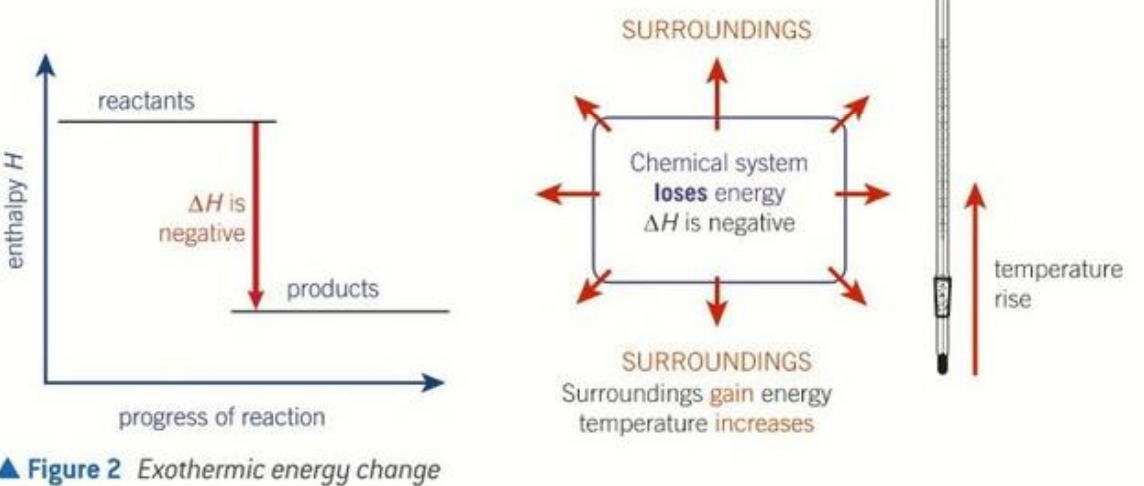
Enthalpy profile diagrams for exothermic reactions
An enthalpy profile diagram is a graphical representation showing the relative enthalpies of reactants and products during a reaction. For exothermic reactions:
- Reactants are positioned at a higher energy level
- Products are positioned at a lower energy level
- An arrow pointing downward shows the negative enthalpy change
- The vertical distance between reactants and products represents the magnitude of
Note
Tip for remembering: "Products Lower = Negative" - In exothermic reactions, products are at a lower energy level, and is negative.
Endothermic changes
An endothermic change occurs when energy is transferred from the surroundings into the chemical system. The name comes from "endo" meaning in - energy enters the system.
Characteristics of endothermic changes
During an endothermic reaction:
- The chemical system gains energy (absorbs heat)
- The surroundings lose energy (release heat)
- is positive (products have more energy than reactants)
- The temperature falls (the surroundings become cooler)
Any energy gained by the chemical system is balanced by an equal energy loss from the surroundings, ensuring conservation of energy is maintained.
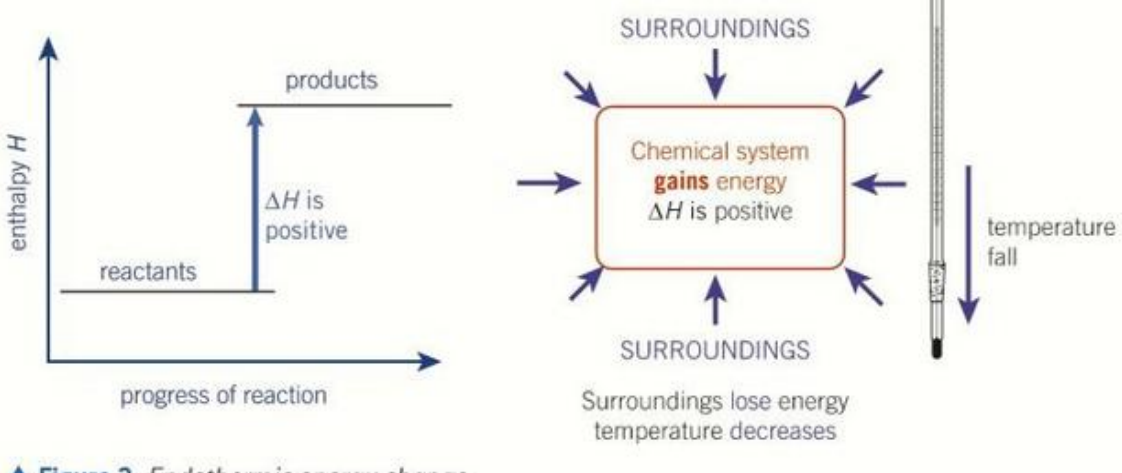
Enthalpy profile diagrams for endothermic reactions
For endothermic reactions, the enthalpy profile diagram shows:
- Reactants positioned at a lower energy level
- Products positioned at a higher energy level
- An arrow pointing upward shows the positive enthalpy change
- The vertical distance represents the magnitude of
Note
Tip for remembering: "Products Higher = Positive" - In endothermic reactions, products are at a higher energy level, and is positive.
Activation energy
Atoms and ions are held together by chemical bonds. During chemical reactions, bonds in the reactants must be broken before new bonds can form in the products. Breaking bonds requires an energy input, which creates an energy barrier that must be overcome.
Activation energy, symbol , is the minimum energy required for a reaction to take place. It represents the energy barrier that reactant molecules must overcome to form products.
The effect of activation energy on reaction rates
The size of the activation energy has important consequences:
- Small activation energies: Reactions occur very rapidly because the energy needed to break bonds is readily available from the surroundings. Most reactant molecules have sufficient energy to overcome the barrier.
- Large activation energies: Very large energy barriers may prevent a reaction from occurring at all, or cause it to proceed extremely slowly. Few molecules have enough energy to overcome the barrier.
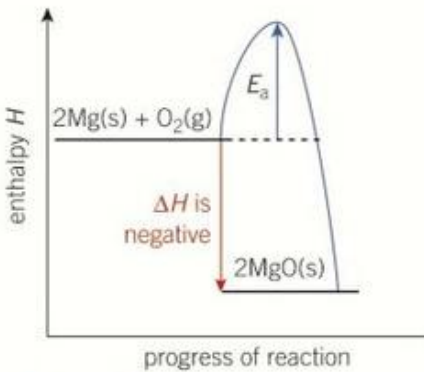
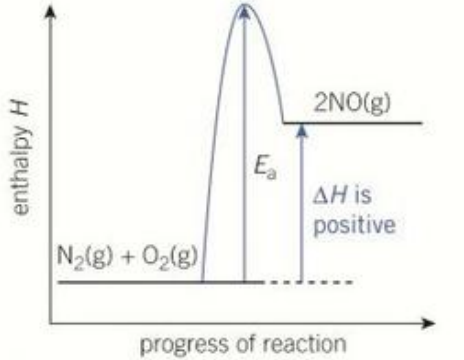
Activation energy on enthalpy profile diagrams
Complete enthalpy profile diagrams show both the enthalpy change () and the activation energy (). The diagrams display:
- A curve that rises from the reactants to a peak (representing the activation energy)
- Then falls to the products level
- The peak height above the reactants represents
- The difference between products and reactants represents
Important
For exothermic reactions, products are still lower than reactants even though the activation energy creates a peak. For endothermic reactions, products are higher than reactants, with the peak rising even higher above the reactants.
Standard conditions
The enthalpy change for a reaction can vary slightly depending on the conditions used, such as temperature and pressure. To ensure consistency and allow comparison between different experiments and data sources, chemists use standard conditions for physical measurements.
Standard conditions represent typical working conditions in a laboratory and are close to normal room conditions.
Defining standard conditions
Note
Standard conditions are defined as:
- Standard pressure: 100 kPa (which is very close to one atmosphere, 101 kPa)
- Standard temperature: 298 K (which equals 25°C)
- Standard concentration: 1 mol dm⁻³ (this applies only to solutions)
- Standard state: The physical state of a substance at 100 kPa and 298 K
Standard state notation
When a physical value, such as an enthalpy change, is measured under standard conditions, a special symbol is used. A small superscript circle (°) is added to the symbol. For example:
- becomes under standard conditions
- This is called the standard enthalpy change
Units for enthalpy changes
Enthalpy changes are usually expressed in kJ mol⁻¹ (kilojoules per mole). The "mol⁻¹" indicates that the value refers to the amount in moles given by the balancing numbers in the chemical equation for the reaction.
Standard enthalpy change of reaction
The standard enthalpy change of reaction, , is the enthalpy change that accompanies a reaction when it occurs in the exact molar quantities shown in a balanced chemical equation under standard conditions, with all reactants and products in their standard states.
Dependence on equation balancing
Important
The value of always refers to a stated chemical equation, and its value depends on the balancing numbers used. Doubling the equation doubles the enthalpy change.
Consider the reaction of magnesium with oxygen to form magnesium oxide:
Example
Worked Example: Effect of Equation Balancing on Enthalpy Change
Using fractional coefficients:
This shows 1 mole of Mg reacting with 0.5 moles of O₂ to form 1 mole of MgO.
If we balance the equation using whole numbers, the amounts are doubled:
This shows 2 moles of Mg reacting with 1 mole of O₂ to form 2 moles of MgO, and the enthalpy change is also doubled.
Both values are correct, but each applies only to the specific quantities given in its equation.
This demonstrates why the balanced equation must always be provided when stating an enthalpy change.
Standard enthalpy change of formation
The standard enthalpy change of formation, , is the enthalpy change that occurs when one mole of a compound is formed from its constituent elements under standard conditions, with all reactants and products in their standard states.
Key points about enthalpy of formation
The definition specifically requires:
- Formation of exactly one mole of the compound
- Reactants must be elements in their standard states
- Standard conditions must apply
Formation of compounds
Example
Worked Example: Standard Enthalpy Change of Formation
For the formation of magnesium oxide from magnesium and oxygen, the equation must show exactly one mole of MgO being formed:
Notice that fractional coefficients are used for O₂ to ensure that exactly one mole of MgO is formed. While the equation could be balanced with whole numbers, it would then no longer match the definition of , which requires formation of one mole of product.
When balancing equations for enthalpy changes of formation, you must not add a balancing number in front of the product that has formed. The equation should be balanced to give exactly one mole of the product.
Formation of elements
Important
From the definition, for any element refers to the formation of one mole of an element from that same element. This represents no change at all, so:
All elements have an enthalpy change of formation of 0 kJ mol⁻¹
This is an important fact to remember when performing calculations involving enthalpy changes.
Standard enthalpy change of combustion
The standard enthalpy change of combustion, , is the enthalpy change that occurs when one mole of a substance reacts completely with oxygen under standard conditions, with all reactants and products in their standard states.
Complete combustion
When a substance undergoes complete combustion with oxygen, the products are the oxides of the elements present in the substance. For organic compounds containing carbon, hydrogen, and possibly oxygen, complete combustion produces carbon dioxide and water.
Combustion equations
Example
Worked Example: Standard Enthalpy Change of Combustion
Consider the combustion of one mole of butane, C₄H₁₀:
The equation shows:
- Exactly one mole of butane (the substance being combusted)
- Fractional coefficients for oxygen are acceptable
- Multiple moles of products formed
The equation could be balanced without fractions, but it would then not match the definition, which requires combustion of one mole of the substance.
Standard enthalpy change of neutralisation
The standard enthalpy change of neutralisation, , is the energy change that accompanies the reaction between an acid and a base to form one mole of water (H₂O(l)) under standard conditions, with all reactants and products in their standard states.
The general neutralisation reaction
All neutralisation reactions can be represented by the same ionic equation:
This shows one mole of H⁺ ions reacting with one mole of OH⁻ ions to form one mole of water.
Example: neutralisation of hydrochloric acid
Example
Worked Example: Neutralisation Reaction
The neutralisation of hydrochloric acid with sodium hydroxide can be written as:
The enthalpy change for this reaction equals .
Universal value for neutralisation
Important
The value of is the same for all neutralisation reactions between strong acids and strong bases at -57 kJ mol⁻¹.
This is because the underlying process is always the same: H⁺(aq) reacting with OH⁻(aq) to form H₂O(l). The spectator ions present in different acids and bases do not affect the enthalpy change.
Remember!
Summary
Key Points to Remember:
- Enthalpy () is the heat energy in a chemical system; enthalpy change () is the difference between products and reactants
- Exothermic: Energy exits the system; is negative; surroundings warm up
- Endothermic: Energy enters the system; is positive; surroundings cool down
- Activation energy () is the minimum energy needed for a reaction to occur; small values mean fast reactions
- Standard conditions: 100 kPa, 298 K, 1 mol dm⁻³ for solutions; the ° symbol indicates standard conditions
- Formation (): Making one mole of compound from elements; elements have
- Combustion (): Burning one mole of substance completely in oxygen
- Neutralisation (): Forming one mole of water from acid and base; always -57 kJ mol⁻¹ for strong acids and bases
- Always balance equations to show exactly one mole of the key product for formation, combustion, and neutralisation