Hess’ Law and Enthalpy Cycles (OCR A-Level Chemistry A): Revision Notes
📚Revision Notes
Hess' Law and Enthalpy Cycles
Introduction to Hess' law
When chemists want to determine the enthalpy change of a reaction, they can sometimes measure it directly through a single experiment. However, many reactions present significant challenges for direct measurement. This is where Hess' law provides a valuable alternative approach.
Note
Hess' law states that when a reaction can proceed via two different routes, and both routes start and end at the same conditions, the total enthalpy change will be identical regardless of which route is taken. This principle stems from the law of conservation of energy and allows us to calculate enthalpy changes indirectly by using alternative pathways.
The power of Hess' law lies in its ability to determine unknown enthalpy changes by combining known values. If we know all enthalpy changes in a cycle except one, we can calculate the missing value using the relationship between the different routes.
Understanding enthalpy cycles
An enthalpy cycle is a diagram that visualizes the different routes a reaction can take from reactants to products. These cycles are essential tools for applying Hess' law in calculations.
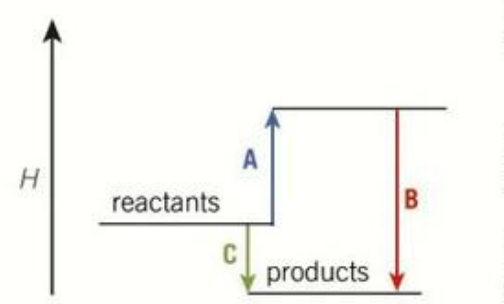
In a typical enthalpy cycle, arrows represent different pathways:
- Route 1 combines two steps (arrows A and B)
- Route 2 shows the direct pathway (arrow C)
According to Hess' law, following the arrows from reactants to products gives us the relationship:
This means if we know any two of these enthalpy changes, we can calculate the third. This mathematical relationship is the foundation for all enthalpy cycle calculations.
Note
The key principle: total enthalpy change is path-independent. Whether you follow the direct route or combine multiple steps, the overall energy change remains the same.
Worked example: basic enthalpy cycle calculation
Example
Worked Example: Basic Enthalpy Cycle Calculation
Let's apply Hess' law to a simple enthalpy cycle to understand the calculation process.
Given information:
- Find
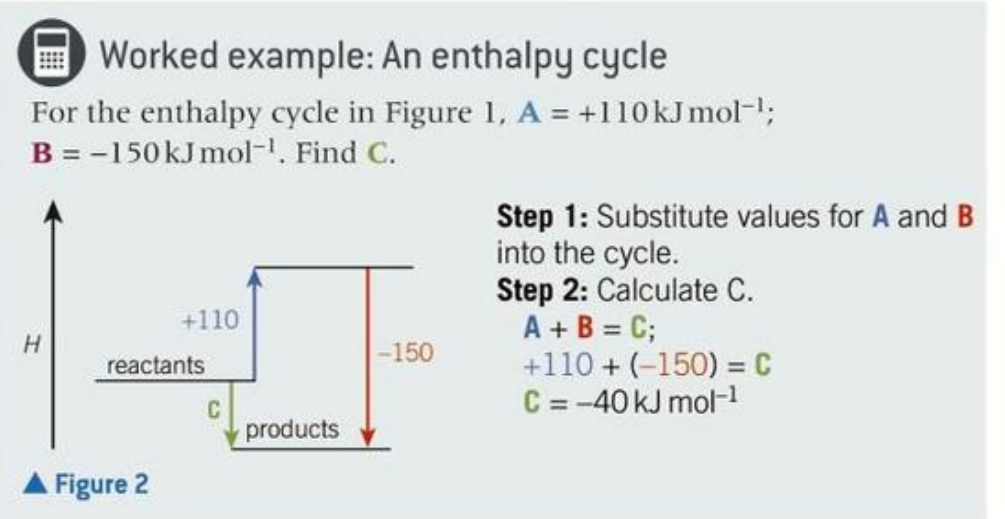
Step 1: Substitute the known values into the relationship
Step 2: Calculate the unknown value:
C & = & A + B \\ C & = & (+110) + (-150) \\ C & = & -40 \text{ kJ mol}^{-1} \end{array}$$ **Result:** The direct route (C) has an enthalpy change of $-40 \text{ kJ mol}^{-1}$, which equals the sum of the two-step pathway.This principle can be extended to cycles with any number of steps, provided all values except one are known.
Indirect determination using standard enthalpy of formation
Standard enthalpy changes of formation () and combustion () are extensively tabulated in data books. These values enable us to calculate enthalpy changes for reactions that would be difficult or impossible to measure directly.
Important
For elements in their standard states, is always zero. This is because no energy change occurs when forming an element from itself. In exams, you typically won't be provided with values of zero for elements - you're expected to know this principle.
Method: using values
To find the standard enthalpy change of a reaction using formation enthalpies, we construct an enthalpy cycle that connects:
- The reactants
- The products
- Their constituent elements
The elements form the common reference point that links reactants and products together.
Worked example: reaction of iron(III) oxide with calcium
Example
Worked Example: Calculating Enthalpy Change Using Formation Data
Calculate the standard enthalpy change for this reaction:
Given data:

Step 1: Construct the enthalpy cycle
When building the cycle, the constituent elements , , and form the common link. Using values:
- The reactants and products are formed from their elements
- Arrows point upwards from elements to reactants and products (formation is the reverse of breaking down)
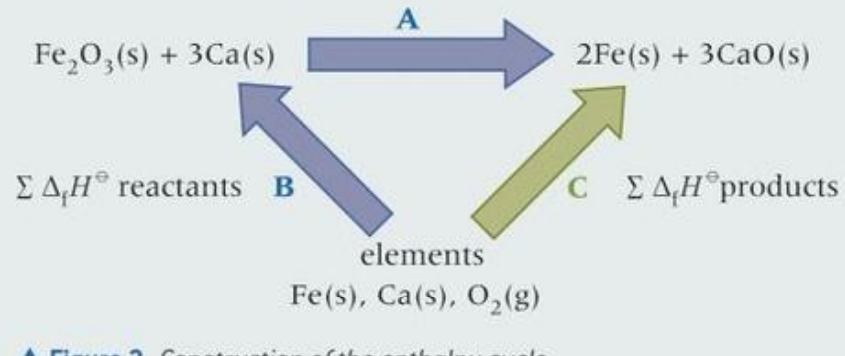
Following the arrows from reactants to products:
- Route 1:
- Route 2:
By Hess' law:
Therefore:
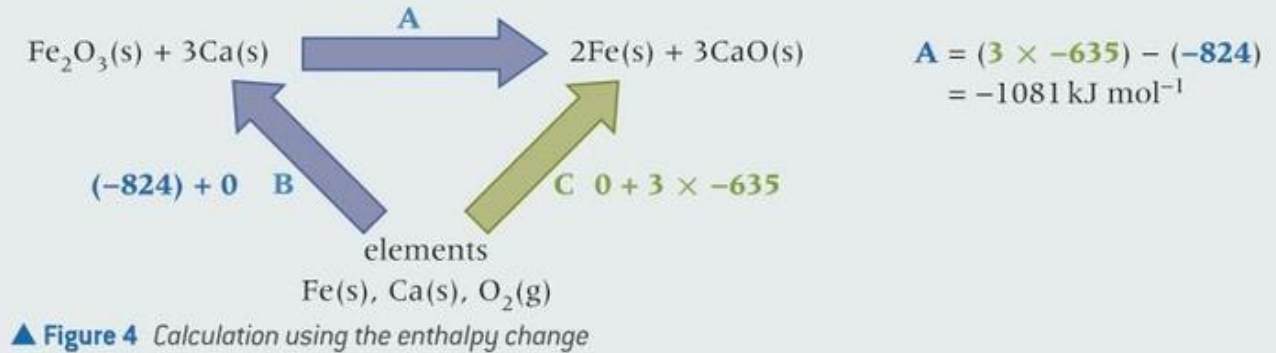
Step 2: Add the values and calculate
General formula for calculations using
For any reaction, the relationship can be expressed as:
The sigma () symbol means "sum of". Remember to multiply each value by its stoichiometric coefficient from the balanced equation.
Indirect determination using standard enthalpy of combustion
When formation enthalpies are unavailable or impractical to use, combustion enthalpies provide an alternative route for calculations. This method is particularly useful for organic compounds.
Method: using values
To determine enthalpy changes using combustion data, we construct an enthalpy cycle connecting:
- The reactants
- The products
- Their common combustion products ( and )
The combustion products form the common reference point in this type of cycle.
Worked example: formation of butane
Example
Worked Example: Determining Formation Enthalpy via Combustion Data
The formation of butane from its elements is shown below:
Direct measurement of this reaction is impossible because carbon and hydrogen form numerous different compounds simultaneously, making it impossible to isolate butane as the sole product.
However, we can measure the combustion enthalpies of , , and directly and use these to find the formation enthalpy indirectly.
Given data:

Step 1: Construct the enthalpy cycle
Both the reactants and products react to form common combustion products: and . Using values, the arrows point downwards (combustion releases energy).
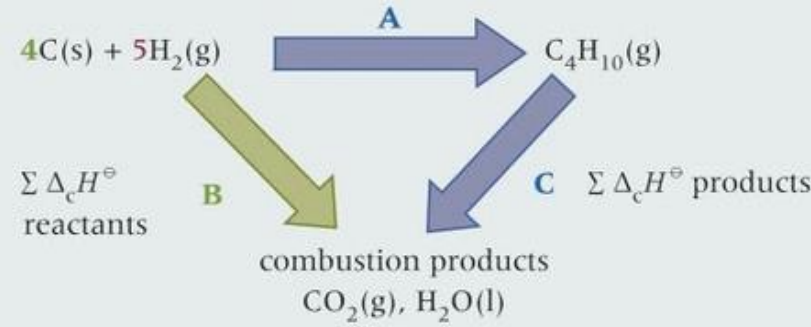
Following the arrows from reactants to products:
- Route 1:
- Route 2:
By Hess' law:
Therefore:
Step 2: Calculate using values
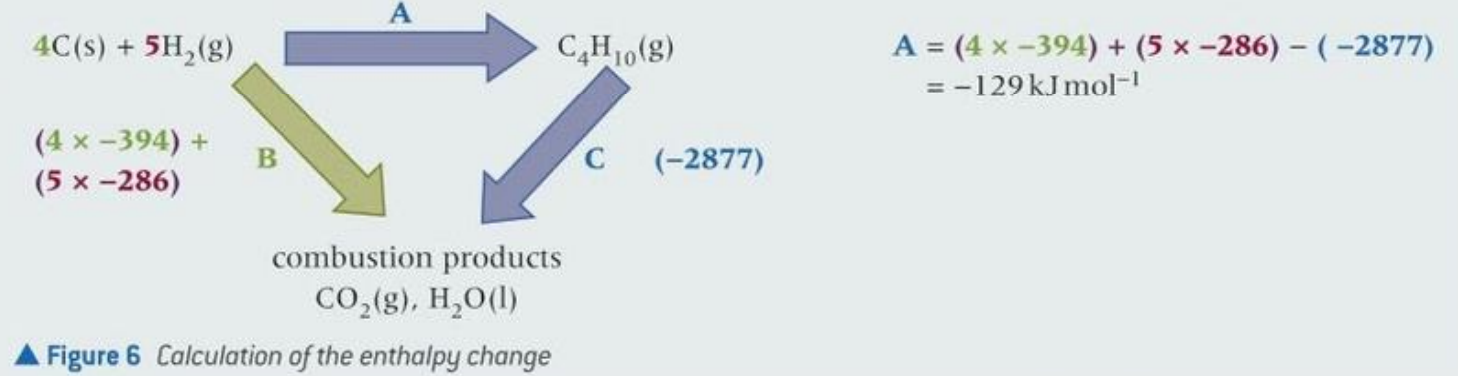
General formula for calculations using
For any reaction, the relationship is:
Important
Notice that for combustion enthalpies, we subtract products from reactants (the opposite order to formation enthalpies). This is because the arrows in combustion cycles point downwards, whereas in formation cycles they point upwards.
Summary of calculation methods
Two key formulas enable you to calculate enthalpy changes indirectly:
Using enthalpy changes of formation:
Using enthalpy changes of combustion:
Note
The order is reversed between these two methods due to the direction of arrows in their respective enthalpy cycles. In formation cycles, arrows point upward from elements. In combustion cycles, arrows point downward to combustion products.
Working with unfamiliar enthalpy cycles
Exam questions may present complex enthalpy cycles involving multiple steps and unfamiliar reactions. The key to solving these is systematic analysis.
General approach:
- Identify all the steps in the cycle and label the enthalpy changes
- Match each enthalpy change to values provided in data tables
- Determine the two possible routes through the cycle
- Apply Hess' law: the sum of enthalpy changes for each route must be equal
- Rearrange to solve for the unknown enthalpy change
Note
Even when cycles appear complicated with multiple pathways, the fundamental principle remains: total enthalpy change is independent of route taken. Focus on identifying which values are known, trace the possible routes carefully, and set up your equation accordingly.
Exam tips
Important
Common mistakes to avoid:
- Forgetting that for elements in their standard state
- Using the wrong sign when rearranging equations
- Confusing the formulas for formation and combustion calculations
- Forgetting to multiply by stoichiometric coefficients
Note
Top tips:
- Always draw the enthalpy cycle clearly, even if one is provided
- Label your arrows and follow them systematically
- Check your final answer makes chemical sense (is it reasonable?)
- Remember: formation arrows point UP, combustion arrows point DOWN
- Keep track of positive and negative signs throughout
Remember!
Summary
Key Points to Remember:
-
Hess' law states that total enthalpy change is independent of the route taken, allowing indirect determination of enthalpy changes that cannot be measured directly.
-
Enthalpy cycles are diagrams showing alternative routes between reactants and products. If all values except one are known, the unknown can always be calculated.
-
Using formation enthalpies: . Formation cycles connect via elements, with arrows pointing upward.
-
Using combustion enthalpies: . Combustion cycles connect via combustion products, with arrows pointing downward.
-
Always multiply tabulated values by their stoichiometric coefficients and remember that for all elements in their standard states.