Periodicity (OCR A-Level Chemistry A): Revision Notes
📚Revision Notes
Ionisation energies
What is ionisation energy?
Ionisation energy is a fundamental concept in chemistry that helps us understand how strongly electrons are held within atoms. It provides a quantitative measure of the energy needed to remove electrons from atoms to form positive ions.
First ionisation energy is defined as the energy required to remove one electron from each atom in one mole of gaseous atoms of an element to form one mole of gaseous 1+ ions. This can be represented by the following general equation:
For example, the first ionisation of sodium can be written as:
Note
The positive energy value indicates that ionisation is an endothermic process - energy must be supplied to remove the electron from the atom. All ionisation energies are positive because energy is always required to overcome the attractive force between electrons and the nucleus.
Factors affecting ionisation energy
The electrons in an atom are held in their shells by electrostatic attraction to the positively charged nucleus. The electron that is lost during ionisation will be in the highest energy level and will experience the least attraction from the nucleus. For instance, when a sodium atom (electron configuration ) loses an electron, it comes from the 3s sub-shell.
Three key factors influence the strength of attraction between the nucleus and outer electrons, and therefore affect the ionisation energy:
Atomic radius: The distance between the nucleus and the outer electrons significantly affects nuclear attraction. The greater the distance, the weaker the attraction becomes. This is because the electrostatic force of attraction decreases sharply with increasing distance. Therefore, atoms with larger atomic radii have lower ionisation energies, as their outer electrons are further from the nucleus and easier to remove.
Nuclear charge: The number of protons in the nucleus determines the positive charge that attracts the negatively charged electrons. A greater number of protons creates a stronger attraction between the nucleus and the outer electrons. Elements with higher nuclear charges (more protons) generally have higher ionisation energies, assuming other factors remain constant.
Electron shielding: Inner shell electrons have a crucial effect on outer shell electrons. Because all electrons are negatively charged, inner shell electrons repel outer shell electrons. This repulsion, known as the shielding effect, reduces the effective nuclear charge experienced by outer electrons. The more inner shells present, the greater the shielding effect, and consequently, the weaker the attraction between the nucleus and outer electrons. This leads to lower ionisation energies.
Note
The Three Key Factors:
These three factors work together to determine ionisation energy:
- Atomic radius - larger distance = weaker attraction
- Nuclear charge - more protons = stronger attraction
- Electron shielding - more inner electrons = weaker effective attraction
Understanding how these factors change is essential for explaining periodic trends.
Successive ionisation energies
Elements contain varying numbers of electrons, and each of these electrons can be removed sequentially. An element has as many ionisation energies as it has electrons. For example, helium has two electrons and therefore has two ionisation energies:

The second ionisation energy is defined as the energy required to remove one electron from each atom in one mole of gaseous 1+ ions of an element to form one mole of gaseous 2+ ions. It's important to note that successive ionisation energies must specify the species losing the electron correctly.
Why successive ionisation energies increase
When we compare the first and second ionisation energies of helium, we observe that the second ionisation energy is significantly greater than the first. This pattern holds true for all elements - successive ionisation energies always increase. The reason for this lies in the changing electronic environment within the atom.
Important
Why Each Successive Ionisation Energy is Higher:
In a helium atom, there are two protons in the nucleus attracting two electrons in the 1s sub-shell. After the first electron is removed, the remaining electron is now the only electron being pulled by those two protons. This single electron experiences much less electron-electron repulsion and is pulled significantly closer to the nucleus. The nuclear attraction on this remaining electron is substantially stronger, meaning considerably more ionisation energy is required to remove this second electron.
This principle applies to all elements: as electrons are removed, those remaining experience less repulsion and stronger nuclear attraction.
Evidence for electron shells from successive ionisation energies
Successive ionisation energies provide compelling experimental evidence for the existence of different electron energy levels in atoms. By plotting successive ionisation energies against ionisation number, we can identify the shell structure of an atom.
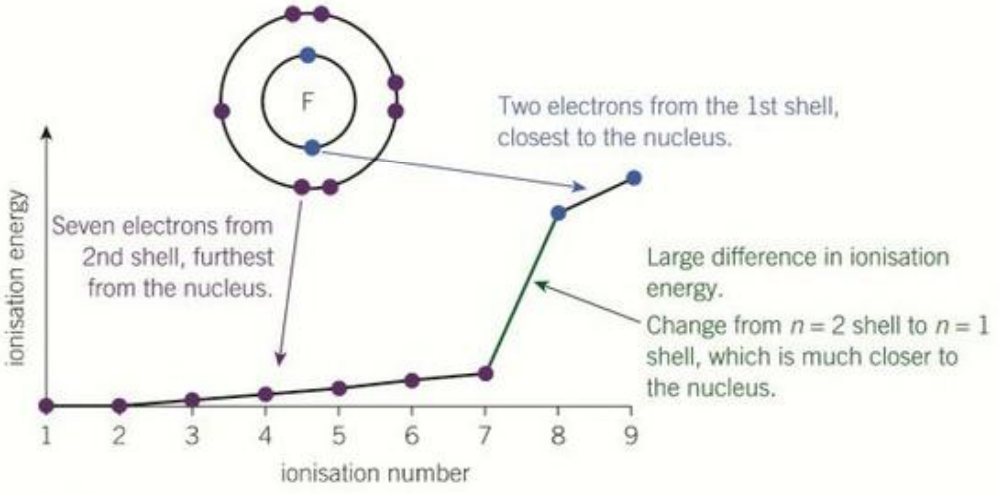
The graph shows the successive ionisation energies of fluorine. Notice that there are seven relatively similar ionisation energies (ionisations 1-7) which correspond to removing the seven electrons from the second shell (n=2). However, there is a dramatic jump in ionisation energy between the seventh and eighth ionisation. This large increase indicates that the eighth electron is being removed from a different shell - specifically the first shell (n=1), which is much closer to the nucleus and experiences minimal shielding.
Note
The Key Principle:
Large jumps in successive ionisation energies mark a change from one electron shell to another, inner shell.
For fluorine:
- The first shell (n=1, closest to nucleus) contains two electrons
- The second shell (n=2, furthest from nucleus) contains seven electrons
The massive energy increase when moving from the outer shell to the inner shell proves that electrons exist in distinct energy levels.
Making predictions from successive ionisation energies
The pattern of successive ionisation energies allows us to make important predictions about elements:
- The number of electrons in the outer shell
- The group of the element in the periodic table
- The identity of an unknown element
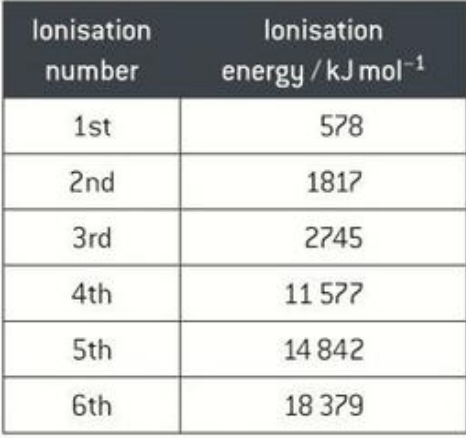
Consider the following successive ionisation energy data for an element from period 3:
Example
Worked Example: Identifying an Unknown Element
Given: Successive ionisation energy data for an unknown element from period 3
Step 1: Identify the pattern
Looking at this data, we can observe that the ionisation energies increase steadily for the first three ionisations (578, 1817, 2745 kJ mol⁻¹).
Step 2: Locate the large jump
There is a dramatic increase between the third and fourth ionisation energies, jumping from 2745 to 11577 kJ mol⁻¹. This large jump tells us that the fourth electron is being removed from an inner shell, one that is closer to the nucleus and experiences much less shielding.
Step 3: Determine the outer shell electrons
This pattern reveals that there are three electrons in the outer shell.
Step 4: Identify the group
Since elements in the same group have the same number of outer shell electrons, this element must be in Group 13 (Group 3 in older notation).
Step 5: Identify the element
Given that we know the element is in period 3, we can confidently identify it as aluminium.
Trends in first ionisation energies
Periodic trends in first ionisation energies provide crucial evidence for the existence of electron shells and sub-shells. These trends can be observed when examining elements both down groups and across periods.
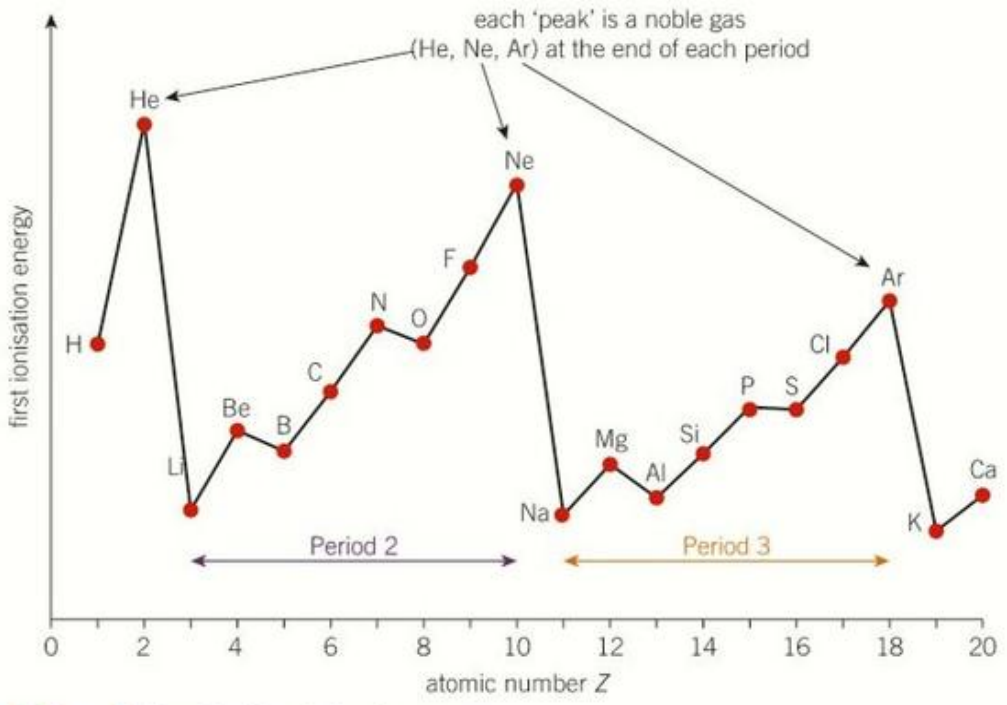
This graph displays the first ionisation energies for the first 20 elements in the periodic table. Two key patterns emerge:
- A general increase in first ionisation energy across each period (from H to He, Li to Ne, Na to Ar)
- A sharp decrease in first ionisation energy between the end of one period and the start of the next (from He to Li, from Ne to Na, from Ar to K)
These trends can be explained by considering how atomic radius, electron shielding, and nuclear charge change in different directions across the periodic table.
Trend in first ionisation energy down a group
First ionisation energies decrease as you move down a group in the periodic table. This trend is clearly visible when comparing the noble gases helium, neon, and argon, which appear as peaks at the end of each period in the graph above.
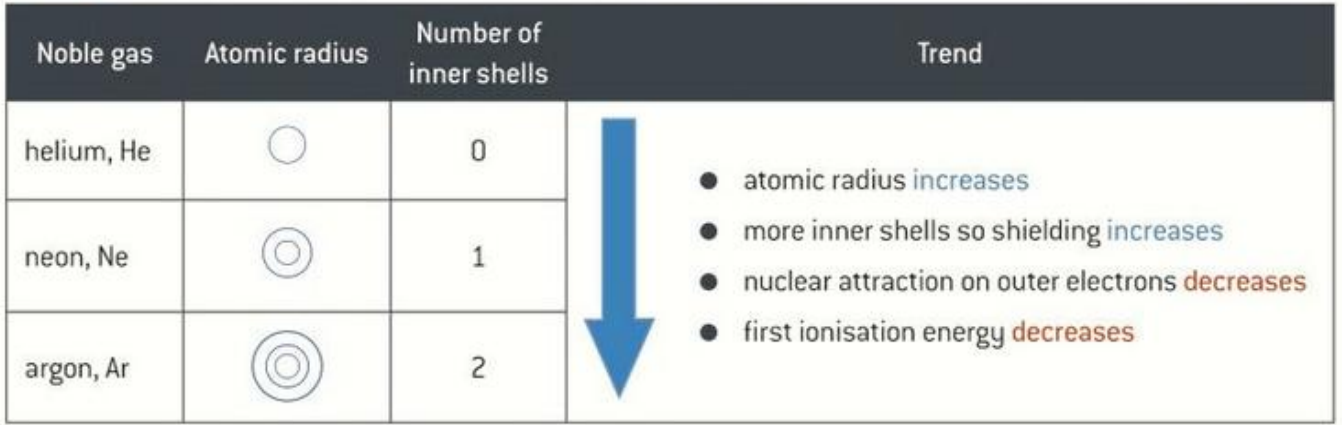
To understand why first ionisation energy decreases down a group, we need to consider how the three key factors change:
Atomic radius increases: As we move down a group, each successive element has an additional electron shell. This means the outer electrons are progressively further from the nucleus, weakening the nuclear attraction.
Electron shielding increases: Each additional shell adds more inner electrons that shield the outer electrons from the full nuclear charge. The increased shielding reduces the effective nuclear attraction experienced by outer electrons.
Nuclear charge increases: While it's true that nuclear charge increases down a group (more protons), this factor is outweighed by the combined effects of increased atomic radius and increased shielding.
Note
Down a Group:
The overall result is that nuclear attraction on outer electrons decreases down a group, making them easier to remove and resulting in lower first ionisation energies. The increased distance between nucleus and outer electrons, combined with greater shielding from additional inner shells, has a more significant effect than the increased nuclear charge.
The two factors that increase (atomic radius and shielding) have a stronger combined effect than the one factor that would increase ionisation energy (nuclear charge).
Trend in first ionisation energy across a period
First ionisation energy shows a general increase across each period, although this trend is not perfectly smooth. This increase can be clearly seen in period 2 (from lithium to neon) and period 3 (from sodium to argon) in the graph.
To explain this trend, let's examine the changes across period 2:
Nuclear charge increases: As we move from left to right across the period, each element has one more proton in its nucleus. This steadily increases the positive charge attracting the electrons.
Same shell - similar shielding: All the elements in period 2 have their outer electrons in the second shell (n=2). The shielding effect remains relatively constant because the same number of inner shell electrons (two electrons in the first shell) shield the outer electrons throughout the period.
Nuclear attraction increases: With increasing nuclear charge and similar shielding, the effective nuclear charge experienced by outer electrons increases across the period.
Atomic radius decreases: The increased nuclear attraction pulls the electrons closer to the nucleus, reducing the atomic radius across the period.
Note
Across a Period:
The result of these combined factors is that electrons are held more tightly and require more energy to remove. Therefore, first ionisation energy generally increases across a period. The most important factor driving this trend is the increasing nuclear charge, which is not offset by increased shielding since electrons are being added to the same shell.
Unlike down a group, here the shielding stays roughly constant while nuclear charge increases, leading to stronger attraction and higher ionisation energies.
Sub-shell trends in first ionisation energy
While there is a general increase in first ionisation energy across periods 2 and 3, the trend is not perfectly smooth. There are two notable drops in each period that occur at the same positions: a fall from beryllium to boron, and a fall from nitrogen to oxygen in period 2 (with equivalent falls in period 3). These drops occur because of the existence of sub-shells and how orbitals are filled with electrons.
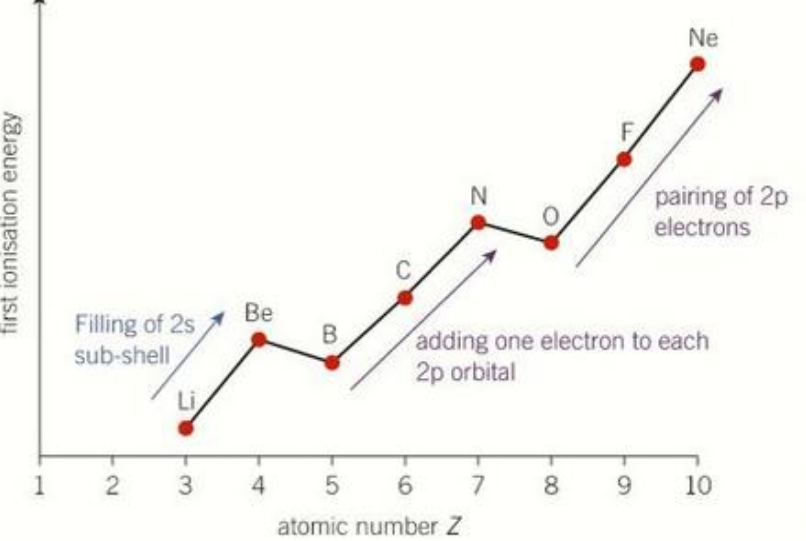
The graph shows three distinct rises and two falls across period 2:
- A rise from lithium to beryllium (filling 2s sub-shell)
- A fall to boron, then a rise through carbon to nitrogen (adding one electron to each 2p orbital)
- A fall to oxygen, then a rise through fluorine to neon (pairing of 2p electrons)
Comparing beryllium and boron
The drop in first ionisation energy from beryllium to boron marks the start of filling the 2p sub-shell.
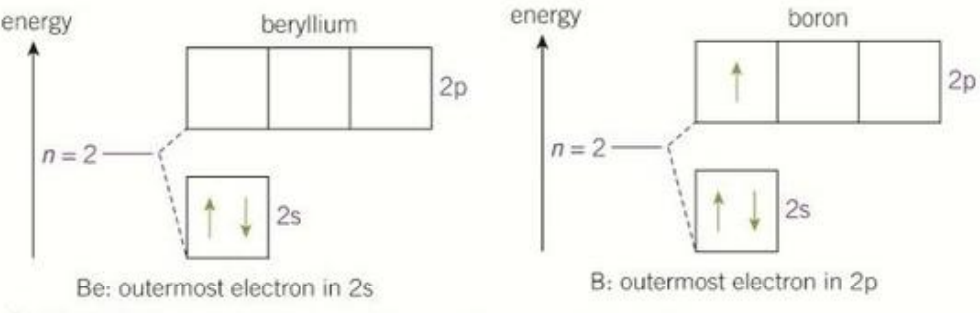
In beryllium, the outermost electron is in the 2s sub-shell, which is at a lower energy level and closer to the nucleus. In boron, the outermost electron occupies a 2p orbital, which has a higher energy than the 2s sub-shell. Even though boron has one more proton than beryllium (increased nuclear charge), the 2p electron in boron is easier to remove than a 2s electron in beryllium because:
- The 2p electron is at higher energy
- The 2p electron is slightly further from the nucleus on average
- The 2p electron experiences slightly more shielding from the 2s electrons
Important
Why Boron Has Lower Ionisation Energy Than Beryllium:
Therefore, the first ionisation energy of boron is lower than that of beryllium, despite the increased nuclear charge. This drop provides evidence for the existence of different sub-shells (s and p) with different energy levels.
This anomaly shows that sub-shell structure is more significant than simply having an extra proton in the nucleus.
Comparing nitrogen and oxygen
The second drop in first ionisation energy, from nitrogen to oxygen, marks the start of electron pairing in the p-orbitals of the 2p sub-shell.
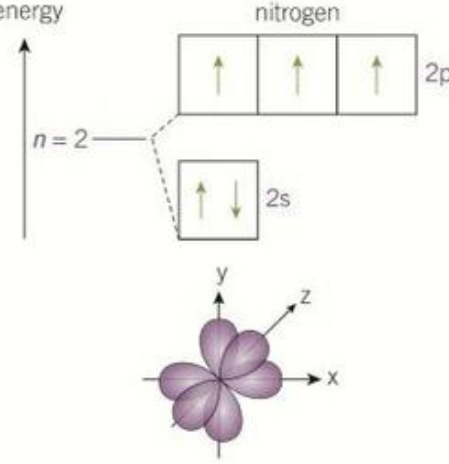
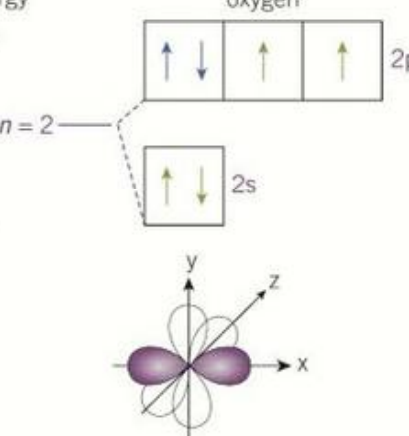
Nitrogen has three electrons in its 2p sub-shell, with one electron in each of the three 2p orbitals (). According to Hund's rule, electrons occupy orbitals singly before pairing, with their spins arranged to minimize repulsion. This configuration keeps the electrons as far apart as possible in three-dimensional space.
Oxygen has four electrons in its 2p sub-shell. This means that one of the 2p orbitals must contain a pair of electrons (). These paired electrons occupy the same region of space and are negatively charged, so they repel one another. This electron-electron repulsion within the paired orbital makes it easier to remove one of these electrons from an oxygen atom compared to removing an unpaired electron from a nitrogen atom.
Important
Why Oxygen Has Lower Ionisation Energy Than Nitrogen:
Although oxygen has a greater nuclear charge than nitrogen (one more proton), the repulsion between the paired electrons in oxygen outweighs this increased nuclear attraction. Consequently, the first ionisation energy of oxygen is slightly less than that of nitrogen.
This drop demonstrates the importance of electron pairing and inter-electron repulsion. The paired electrons in oxygen experience mutual repulsion, making one of them easier to remove despite the higher nuclear charge.
These sub-shell effects provide strong evidence for the existence of sub-shells (s and p), different orbital energies, and the way electrons fill orbitals according to quantum mechanical principles.
Summary
Key Points to Remember:
-
First ionisation energy is the energy required to remove one mole of electrons from one mole of gaseous atoms to form one mole of gaseous 1+ ions:
-
Three factors affect ionisation energy: atomic radius (larger = lower ionisation energy), nuclear charge (more protons = higher ionisation energy), and electron shielding (more inner shells = lower ionisation energy)
-
Successive ionisation energies always increase because as each electron is removed, the remaining electrons experience less repulsion and stronger nuclear attraction. Large jumps between successive ionisation energies indicate removal from a new, inner shell.
-
Down a group, first ionisation energy decreases because atomic radius and shielding increase more significantly than nuclear charge, making outer electrons easier to remove.
-
Across a period, first ionisation energy generally increases because nuclear charge increases while shielding remains similar, making electrons harder to remove. However, there are notable drops at the start of new sub-shells (Be→B) and when electron pairing begins (N→O).