Reaction Rates and Equilibrium (OCR A-Level Chemistry A): Revision Notes
📚Revision Notes
Dynamic equilibrium and Le Chatelier's principle
Understanding reversible reactions
Most chemical reactions you have studied so far have been irreversible reactions - they proceed in one direction only until the reactants are used up. For example, when hydrogen gas is ignited in oxygen, water forms through a reaction that goes to completion:
In this reaction, all the hydrogen reacts with oxygen, the reaction finishes, and only products remain.
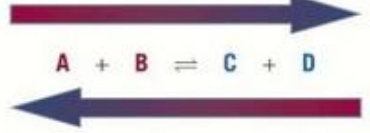
However, many important chemical reactions are reversible reactions - they can proceed in both forward and reverse directions simultaneously. These reactions are particularly important in industrial processes.
Note
The key difference between irreversible and reversible reactions is that irreversible reactions proceed to completion (all reactants consumed), while reversible reactions can reach a state of equilibrium where both reactants and products coexist.
A classic example is the Haber process used to manufacture ammonia:
The symbol indicates that this reaction is reversible and can reach equilibrium. In this system, nitrogen and hydrogen combine to form ammonia (forward reaction), while simultaneously ammonia breaks down to reform nitrogen and hydrogen (reverse reaction).
What is dynamic equilibrium?
When a reversible reaction is carried out in a closed system (isolated from its surroundings), it can reach a state called dynamic equilibrium. Understanding this concept is essential for predicting and controlling chemical reactions.
Characteristics of equilibrium systems
Important
A system at dynamic equilibrium has two key features:
- The rate of the forward reaction equals the rate of the reverse reaction
- The concentrations of all reactants and products remain constant (they do not change)
The term "dynamic" is important here. Although concentrations stay constant, both reactions continue to occur. Reactant molecules are constantly converting to product molecules at the same rate that product molecules convert back to reactants. This creates a balance where the overall composition doesn't change, even though molecular conversions are still happening.
Closed systems
For equilibrium to be maintained, the system must be closed - it must be isolated from its surroundings. This means temperature, pressure, and concentrations cannot be affected by external factors. Any exchange of matter or uncontrolled energy with the surroundings would disrupt the equilibrium state.
Le Chatelier's principle
When an equilibrium system is disturbed by changing conditions, it responds in a predictable way. This behavior is described by Le Chatelier's principle.
Important
Le Chatelier's principle states: When a system in equilibrium is subjected to an external change, the system readjusts itself to minimize the effect of that change.
In simpler terms, if you push an equilibrium system one way, it pushes back to oppose the change. The equilibrium position shifts to counteract the disturbance and establish a new equilibrium.
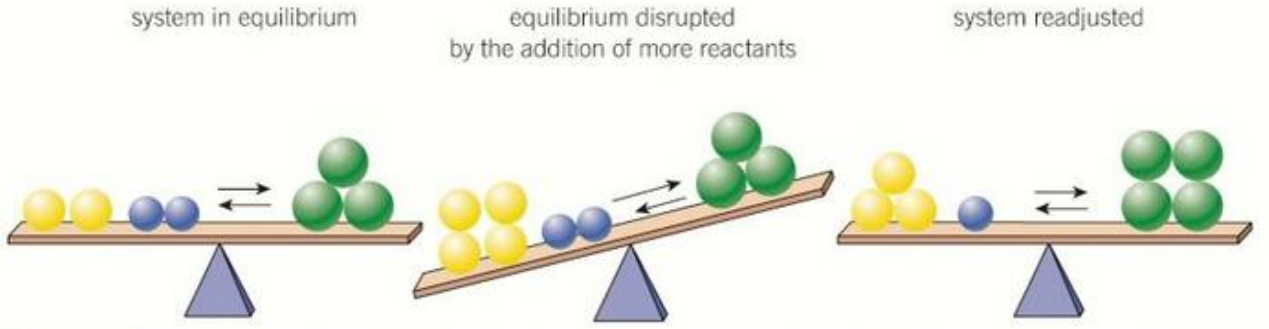
This diagram shows how an equilibrium system responds when disturbed. When extra reactant is added, the system shifts to the right (toward products) to minimize the change in reactant concentration. A new equilibrium is then established with different concentrations but with forward and reverse rates again equal.
Position of equilibrium
The position of equilibrium tells us the extent of a reaction - how much of the reactants have converted to products at equilibrium. We can describe the position as:
- Shifted to the right when products are favored (more products than reactants at equilibrium)
- Shifted to the left when reactants are favored (more reactants than products at equilibrium)
Changes in temperature, pressure (for gaseous reactions), or concentration can alter the position of equilibrium. Le Chatelier's principle helps us predict which direction the equilibrium will shift.
Effect of concentration changes on equilibrium
When you change the concentration of a reactant or product in an equilibrium system, the position of equilibrium shifts to counteract that change.
General principles
Note
The rules for concentration changes are:
- If you increase the concentration of a substance, the equilibrium shifts away from that substance (to use it up)
- If you decrease the concentration of a substance, the equilibrium shifts toward that substance (to replace it)
Put another way:
- If more products form, the equilibrium has shifted to the right
- If more reactants form, the equilibrium has shifted to the left
Investigating the chromate-dichromate equilibrium
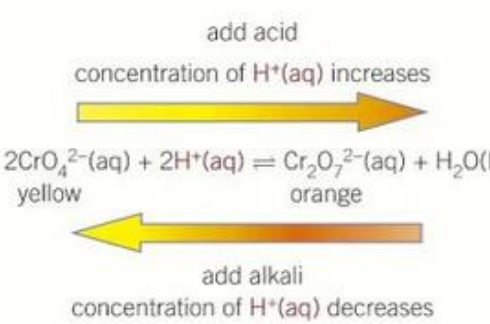
An excellent demonstration of concentration effects uses the equilibrium between yellow chromate ions and orange dichromate ions:
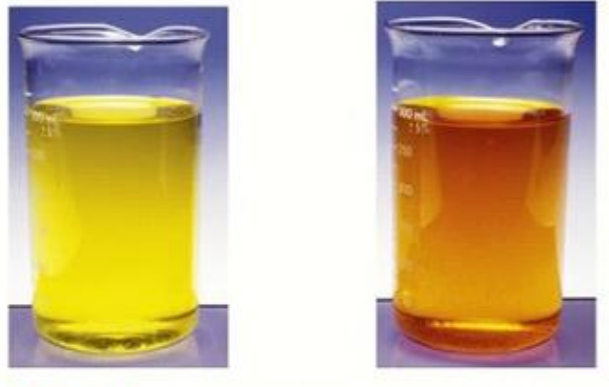
The different colors make it easy to see when the equilibrium position changes.
Example
Worked Example: The Chromate-Dichromate Equilibrium Shift
What happens when acid is added:
When you add dilute sulfuric acid to a yellow chromate solution, you increase the concentration of ions. According to Le Chatelier's principle, the system shifts to minimize this change:
- The increase in concentration causes the forward reaction rate to increase
- The equilibrium shifts to the right (toward products) to decrease the concentration
- More dichromate ions () form
- The solution turns orange
- A new equilibrium is established
What happens when alkali is added:
When you add aqueous sodium hydroxide (), the ions react with and remove ions:
This decreases the concentration. The equilibrium responds by:
- The decrease in concentration causes the forward reaction rate to decrease
- The equilibrium shifts to the left (toward reactants) to increase the concentration
- More chromate ions () form
- The solution turns yellow
- A new equilibrium is established
This experiment can be repeated many times, with the color changing from yellow to orange and back to yellow, demonstrating the reversible nature of the equilibrium.
Effect of temperature changes on equilibrium
Temperature changes affect equilibrium position differently than concentration changes because temperature affects the rates of both forward and reverse reactions. The direction of the equilibrium shift depends on whether the reaction is exothermic or endothermic.
Understanding enthalpy changes in reversible reactions
In any reversible reaction, the forward and reverse reactions have enthalpy changes () that are equal in magnitude but opposite in sign:
- If the forward reaction is exothermic ( is negative), the reverse reaction is endothermic ( is positive)
- If the forward reaction is endothermic ( is positive), the reverse reaction is exothermic ( is negative)
General principles for temperature effects
Important
Le Chatelier's principle for temperature changes:
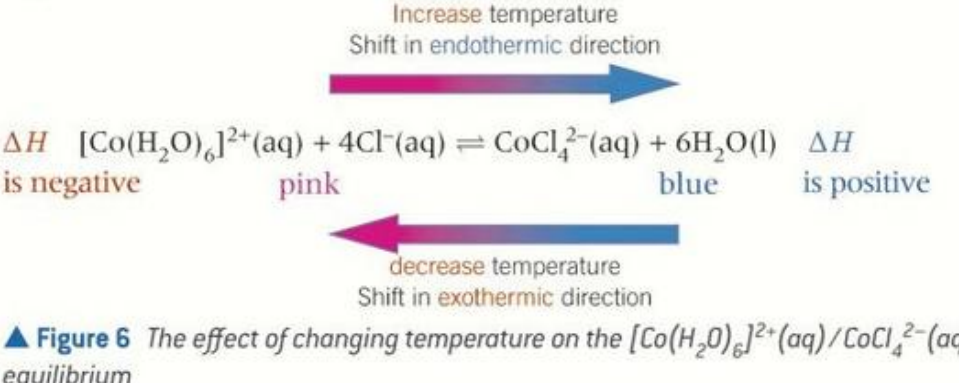
- An increase in temperature shifts the equilibrium in the endothermic direction (the direction that absorbs heat energy)
- A decrease in temperature shifts the equilibrium in the exothermic direction (the direction that releases heat energy)
This makes sense because the system responds to minimize the temperature change. Adding heat favors the reaction that absorbs heat (endothermic), while cooling favors the reaction that releases heat (exothermic).
Investigating the cobalt chloride equilibrium
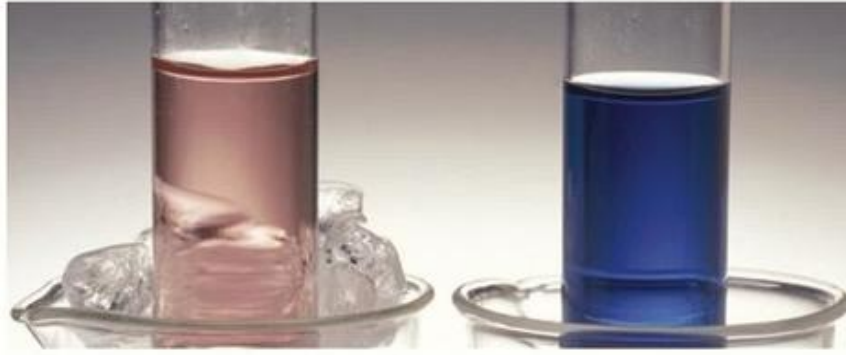
The equilibrium between two cobalt complexes provides a vivid demonstration of temperature effects. One complex is pink and the other is blue:
The forward reaction (pink to blue) is endothermic ( is positive), meaning it absorbs heat energy. The reverse reaction (blue to pink) is exothermic ( is negative), meaning it releases heat energy.
Example
Worked Example: The Cobalt Chloride Temperature Equilibrium
What happens when temperature increases:
When you place the pink cobalt solution in boiling water, you increase the heat energy of the system. According to Le Chatelier's principle:
- The system shifts to minimize the temperature increase by absorbing heat
- The equilibrium shifts to the right in the endothermic direction
- More blue complex forms
- The solution turns blue
What happens when temperature decreases:
When you transfer the boiling tube to iced water, you decrease the temperature. The system responds by:
- The system shifts to minimize the temperature decrease by releasing heat
- The equilibrium shifts to the left in the exothermic direction
- More pink complex forms
- The solution turns pink
Summary of temperature effects
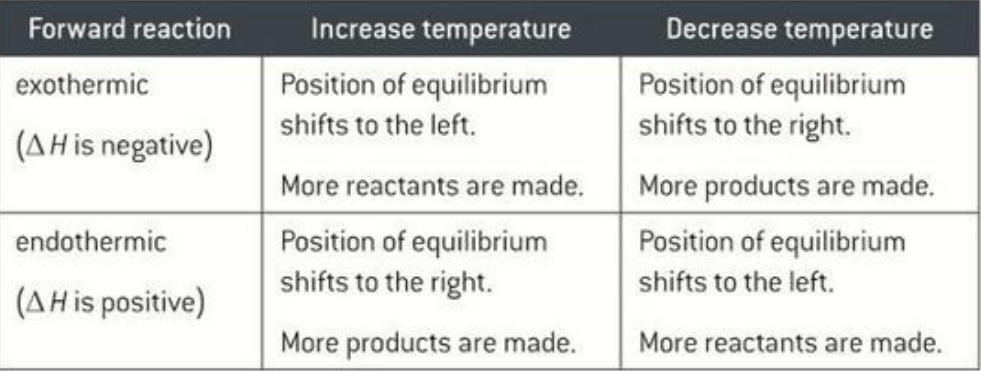
The table below summarizes how temperature changes affect equilibrium position for both exothermic and endothermic reactions:
Summary
Key Points to Remember about Temperature Effects:
-
For an exothermic forward reaction ( negative):
- Increasing temperature shifts equilibrium to the left (more reactants)
- Decreasing temperature shifts equilibrium to the right (more products)
-
For an endothermic forward reaction ( positive):
- Increasing temperature shifts equilibrium to the right (more products)
- Decreasing temperature shifts equilibrium to the left (more reactants)
Effect of pressure changes on equilibrium
Pressure changes only affect equilibrium systems that contain gases. Moreover, the equilibrium only shifts if there are different numbers of gaseous molecules on each side of the equation.
Understanding pressure and gas molecules
The pressure of a gas is directly proportional to its concentration. In the same container, having more moles of gas means higher concentration and higher pressure. Therefore, two moles of a gas would have twice the pressure of one mole of the same gas in the same container.
General principles for pressure effects
Note
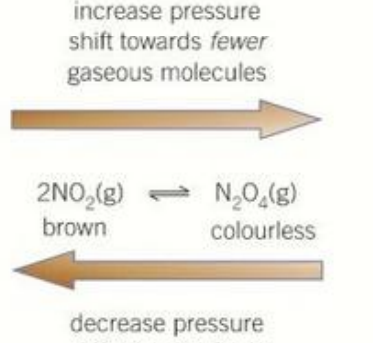
When pressure is increased, the equilibrium shifts to the side with fewer gaseous molecules to reduce the pressure.
When pressure is decreased, the equilibrium shifts to the side with more gaseous molecules.
The nitrogen dioxide-dinitrogen tetroxide equilibrium
Brown nitrogen dioxide gas () exists in equilibrium with colorless dinitrogen tetroxide ():
Note that there are:
- 2 moles of gas on the left (reactant side)
- 1 mole of gas on the right (product side)
Example
Worked Example: The Nitrogen Dioxide Pressure Equilibrium
What happens when pressure increases:
When you increase the pressure of this system:
- The system shifts to minimize the pressure increase
- The equilibrium moves toward the side with fewer gaseous molecules
- The equilibrium shifts to the right (toward )
- More colorless dinitrogen tetroxide forms
- The brown color fades
What happens when pressure decreases:
When you decrease the pressure:
- The system shifts to the side with more gaseous molecules
- The equilibrium shifts to the left (toward )
- More brown nitrogen dioxide forms
- The brown color deepens
Important
Pressure changes only affect equilibria where the total number of gas molecules differs between reactants and products. If there are equal numbers of gas molecules on both sides, changing pressure has no effect on the position of equilibrium.
Effect of catalysts on equilibrium
A catalyst is a substance that speeds up the rate of a chemical reaction without being used up in the process. For equilibrium systems, catalysts have a special characteristic:
Important
A catalyst does not change the position of equilibrium - it affects only the rate at which equilibrium is established.
How catalysts work in equilibrium systems
A catalyst speeds up both the forward and reverse reactions equally. This means:
- The same equilibrium position is reached
- The same final concentrations are obtained
- The same ratio of products to reactants exists at equilibrium
The only difference is that equilibrium is reached more quickly.
Why catalysts are useful
Even though catalysts don't change the position of equilibrium, they are extremely valuable in industrial processes. Reaching equilibrium faster means:
- Products are formed more quickly
- Manufacturing time is reduced
- Production rates increase
- Economic efficiency improves
Industrial application: the Haber process
The Haber process demonstrates how Le Chatelier's principle is applied in real industrial chemistry to manufacture ammonia efficiently and economically.
The Haber process equation
This reaction is exothermic in the forward direction - it releases energy when ammonia forms.
Applying Le Chatelier's principle
Using Le Chatelier's principle, we can predict the best conditions to maximize ammonia production:
Temperature considerations:
Since the forward reaction is exothermic, a low temperature would shift the equilibrium to the right (toward products), producing more ammonia. However, if the temperature is too low, the reaction rate becomes extremely slow, and equilibrium may never be reached.
Note
Compromise: Industrial plants typically use temperatures of 350-500°C - high enough to achieve a reasonable reaction rate but not so high that the equilibrium shifts too far back toward reactants.
Pressure considerations:
Looking at the equation, there are:
- 4 moles of gas on the left (1 N₂ + 3 H₂)
- 2 moles of gas on the right (2 NH₃)
A high pressure would shift the equilibrium to the right (toward fewer molecules), producing more ammonia. High pressure also increases concentration and reaction rate.
Note
Compromise: Industrial plants use pressures of 100-200 atmospheres - high enough to give good yields but not so high that the equipment becomes too expensive or dangerous.
Catalyst use:
An iron catalyst is used to speed up the reaction so that lower temperatures can be used. This reduces operating costs while still achieving economically viable production rates.
Recycling unreacted materials
Note
Only about 15% of the nitrogen and hydrogen is converted to ammonia in each pass through the reactor. However, unreacted nitrogen and hydrogen are recycled repeatedly, so nearly all of the reactants are eventually converted to ammonia. This makes the process economically efficient despite the relatively low conversion per pass.
Key points about the Haber process
Important
The Haber process illustrates that industrial conditions are often a compromise between:
- Maximum yield (what equilibrium position theory predicts)
- Adequate reaction rate (practical speed considerations)
- Economic factors (equipment costs, energy costs, safety)
Understanding Le Chatelier's principle allows chemists and engineers to optimize these competing factors and design efficient industrial processes.
Remember!
Summary
Key Concepts to Remember:
-
Dynamic equilibrium occurs when the forward and reverse reaction rates are equal, and concentrations remain constant in a closed system
-
Le Chatelier's principle: A system at equilibrium responds to external changes by shifting to minimize the effect of those changes
-
Concentration changes: Adding a substance shifts equilibrium away from it; removing a substance shifts equilibrium toward it
-
Temperature changes: Increasing temperature favors the endothermic direction; decreasing temperature favors the exothermic direction
-
Pressure changes: Only affect gaseous equilibria where molecule numbers differ - increasing pressure favors the side with fewer gas molecules
-
Catalysts speed up the rate of reaching equilibrium but do not change the equilibrium position
-
Industrial applications like the Haber process use compromise conditions to balance maximum yield with practical reaction rates and economic considerations