Reactivity Trends (OCR A-Level Chemistry A): Revision Notes
📚Revision Notes
Qualitative Analysis
What is qualitative analysis?
Qualitative analysis is a method used to identify substances based on observations rather than measurements. Unlike quantitative analysis (which uses titration and gives numerical results), qualitative analysis can be carried out quickly using simple test-tube scale experiments.
Note
The key difference between these two approaches:
- Qualitative analysis: Uses observations like colors, precipitates, and gas production to identify substances
- Quantitative analysis: Uses measurements and calculations to determine exact amounts or concentrations
The observations you make might include:
- Gas bubbles forming (effervescence)
- Precipitates appearing
- Colour changes
- Identifying gases produced
This makes qualitative analysis particularly useful for identifying unknown compounds in the laboratory.
Tests for anions
Carbonate test (testing for CO₃²⁻ ions)
Carbonates react with acids to produce carbon dioxide gas. This gas production forms the basis of the test for carbonate ions.
Procedure:
- Add dilute nitric acid (HNO₃) to the solid or solution being tested
- If bubbles appear, the unknown compound could be a carbonate
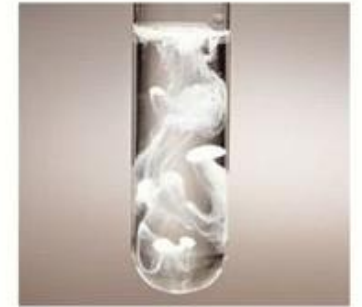
- To confirm the gas is carbon dioxide, bubble it through lime water (a saturated aqueous solution of calcium hydroxide, Ca(OH)₂)
- If carbon dioxide is present, the lime water turns cloudy or milky white
Note
What is lime water?
Lime water is a saturated aqueous solution of calcium hydroxide, Ca(OH)₂. When carbon dioxide is bubbled through it, the calcium hydroxide reacts to form calcium carbonate, which is insoluble and appears as a white cloudiness. This is one of the most reliable tests for carbon dioxide gas.
Chemical equations:
The reaction with dilute nitric acid:
The confirmation test with lime water:
The cloudiness forms because calcium carbonate is a fine white precipitate that makes the lime water appear milky.
Note
All carbonates react with acids in a similar way, so this test works for any carbonate compound - whether it's sodium carbonate, potassium carbonate, or calcium carbonate.
Sulfate test (testing for SO₄²⁻ ions)
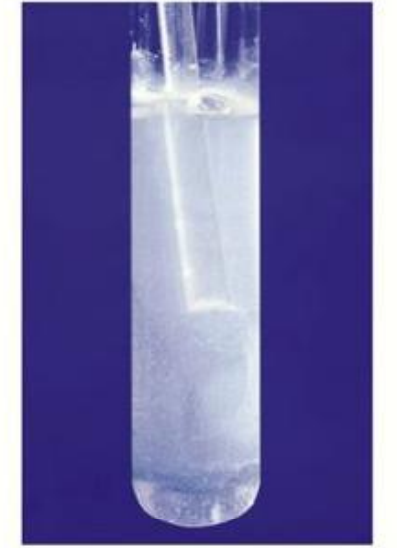
Most sulfates dissolve in water, but barium sulfate (BaSO₄) is very insoluble. The formation of a white precipitate of barium sulfate forms the basis of this test.
Procedure:
- Add aqueous barium ions (Ba²⁺) to the solution being tested
- The barium ions are usually added as either barium chloride (BaCl₂) or barium nitrate (Ba(NO₃)₂)
- If sulfate ions are present, a white precipitate of barium sulfate forms
- The precipitate is very dense and sinks to the bottom of the test tube
Chemical equation:
The ionic equation for the test:
Important
Choosing the right reagent:
- If you plan to test for halide ions afterwards, use barium nitrate, Ba(NO₃)₂
- Do not use barium chloride, BaCl₂, because you would be introducing chloride ions to your solution, which would give a false positive result in the halide test
This is a common source of errors in practical work - always think ahead about which tests you'll perform next!
Halide tests (testing for Cl⁻, Br⁻, and I⁻ ions)
Most halides are soluble in water, but silver halides are insoluble. Aqueous silver ions react with halide ions to form precipitates of different colours.
Procedure:
- Add aqueous silver nitrate (AgNO₃) to the solution being tested
- If halide ions are present, a precipitate forms
- The colour of the precipitate indicates which halide is present:
- Silver chloride (AgCl) is white
- Silver bromide (AgBr) is cream
- Silver iodide (AgI) is yellow
- Add aqueous ammonia to test the solubility of the precipitate (this helps distinguish between the three halides as their colours can be difficult to tell apart)
Chemical equations:
General equation (where X⁻ represents any halide):
Specific equations for each halide:
Solubility in ammonia:
The three silver halide precipitates have different solubilities in ammonia, which helps confirm which halide you have:

| Halide | Ionic equation | Colour of precipitate | Solubility in NH₃(aq) |
|---|---|---|---|
| Chloride, Cl⁻ | Ag⁺(aq) + Cl⁻(aq) → AgCl(s) | white | soluble in dilute NH₃(aq) |
| Bromide, Br⁻ | Ag⁺(aq) + Br⁻(aq) → AgBr(s) | cream | soluble in conc. NH₃(aq) |
| Iodide, I⁻ | Ag⁺(aq) + I⁻(aq) → AgI(s) | yellow | insoluble in conc. NH₃(aq) |
Note
Why is the ammonia test important?
The ammonia solubility test is particularly useful because the three precipitate colours can be difficult to distinguish, especially between white and cream. By testing solubility in ammonia, you get a clear, definitive result:
- AgCl dissolves in dilute ammonia
- AgBr only dissolves in concentrated ammonia
- AgI doesn't dissolve even in concentrated ammonia
Sequence of tests - why order matters
When analysing an unknown inorganic compound, you must carry out the anion tests in the correct order. Otherwise, you could get confusing results or make an incorrect identification.
Important
The correct test order is crucial:
- Carbonate (CO₃²⁻)
- Sulfate (SO₄²⁻)
- Halides (Cl⁻, Br⁻, I⁻)
Testing in any other order will lead to false positive results and incorrect identification of your compound!
Let's understand why this order is essential:
Why test for carbonate first
When you add dilute acid in the carbonate test, you look for bubbles from carbon dioxide gas. Neither sulfate ions nor halide ions produce bubbles with dilute acid. This means:
- The carbonate test can be carried out without the possibility of an incorrect result
- If the test shows no bubbles, there is no carbonate present and you can safely proceed to the next test
- You have not added any reagents that might interfere with later tests
Why test for sulfate second
In the sulfate test, you add Ba²⁺ ions and look for a white precipitate of barium sulfate (BaSO₄).
However, barium carbonate (BaCO₃) is also white and insoluble in water. If you carry out the sulfate test on a carbonate, you will get a white precipitate even though no sulfate is present. This is a false positive result.
Example
Example: What happens if you test sulfate before carbonate
Imagine you have a sample containing carbonate ions (CO₃²⁻) but no sulfate ions.
If you add Ba²⁺ ions first:
- Ba²⁺(aq) + CO₃²⁻(aq) → BaCO₃(s)
- You see a white precipitate
- You incorrectly conclude sulfate ions are present!
This is why you must test for carbonate first and remove any carbonate ions before testing for sulfate.
Therefore, it is important to:
- Carry out the carbonate test first
- Only proceed to the sulfate test when you know that no carbonate is present
Why test for halides last
In the halide test, you add Ag⁺ ions (as AgNO₃) and look for a precipitate.
Both silver carbonate (Ag₂CO₃) and silver sulfate (Ag₂SO₄) are insoluble in water. They would form precipitates in this test even though no halide ions are present.
Therefore, it is important to:
- Carry out the carbonate and sulfate tests first
- Only proceed to the halide test after ruling out carbonate and sulfate ions
Testing mixtures of ions
If you need to analyse a mixture containing multiple ions, you carry out the tests in the same sequence, but on the same solution:
1. Carbonate test:
- Add dilute nitric acid (HNO₃) and continue adding until the bubbling stops
- All carbonate ions will have been removed and there will be none left to interfere with the next tests
Important
Why use dilute nitric acid?
Use dilute nitric acid (HNO₃) for this test, not sulfuric acid or hydrochloric acid:
- Sulfuric acid contains sulfate ions (SO₄²⁻) which would show up in the sulfate test
- Hydrochloric acid contains chloride ions (Cl⁻) which would show up in the halide test
Nitric acid doesn't contain any anions that we're testing for, making it the safe choice!
2. Sulfate test:
- To the solution left from the carbonate test, add excess barium nitrate, Ba(NO₃)₂
- Any sulfate ions present will precipitate as barium sulfate
- Filter the solution to remove the barium sulfate precipitate
Note
Use barium nitrate, not barium chloride, because chloride ions would interfere with the halide test.
3. Halide test:
- To the solution left from the sulfate test, add silver nitrate (AgNO₃)
- Any carbonate or sulfate ions initially present have already been removed
- Therefore, any precipitate formed must be due to halide ions
- Add NH₃(aq) to confirm which halide you have
Tests for cations
Ammonium ion test (testing for NH₄⁺)
When heated together, ammonium ions (NH₄⁺) and hydroxide ions (OH⁻) react to produce ammonia gas (NH₃).
Procedure:
- Add aqueous sodium hydroxide (NaOH) to a solution containing the ammonium ion
- Warm the mixture by gently heating
- Ammonia gas is produced (you are unlikely to see bubbles as ammonia is very soluble in water)
- You may be able to smell the ammonia, which has a distinctive sharp odour
- To confirm the gas is ammonia, test it with moist pH indicator paper
- Ammonia is alkaline, so its presence will turn the paper blue
Chemical equation:
Note
Safety note: The mixture must be warmed to release the ammonia gas effectively, but be careful not to overheat as ammonia is a toxic gas. Always work in a well-ventilated area or use a fume cupboard.
Practical applications - barium meals
Qualitative analysis isn't just used in chemistry laboratories. One important medical application uses the precipitation reaction of barium sulfate.
Note
Real-world application: Medical imaging
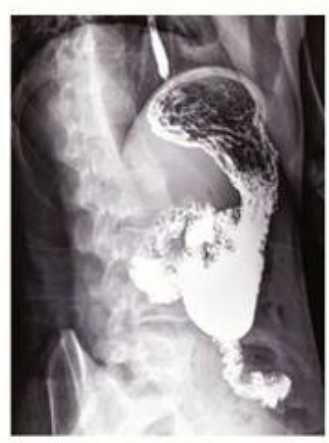
Barium meals are used to help doctors see the outline of the digestive system on X-ray images. The process works as follows:
- The patient swallows water that has been shaken with barium sulfate
- Barium sulfate is the insoluble white precipitate that forms during the sulfate test
- The white precipitate coats the inner lining of the digestive tract
- An X-ray image is then taken
- The barium sulfate shows up white in the X-ray, displaying the shape of the oesophagus, stomach, and upper small intestine
- This allows doctors to identify abnormalities such as ulcers or tumours
Important
Why is barium sulfate safe for medical use?
Barium ions (Ba²⁺) in solution are extremely toxic. However, patients are not poisoned by this treatment because barium sulfate is completely insoluble in water. The Ba²⁺ ions remain locked in the solid compound and cannot be absorbed by the body.
This is a perfect example of how chemical properties determine safety - the same barium that would be deadly as soluble barium chloride is completely safe as insoluble barium sulfate!
Common exam mistakes
Important
Avoid these common errors:
Mistake 1: Not stating which reagent is used
- Always specify the complete reagent name (e.g., "dilute nitric acid", not just "acid")
Mistake 2: Confusing the test order
- Remember: Carbonate → Sulfate → Halide (never test in a different sequence)
Mistake 3: Using the wrong acid for the carbonate test when testing mixtures
- Must use dilute nitric acid (HNO₃)
- Sulfuric acid contains SO₄²⁻ ions
- Hydrochloric acid contains Cl⁻ ions
Mistake 4: Using barium chloride before testing for halides
- Use barium nitrate, Ba(NO₃)₂, to avoid introducing Cl⁻ ions
Mistake 5: Not describing the ammonia solubility test fully
- State whether you use dilute or concentrated ammonia
- State whether the precipitate dissolves or remains
Key takeaways
Summary
Essential points to remember:
-
Qualitative analysis uses observations (colours, bubbles, precipitates) rather than measurements to identify substances
-
Test sequence is crucial: Always test in the order: carbonate → sulfate → halide, to avoid false positive results
-
Carbonate test: Add dilute nitric acid, look for bubbles, confirm with lime water (turns milky)
-
Sulfate test: Add Ba(NO₃)₂, look for white precipitate of BaSO₄
-
Halide test: Add AgNO₃, look for coloured precipitates:
- AgCl is white (soluble in dilute NH₃)
- AgBr is cream (soluble in concentrated NH₃)
- AgI is yellow (insoluble in concentrated NH₃)
-
Ammonium test: Add NaOH and warm, ammonia gas produced turns moist pH paper blue
-
For mixtures: Use the same solution throughout, removing ions at each stage (carbonate removed by excess acid, sulfate removed by filtration)
-
Reagent choice matters: Use nitric acid (not sulfuric or hydrochloric) and barium nitrate (not barium chloride) when testing mixtures to avoid introducing interfering ions