Group 2 (OCR A-Level Chemistry A): Revision Notes
📚Revision Notes
Group 2
Introduction to Group 2 elements
Group 2 elements, also known as alkaline earth metals, are reactive metals located in the second column of the periodic table. This name derives from the alkaline nature of their metal hydroxides. These elements include beryllium (Be), magnesium (Mg), calcium (Ca), strontium (Sr), barium (Ba), and radium (Ra).
Note
Unlike many other metals, Group 2 elements do not occur freely in nature due to their high reactivity. Instead, they exist in stable ionic compounds, such as calcium carbonate (), which is commonly found in limestone and chalk.
All Group 2 elements share similar chemical properties because they have the same number of electrons in their outer shell. This outer shell configuration determines how these elements react with other substances and explains the predictable patterns we observe in their chemistry.
Electron configuration and structure
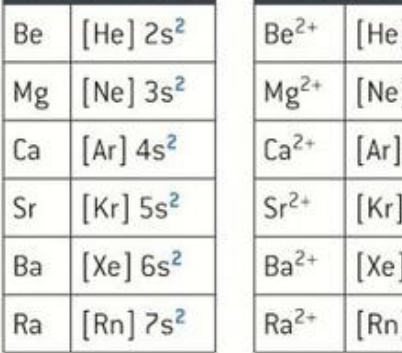
Each Group 2 element possesses two electrons in its outermost s-subshell. These valence electrons are crucial for understanding the chemical behaviour of these elements. The electron configuration follows a pattern where each element has two more electrons than a noble gas configuration.
Important
When Group 2 atoms react, they lose both outer shell electrons to achieve a stable noble gas electron configuration. This loss of two electrons is energetically favourable and explains why Group 2 elements always form +2 ions in their compounds.
For example, calcium has the electron configuration in its atomic state, but forms ions with the configuration , matching the stable configuration of argon.
Redox reactions and reducing agents
Group 2 elements are classified as reducing agents because they readily donate electrons to other species during chemical reactions. In redox (reduction-oxidation) reactions, the Group 2 metal atom undergoes oxidation by losing two electrons, while another species gains these electrons and is reduced. This electron transfer is the fundamental characteristic of all redox processes.
Note
The term "reducing agent" means that the Group 2 element causes another substance to be reduced (gain electrons) while itself being oxidised (losing electrons). This behaviour makes Group 2 elements valuable in various chemical applications where electron donation is required.
Reactions with oxygen
All Group 2 elements react with oxygen to form metal oxides with the general formula , where M represents the Group 2 metal. These oxides consist of metal cations and oxide anions held together by strong ionic bonding.
A common laboratory demonstration involves burning magnesium in air. The reaction produces an intensely bright white light and forms white magnesium oxide powder:

Example
Worked Example: Oxidation States in Magnesium-Oxygen Reaction
In the reaction :
Step 1: Identify oxidation state changes
- Each magnesium atom: 0 to +2 (oxidation - loss of electrons)
- Each oxygen atom: 0 to -2 (reduction - gain of electrons)
Step 2: Check that oxidation numbers balance
- Two magnesium atoms increase by +2 each = total +4
- Two oxygen atoms decrease by -2 each = total -4
- Net change: 0 ✓
Reactions with water
Group 2 elements react with water to produce an alkaline metal hydroxide and hydrogen gas. The general equation for this reaction is:
For example, strontium reacts with water as follows:
Note
The reactivity of these metals with water increases significantly as you move down the group:
- Magnesium: Reacts very slowly with cold water, producing only small amounts of hydrogen gas over an extended period
- Calcium: Reacts more vigorously, producing steady bubbles of hydrogen and forming a cloudy suspension of calcium hydroxide
- Strontium and Barium: Reactions become increasingly vigorous and rapid
In the reaction with water, the Group 2 metal is oxidised from 0 to +2, while hydrogen in water (oxidation state +1) is partially reduced to hydrogen gas (oxidation state 0). Note that not all hydrogen atoms are reduced - those in the hydroxide ions () remain with an oxidation state of +1.
Reactions with dilute acids
All Group 2 elements undergo redox reactions with dilute acids, forming a salt and releasing hydrogen gas. The general equation is:
For instance, magnesium reacts with dilute hydrochloric acid:
The magnesium is oxidised from 0 to +2, while hydrogen ions in the acid (oxidation state +1) are reduced to hydrogen gas (oxidation state 0). The vigour of these reactions also increases down the group, following the same trend as reactions with water.
Trends in reactivity and ionisation energy
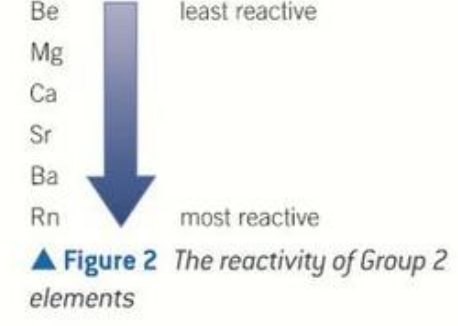
The reactivity of Group 2 elements increases progressively down the group, with beryllium being the least reactive and radium the most reactive. This trend can be explained by examining the ionisation energies required to form the +2 ions.
When Group 2 atoms react, they must lose two electrons to form +2 ions. This process requires energy input in two stages:
First ionisation energy:
Second ionisation energy:
Important
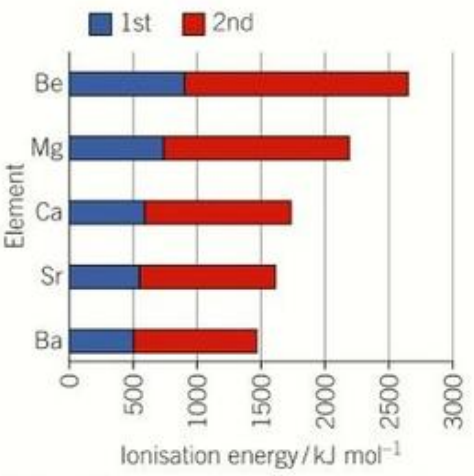
Both the first and second ionisation energies decrease as you descend the group. This decrease occurs due to two main factors working together:
-
Increasing atomic radius: Additional electron shells are added down the group. The outer electrons are therefore located further from the nucleus, experiencing weaker electrostatic attraction.
-
Greater electron shielding: The increased number of inner electron shells provides greater shielding, which further reduces the effective nuclear charge experienced by the outer electrons.
As ionisation energies decrease, less energy is required to remove the outer electrons and form +2 ions. Consequently, the Group 2 elements become more reactive down the group, reacting more readily and vigorously with oxygen, water, and acids. Although other energy changes occur during reactions (such as lattice formation and hydration), the ionisation energies constitute the largest energy input and therefore largely determine the reactivity trend.
Reactions of Group 2 compounds
Group 2 oxides with water
The oxides of Group 2 elements react readily with water to release hydroxide ions () and form alkaline solutions. The general reaction produces an aqueous solution of the metal hydroxide:
For example, calcium oxide reacts with water:
These solutions are alkaline due to the presence of hydroxide ions. However, Group 2 hydroxides have limited solubility in water. When the solution becomes saturated (contains the maximum possible concentration of dissolved hydroxide), any additional metal and hydroxide ions will precipitate as a solid:
Solubility and alkalinity of hydroxides
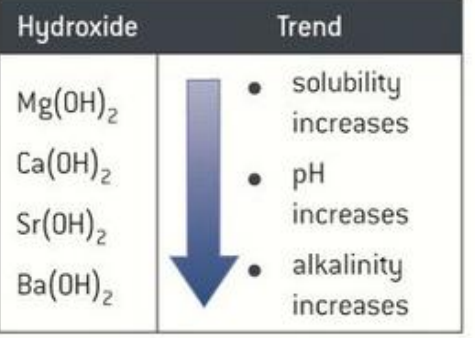
The solubility of Group 2 hydroxides increases down the group. This trend has important consequences for the alkalinity of the resulting solutions.
Note
Solubility and pH Trend:
- Magnesium hydroxide (): Very limited solubility, weakly alkaline solution with pH ~10
- Barium hydroxide (): Considerably more soluble, strongly alkaline solution with pH ~13
This trend can be demonstrated through a simple experiment. When a spatula of each Group 2 oxide is added to separate test tubes of water and shaken, the mixture produces saturated solutions of the metal hydroxides with undissolved solid settling at the bottom. Measuring the pH of each solution reveals that alkalinity increases down the group, reflecting the increasing solubility of the hydroxides.
As solubility increases down the group, the solutions contain progressively higher concentrations of hydroxide ions, making them more alkaline and giving them stronger base properties.
Uses of Group 2 compounds
Group 2 compounds in agriculture
Calcium hydroxide (), commonly known as slaked lime, plays a vital role in agriculture. Farmers spread powdered lime on their fields to neutralise acidic soils and raise the pH to levels suitable for crop growth.

Acidic soils contain excess hydrogen ions () that can inhibit plant growth and reduce crop yields. Calcium hydroxide acts as a base, neutralising these acidic conditions through the following reaction:
Note
The calcium hydroxide reacts with hydrogen ions to produce neutral water molecules, effectively reducing soil acidity. This neutralisation process creates better growing conditions, allowing crops to access nutrients more effectively and improving overall agricultural productivity.
Group 2 compounds in medicine
Group 2 bases are widely used as antacids to treat acid indigestion and heartburn. These conditions occur when excess hydrochloric acid in the stomach causes discomfort. Many over-the-counter indigestion remedies contain magnesium or calcium carbonates as their active ingredients.
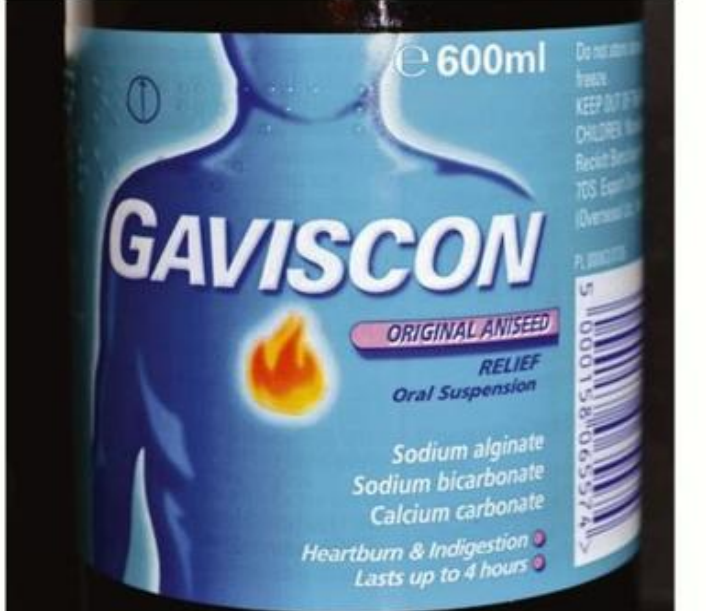
For example, some products contain magnesium hydroxide () as a suspension in water, often called "milk of magnesia". Although magnesium hydroxide has very low solubility, the small amount that does dissolve is sufficient to neutralise stomach acid effectively.
The neutralisation reactions that occur are:
Note
These reactions convert the hydrochloric acid in the stomach into neutral products - water and soluble salts. The calcium carbonate reaction also produces carbon dioxide gas, which may cause belching but indicates successful neutralisation of the acid.
Summary
Key Points to Remember:
-
Group 2 elements all have two electrons in their outer s-subshell and form +2 ions by losing both electrons to achieve noble gas configurations
-
These elements are reducing agents because they donate electrons to other species, causing reduction while being oxidised themselves
-
Reactivity increases down Group 2 (Be < Mg < Ca < Sr < Ba < Ra) because ionisation energies decrease due to increasing atomic radius and electron shielding
-
Group 2 metals react with:
- Oxygen to form oxides (MO)
- Water to form hydroxides and hydrogen ()
- Acids to form salts and hydrogen
-
The solubility and alkalinity of Group 2 hydroxides increase down the group, with being sparingly soluble (pH ~10) and being much more soluble (pH ~13)
-
Practical applications:
- Agriculture: Calcium hydroxide neutralises acidic soils
- Medicine: Magnesium and calcium carbonates are used as antacids to treat indigestion by neutralising stomach acid