The Halogens (OCR A-Level Chemistry A): Revision Notes
📚Revision Notes
The Halogens
Introduction to the halogen group
The halogens form Group 17 (also known as Group 7) of the periodic table and represent the most reactive group of non-metallic elements. These elements do not exist naturally in their pure elemental form. Instead, they are found on Earth as stable halide ions (, , and ) dissolved in seawater or present in solid mineral deposits such as sodium chloride (common salt, NaCl) found in salt mines.
Note
Halogens never occur freely in nature due to their extremely high reactivity. They are always found combined with other elements, most commonly as halide ions in mineral deposits or dissolved in seawater.
Physical properties of the halogens
Physical states at room temperature and pressure
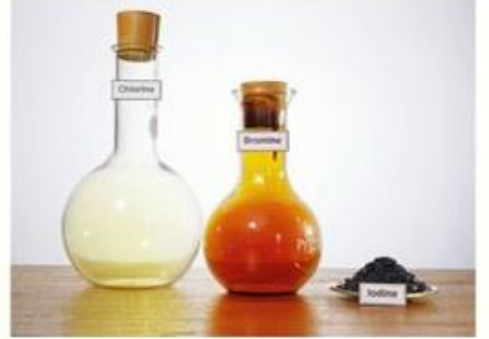
At room temperature and pressure (RTP), the halogens exist as diatomic molecules with the general formula , where X represents any halogen element. The group demonstrates all three states of matter at RTP:
- Fluorine (): Pale yellow gas
- Chlorine (): Pale green gas
- Bromine (): Red-brown liquid (readily vaporises at room temperature)
- Iodine (): Shiny grey-black solid
- Astatine (): Never been observed (radioactive with extremely short half-life)
Trend in boiling points
The boiling points of the halogens increase progressively down the group. This trend can be understood by examining the relationship between molecular size and intermolecular forces.
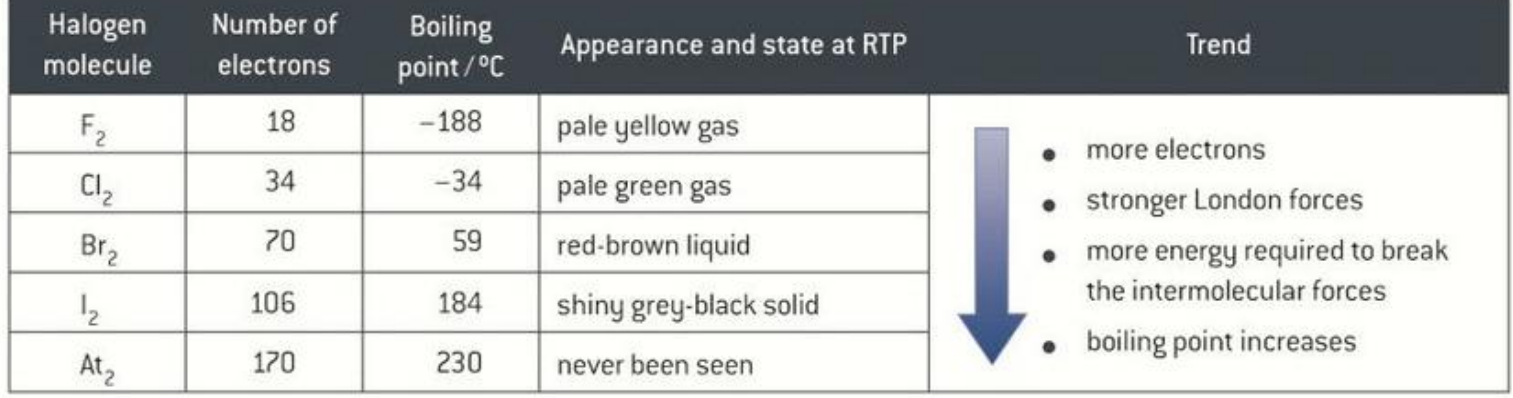
| Halogen molecule | Number of electrons | Boiling point / °C | Appearance at RTP |
|---|---|---|---|
| 18 | -188 | Pale yellow gas | |
| 34 | -34 | Pale green gas | |
| 70 | 59 | Red-brown liquid | |
| 106 | 184 | Shiny grey-black solid | |
| 170 | 230 | Never been seen |
Explanation of the trend:
As you move down the halogen group, several changes occur:
- The number of electrons in each molecule increases
- This results in stronger London dispersion forces (temporary induced dipole-dipole interactions) between molecules
- Greater energy is required to overcome these stronger intermolecular forces
- Therefore, the boiling point increases
Important
During boiling, the covalent bonds within each molecule are NOT broken - only the weak intermolecular forces between separate molecules are overcome. This is a crucial distinction between intramolecular and intermolecular forces.
Redox chemistry of the halogens
Electron configuration of halogens and halides
Each halogen atom contains seven electrons in its outer shell, with the general electron configuration ending in (where n represents the principal quantum number). This means halogens are one electron short of achieving the stable electron configuration of a noble gas.
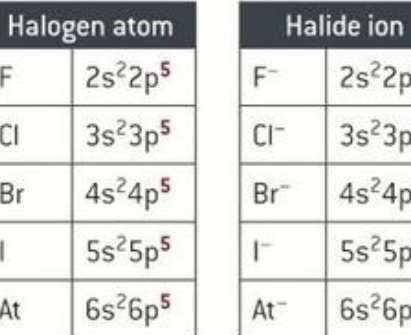
During chemical reactions, halogen atoms readily gain one electron to form halide ions with a negative charge. The electron configuration of these ions ends in , which corresponds to a complete outer shell with the stable electronic structure of the nearest noble gas.
Example
Example: Electron Configurations of Chlorine and Bromide
| Halogen atom | Halide ion |
|---|---|
| Cl: | : or |
| Br: | : or |
Notice how the halide ion achieves the same electron configuration as the nearest noble gas.
Halogens as oxidising agents
Redox reactions represent the most common type of chemical reaction for halogens. In these reactions, each halogen atom undergoes reduction by gaining one electron to form a halide ion ().
The general half-equation for this process is:
For chlorine specifically:
In this reaction, chlorine is reduced (gains electrons). Since the halogen causes another species to lose electrons (become oxidised), the halogen acts as an oxidising agent.
Halogen-halide displacement reactions
Experimental procedure and observations
Displacement reactions between halogens and halide ions can be performed on a test-tube scale to investigate the relative reactivity of different halogens. In these experiments:
- A solution of each halogen is added to aqueous solutions containing different halide ions
- If the halogen added is more reactive than the halide present in solution, a reaction occurs
- The halogen displaces the halide from solution, with observable colour changes
Note
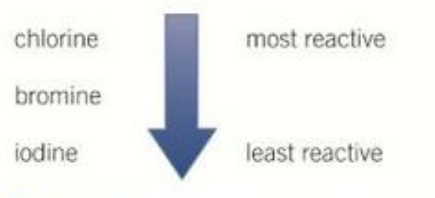
The results demonstrate that halogen reactivity decreases down the group. This is the opposite trend to the boiling points, which increase down the group.
Colour of halogen solutions
The appearance of halogens differs depending on the solvent used:
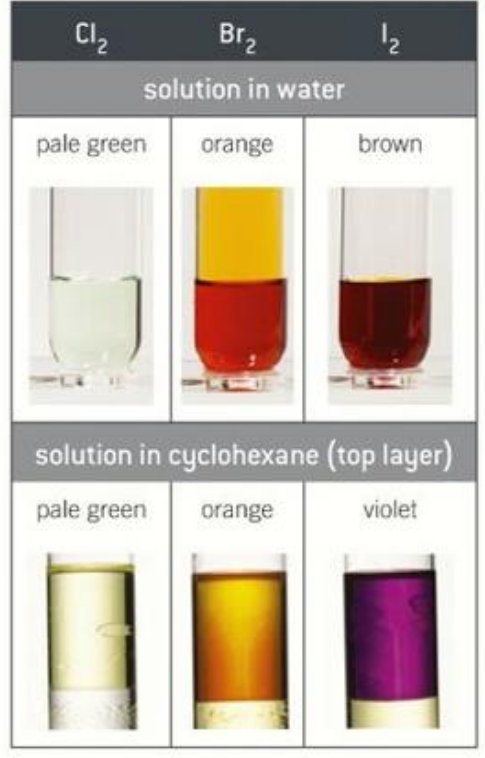
In water:
- : Pale green solution
- : Orange solution
- : Brown solution
In cyclohexane (non-polar organic solvent):
- : Pale green solution
- : Orange solution
- : Violet solution
The non-polar halogens dissolve more readily in cyclohexane than in water, making the colours more distinct and easier to distinguish - particularly the deep violet colour of iodine.
Displacement reaction results
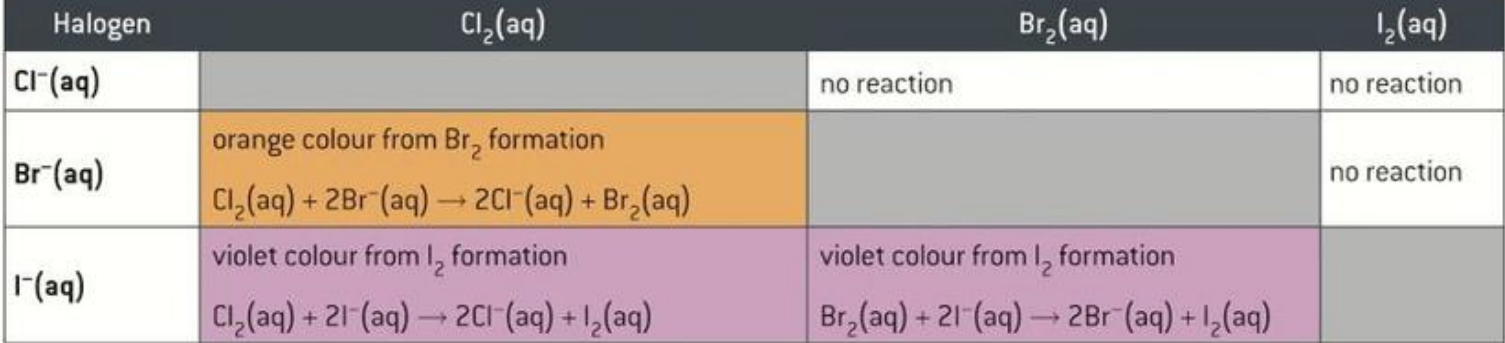
The table below summarises the displacement reactions between aqueous halogen solutions and halide ions:
| Halide ion | With | With | With |
|---|---|---|---|
| No reaction | No reaction | No reaction | |
| Orange colour from formation | No reaction | No reaction | |
| Violet colour from formation | Violet colour from formation | No reaction |
Key observations:
- Chlorine reacts with both bromide and iodide ions (displaces both)
- Bromine reacts only with iodide ions (displaces only iodine)
- Iodine does not react with any halide ions (cannot displace anything)
This establishes the reactivity order:
Understanding displacement reactions as redox processes
Displacement reactions are redox reactions where the halogen is reduced and the halide ion is oxidised.
Example
Example: Reaction of chlorine with sodium bromide
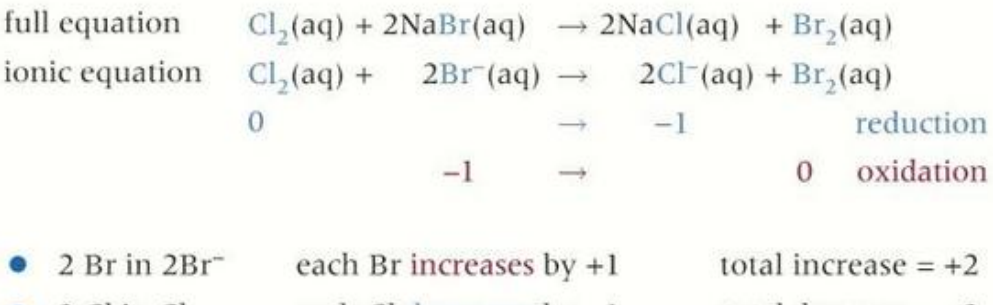
Full equation:
Ionic equation (removing spectator ions):
Oxidation state analysis:
-
Chlorine: oxidation state changes from 0 (in ) to -1 (in )
- Oxidation state decreases → reduction
- Chlorine gains electrons
-
Bromide: oxidation state changes from -1 (in ) to 0 (in )
- Oxidation state increases → oxidation
- Bromide loses electrons
Fluorine and astatine
Fluorine is a pale yellow gas that reacts vigorously with almost any substance it contacts, making it the most reactive halogen. Due to its extreme reactivity, fluorine is rarely encountered in displacement reactions at A-Level.
Astatine is extremely rare because it is radioactive and decays rapidly. The element has never been observed directly and is predicted to be the least reactive halogen based on group trends.
Trend in reactivity of the halogens
In redox reactions, halogens act by gaining electrons. The reactivity trend shows that the tendency to gain electrons decreases down the group, making the halogens progressively less reactive.
Factors affecting the reactivity trend:
| Halogen | Number of inner electron shells | Trend |
|---|---|---|
| 1 | Atomic radius increases | |
| 2 | More inner shells provide greater shielding | |
| 3 | Reduced nuclear attraction to capture an electron | |
| 4 | Reactivity decreases | |
| 5 |
Explanation:
As you descend the halogen group:
- Atomic radius increases - the outer electrons are further from the nucleus
- Number of inner electron shells increases - causing greater shielding of the nuclear charge
- Nuclear attraction decreases - the nucleus experiences reduced ability to attract and capture an additional electron from another species
- Reactivity as an oxidising agent decreases - it becomes progressively more difficult for the halogen to gain an electron
Important
Fluorine acts as the strongest oxidising agent (most readily gains electrons), while the halogens become weaker oxidising agents down the group. This trend is directly related to how easily each halogen can attract and gain an electron - the smaller the atom and the fewer the shielding electron shells, the stronger the oxidising ability.
Disproportionation reactions
What is disproportionation?
Disproportionation is a specific type of redox reaction in which the same element is simultaneously both oxidised and reduced. Chlorine undergoes disproportionation when it reacts with water and with cold, dilute sodium hydroxide solution.
Reaction of chlorine with water
When small amounts of chlorine are added to water, a disproportionation reaction occurs:

Example
Example: Oxidation State Analysis in Chlorine Disproportionation
In the reaction above:
- One chlorine atom: 0 → -1 (reduction)
- Other chlorine atom: 0 → +1 (oxidation)
The same element (chlorine) undergoes both processes simultaneously in a single reaction.
The two products formed are both acids:
- Chloric(I) acid (hypochlorous acid, HClO)
- Hydrochloric acid (HCl)
Note
The bacteria-killing properties of chlorinated water arise primarily from chloric(I) acid and chlorate(I) ions (), rather than from chlorine itself. Chloric(I) acid also acts as a weak bleaching agent.
You can demonstrate this bleaching action by adding an indicator solution to chlorinated water. The indicator initially turns red due to the presence of the two acids. The colour then disappears as the bleaching action of chloric(I) acid takes effect.
Reaction of chlorine with cold, dilute sodium hydroxide
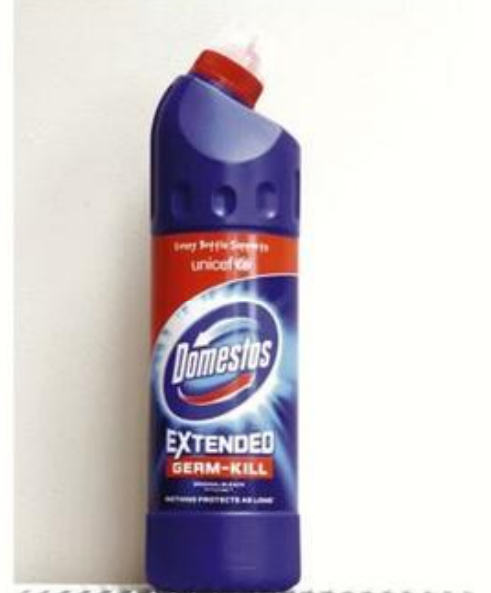
The reaction of chlorine with water has limited use because chlorine has low solubility in water. When the water contains dissolved sodium hydroxide, much more chlorine dissolves and another disproportionation reaction occurs:
Example
Example: Oxidation State Analysis in Alkaline Disproportionation
In the reaction with sodium hydroxide:
- One chlorine atom: 0 → -1 (reduction)
- Other chlorine atom: 0 → +1 (oxidation)
Again, chlorine is simultaneously oxidised and reduced, confirming this is a disproportionation reaction.
The resulting solution contains a high concentration of chlorate(I) ions () from the sodium chlorate(I) (sodium hypochlorite, NaClO) that forms. This solution serves as household bleach, which is manufactured by reacting chlorine with cold dilute aqueous sodium hydroxide.
Uses of chlorine in water purification and bleach
Chlorine in water treatment
Chlorine began to be used widely as a disinfectant for drinking water treatment over 100 years ago, revolutionising public health by dramatically reducing the incidence of waterborne diseases caused by harmful bacteria.
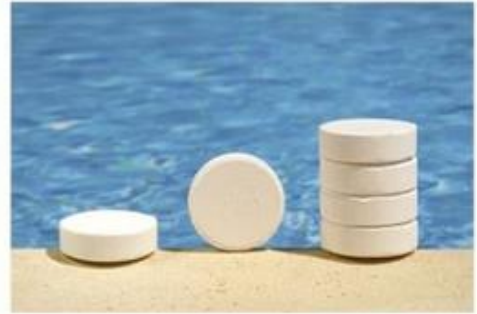
In water treatment facilities and swimming pools, chlorine is added to water in controlled amounts where it undergoes the disproportionation reaction described above. Chlorine tablets are often used in swimming pools and can be employed to purify water supplies following natural disasters.
Benefits and risks of chlorine use
Benefits:
- Ensures drinking water is safe to consume
- Kills harmful bacteria effectively
- Prevents diseases such as typhoid and cholera
- Essential for emergency water treatment after natural disasters
Risks:
- Chlorine is an extremely toxic gas
- Acts as a respiratory irritant even in small concentrations
- Large concentrations can be fatal
- Can react with organic hydrocarbons (such as methane from decaying vegetation) to form chlorinated hydrocarbons, which are suspected carcinogens
Important
Risk Assessment:
While there are risks associated with adding chlorine to drinking water, the overall health risk of not adding chlorine to the water supply is far greater. Without chlorine treatment, water quality would be compromised and serious diseases like typhoid and cholera might break out.
Before implementing any safeguard against potential risks, we must also consider why chlorine is added to drinking water in the first place - the life-saving benefits far outweigh the minimal risks. After a natural disaster, one of the most critical early tasks is ensuring survivors have access to a safe water supply, highlighting the essential role of chlorine in water treatment.
Tests for halide ions
Precipitation reactions with aqueous silver ions
Aqueous halide ions react with aqueous silver ions to form precipitates of silver halides. The general equation is:
where represents any halide ion in aqueous solution.
Note
This reaction forms the basis for a test to identify the presence of halide ions in solution. The detailed procedure and observations for halide tests are covered in qualitative analysis sections of your course.
Halide ions as reducing agents
In displacement reactions between halogens and halide ions, the halogen gains electrons (is reduced) while the halide ion loses electrons (is oxidised). Therefore, halide ions act as reducing agents in these reactions.
The reducing ability of halide ions can be demonstrated through their reactions with sulfuric acid (), which is a strong oxidising agent.
Chloride ions are not powerful enough to reduce sulfuric acid.
Bromide ions are more powerful reducing agents and can reduce sulfuric acid to sulfur dioxide ():
Notice that both the atoms and the charges balance in this equation.
Iodide ions are even more powerful reducing agents. They reduce the sulfur dioxide formed initially to sulfur (S), which is then reduced further to hydrogen sulfide ().
Important
The reducing power of halide ions increases down the group, which is the opposite trend to the oxidising power of the halogens. This inverse relationship is crucial to understand:
- Halogens: Oxidising power decreases down the group (F₂ > Cl₂ > Br₂ > I₂)
- Halides: Reducing power increases down the group (I⁻ > Br⁻ > Cl⁻ > F⁻)
Summary
Key Points to Remember:
-
Physical trend: Halogen boiling points increase down the group due to stronger London forces arising from more electrons in larger molecules.
-
Reactivity: Halogens become less reactive (weaker oxidising agents) down the group because larger atomic radius and increased shielding make it harder to attract and gain an electron.
-
Displacement reactions: A more reactive halogen will displace a less reactive halide from solution in a redox reaction (e.g., displaces and ; displaces only ).
-
Disproportionation: Chlorine undergoes simultaneous oxidation and reduction when reacting with water or dilute alkali, forming products with chlorine in different oxidation states (-1 and +1).
-
Chlorine uses: Despite being toxic, chlorine is essential for water purification and bleach production. The benefits of preventing waterborne diseases far outweigh the minimal health risks when used properly.