Japanese expansion in China (OCR A-Level History A): Revision Notes
📚Revision Notes
Japanese expansion in China
Second Sino-Japanese War
In 1931, the Japanese Imperial Army invaded Manchuria, the northern region of China where 300,000 people were massacred.
Since Chiang Kai-shek was focused on exterminating the communists, he was detained by subordinates Generals Zhang Xueliang and Yang Hucheng in Xian in 1936. The objective was for him to change Kuomintang policy regarding the Japanese threat. After a two-week negotiation, he was released and returned to Nanjing agreeing to end its war with the communists and focus instead on the Japanese occupation.
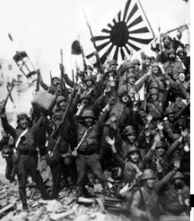
Japanese troops during the Second Sino-Japanese War
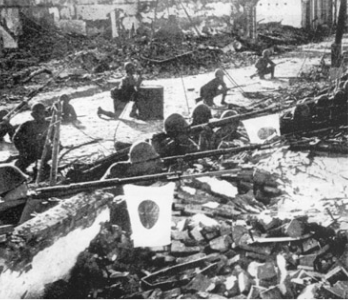
Japanese troops in the ruins of Shanghai
By 1936, the nationalists and the Communist Party had been forced to collaborate in the Second United Front against the Japanese. After the Second World War, the Chinese communists started to organise in the northern part of the country. They formalised their group through the 'mass line' policy in which they responded to the needs and demands of the Chinese people.
The Second Sino-Japanese War started in July 1937 when the Japanese claimed that they were attacked by Chinese troops at the Marco Polo Bridge near Beijing.
They launched a full-scale invasion of China and used the already-conquered Manchuria as a launching base for their army. The Chinese organised resistance but they were up against a formidable enemy and China's most important port, Shanghai, and Chiang Kai capital, Nanking, fell in December 1937.
The peasants, in the beginning, had long since supported the Red Army. Mao even described the Red Army as the "fish who swam in the sea", with the sea being the peasants.
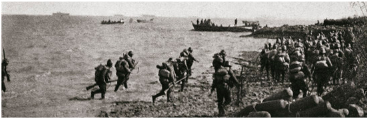
Japanese landing near Shanghai 1937
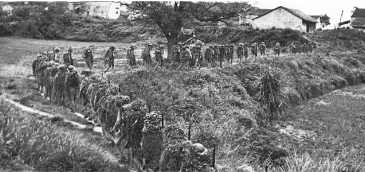
NRA soldiers march to the front in 1939
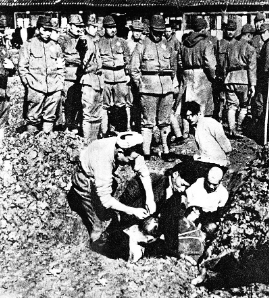
Chinese civilians to be killed during the Sino-Japanese War
The Red Army successfully carried out guerilla operations against the Japanese from 1937 onwards. During their Hundred Regiments Offensive in 1940, they attacked the Japanese-controlled railway system to halt Japanese transport. With the help of the peasants, the communists were soon in control of the countryside.
Though all seemed to go well with the communists, the Japanese began to retaliate in 1941 through their scorched earth policy known as the Three All Campaign: kill all, burn all, destroy all. Their objective was to burn the villages and crops of the peasants. This plan, however, backfired as the peasants did not turn their backs on the communists but rather, it drove them to support the CCP more.
The KMT eventually lost support and thus became weaker as a result of the war with Japan. This was due to a number of reasons:
- The Kuomintang became corrupt as officials competed for wealth and power.
- Chiang Kai-shek, leader of the KMT, ruled as a military dictator.
- Chiang Kai-shek did little to resolve China's welfare problems in terms of education, medical care and housing.
- The KMT had little support from the countryside as it did nothing to improve the peasants' way of life.
- The peasants perceived the KMT as a party for the wealthy.
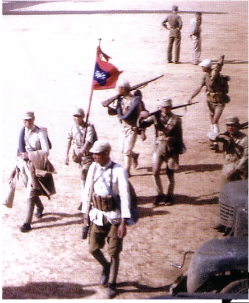
KMT soldiers during the Second Sino-Japanese War
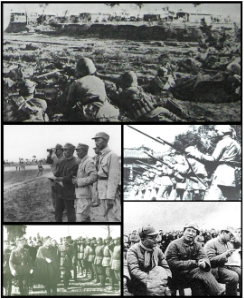
Chinese Civil War
Outbreak of the Civil War
The occupation of Manchuria by the Soviet Army forced the Japanese to surrender in 1946. The CCP was able to get 300,000 sq miles of land with 95 million people. When the Soviets withdrew from the region, the nationalists occupying Mukden, the largest city in the region, and the communists occupying northern Manchuria, scrambled for control of the area.
When the nationalists occupied Changchun, the northeast part of the region, a 15-day truce was held from 6 to 22 June and fighting took place in different areas in China. By 1946, a full-scale Chinese Civil War erupted between Chiang Kai-shek's nationalist government Kuomintang and Mao Tse-Tung's Chinese Communist Party.
Glossary of Terms
Kuomintang
Abbreviated to KMT, the Kuomintang is the nationalist government in China that took over after the fall of the Qing dynasty
Chinese Communist Party
Abbreviated to CCP, the Chinese Communist Party is the party that has been in sole control of the Chinese government since the country's establishment as a republic
Second Sino-Japanese War
The war fought between China and Japan from 1937 to 1945
Red Army
Later referred to as the People's Liberation Army, it is the regular armed forces created by Mao Tse-tung of the Chinese Communist Party (CCP)
National Revolutionary Army
The military arm of the Kuomintang from 1925 until 1947
Chinese Civil War
The 1945 to 1949 war between Chiang Kai-shek's nationalist government Kuomintang (KMT) and Mao Tse-tung's Chinese Communist Party (CCP)