Political development: Democracy Movement and Tiananmen Square demonstrations (OCR A-Level History A): Revision Notes
📚Revision Notes
Political development
Democracy Movement
Deng may have been an economic reformer, but he was a firm believer of communism. He particularly wanted China to take a break from the political argument that they felt from the tragedies caused by the Cultural Revolution.
During the 1980 National People's Congress, a resolution 'condemned' the view that the people had the right to speak freely.
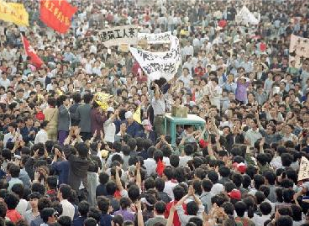
Democracy Movement
Furthermore, though the events of the Great Leap Forwards and the Cultural Revolution showed the incapability of the CCP to govern, Deng wanted to prove otherwise. Thus, his leadership consisted of restoring the authority of the CCP.
Deng's beliefs and ideals of ruling angered some, especially the youth who sought greater reforms as well as a more democratic political system in China. This led to the creation of the Democracy Movement. On 18 August 1977, the Chinese Communist Party (CCP) recommended the addition of Four Freedoms.
Four Freedoms

Freedom of speech
Freedom of debate
Freedom to post big-character posters, or dazibao
This was part of the plan to further criticise the Gang of Four as well as the previous government, and making Deng Xiaoping more favourable. Several universities began to post dazibaos on the walls.
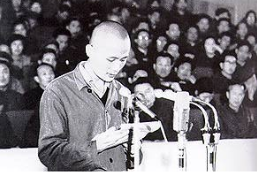
Wei Jingsheng
The most aggressive posters appeared near the Forbidden City on what was known as the Democracy Wall. People began to post criticisms of the Cultural Revolution as well as of the Gang of Four. However, anti-Deng movements criticising the leader began to appear.
The most prominent was Wei Jingsheng who called for the country to adopt democracy as part of the "fifth modernisation" but Deng countered that they only needed four. Afterwards, protesters were arrested, including Wei who was sentenced to 15 years' imprisonment. Though imprisoned, Wei was regarded as the first martyr of the Democracy Movement.
At first, Deng tolerated the Democracy Movement. He only attacked when he was directly challenged (like what happened with Wei Jingsheng). However, the recent events made him insist that genuine democracy was not an option for China and that greater participation of the people in politics was unnecessary. Furthermore, he argued that the people should be content with a government that leads them and prioritises their needs.
Tiananmen Square
The Tiananmen Square events in 1989 were a series of student-led demonstrations. The Tiananmen Square Massacre was the climax to the rising tensions due to the failures of Deng Xiaoping's reforms.
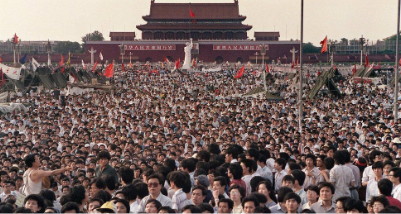
Tiananmen Square 1989 events
A series of protests and hunger strikes led by students were held in Tiananmen Square, Beijing. In reaction to this, Deng introduced martial law to end the demonstrations. When news broke out that martial law would be imposed, thousands of residents in Beijing blocked the roads and avenues to prevent troops from coming onto Tiananmen Square.
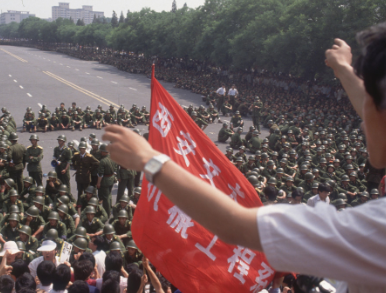
PLA at the Tiananmen Square demonstration
Now determined to end the demonstrations, Deng commanded the People's Liberation Front (PLA) to carry out a full military campaign that would reclaim Tiananmen Square at any cost.
On 3 June 1989, shots from the PLA were fired at the protesters, resulting in an unknown number of casualties. The demonstration marked the end of the Democracy Movement.