Social development (OCR A-Level History A): Revision Notes
📚Revision Notes
Social development
Changes in the Roles of Women
One of the changes implemented by Mao Tse-tung in China was the improvement of the status of women. Mao believed that, as per the doctrine of communism, all workers were equal regardless of their gender.
Thus, the lives of women improved in China when he became the Chairman of the CCP. As influenced by the Chinese philosophy of great respect for women, several traditions and practices ended during Mao's time.
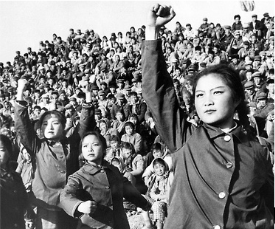
Empowering women was one goal of the CCP social reforms
Women before 1950:
- Had few rights and were considered second-class citizens.
- Poor families often wanted sons to be able to work in the field. Hence, daughters were sold as slaves.
- Female infanticide was high in the countryside due to families' desire for sons.
- In marriage, men could engage in a polygamous relationship and women could be concubines. Some progress had been made under the Kuomintang, but these changes had very little impact in the countryside where Chinese traditions were deeply rooted. On 1 May 1950, the Marriage Law was passed, which gave Chinese women equality with men under the law.
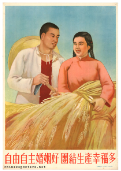
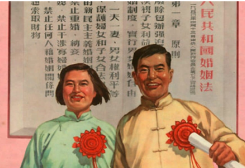
Marriage Law posters
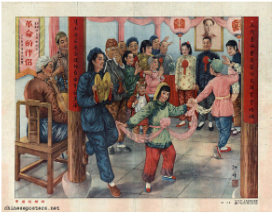
Marriage Law poster
Marriage Law effects:
- Men and women had equal political status.
- Divorce was permitted in China for the first time.
- Maternity benefits were introduced in 1951, including feeding time and nurseries in government-run businesses.
- Women were not at a disadvantage to their husbands in terms of owning property, since it was already owned by the state. Chinese women were given redistributed land.
- It ended the influence of male patriarchy and ageism that existed in the traditional Chinese feudal family system.
- The law banned polygamy, arranged marriages, child brides under 12, and being concubines.
Foot Binding
Known as 'lotus feet', foot binding was the crippling and deforming of the feet by applying tight binding to young women's feet, aged four to nine, to modify the size and shape to resemble a lotus flower. This was based on a firm belief that small, delicate feet were beautiful, which was practised as early as the 10th century.
In 1912, the newly formed Republic of China (ROC) campaigned to stop this practice. It was only around the 1950s that this process was banned as Mao and the CCP believed that this was a sign of China's 'backwardness'.
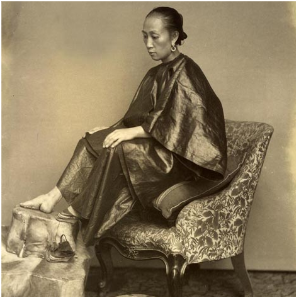
A Chinese woman showing her lotus foot
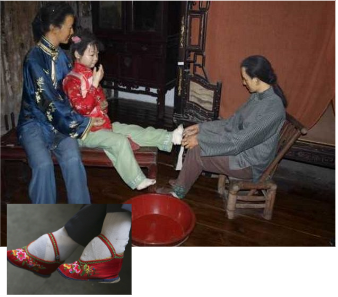
Foot-Binding Process
- Soak feet in warm water with herbs and animal blood.
- Curl the toes over the sole of the foot.
- To keep the toes curled over the sole, bind them with cotton bandages. Breaking the toes by forcing them to arch over the sole is also needed to form the desired lotus shape.

Great Chinese Famine
In 1959, China suffered the Great Chinese Famine that ended in 16-23 million deaths, while other records suggest the number was as high as 40 million.
Furthermore, from 1959 until 1962, heavy industrial output dropped by 55% while light industrial output dropped by 30%. 25,000 state enterprises had to be shut down and new construction projects were cancelled. Around 8.5 million urban workers lost their jobs. The period from 1958 until 1960 is known as the Three Bitter Years in China.
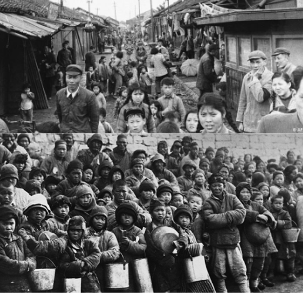
China during the famine
Factors that led to the famine

- Droughts, which persisted from 1959 until 1960.
- Failure of the Four Pests Campaign and Lysenkoism.
- Poor planning in communes and of central government officials who were terrified of Mao Tse-tung.
The Great Famine was not admitted until 1980. China continuously exported rice, hence falling production was not noticed abroad. Seven million tonnes of grain was exported to finance industrial development in China. Furthermore, Mao Tse-tung did not ask for international aid.
Stealing and robbery were rampant, prostitution grew, and starving families ate rats, worms, tree bark, leaves and even turned to cannibalism. Chinese officials only relied on the fertility rate, which dropped, for data and the mortality rate increased during this period.