Cognitive Explanations of Depression (OCR A-Level Psychology): Revision Notes
📚Revision Notes
4.3.2 Cognitive Explanations of Depression
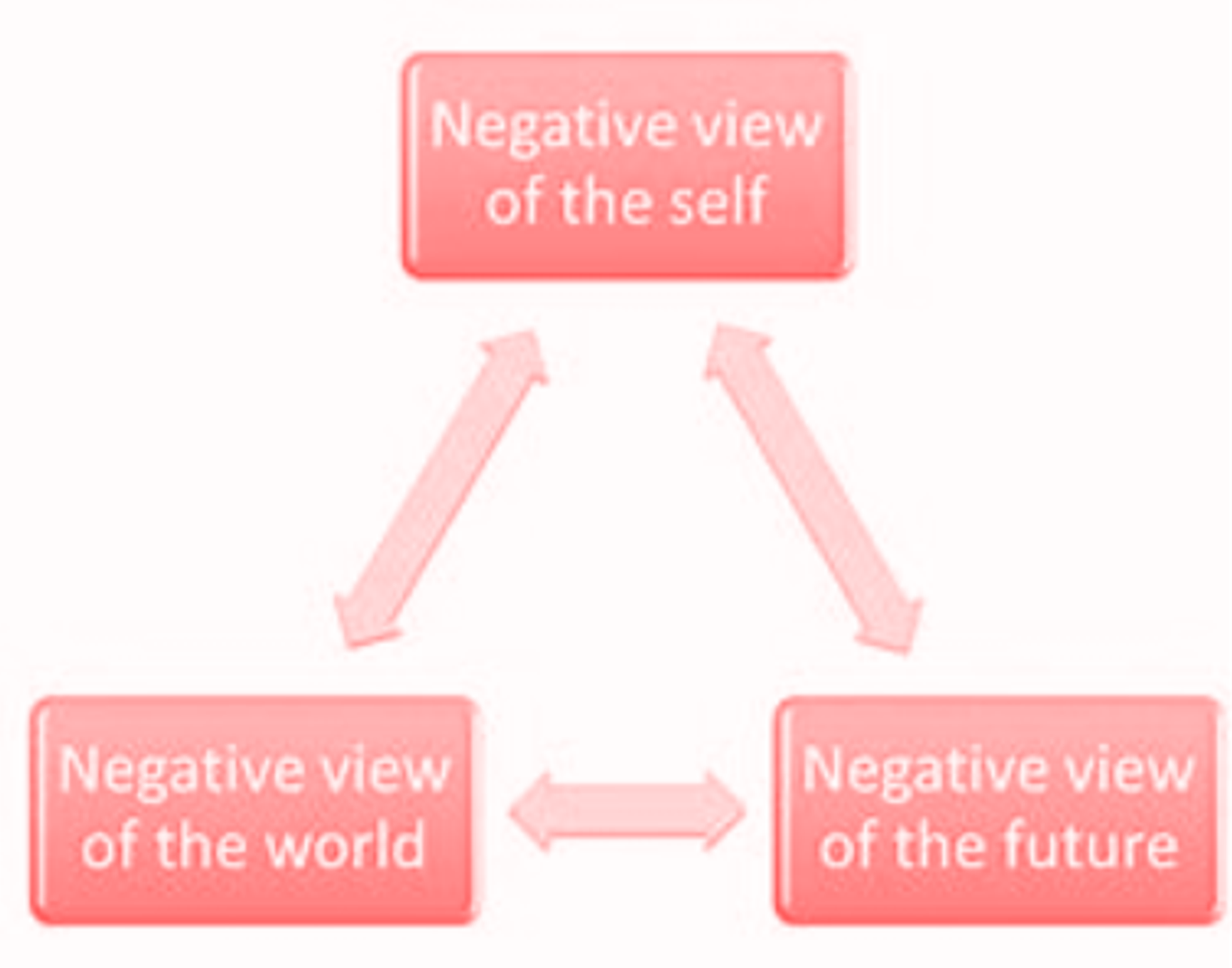
Beck's Negative Triad (1967)
Thinking dominated by negative schemas
Faulty information processing due to their thinking being dominated by negative schemas.
- interprets all info about themselves negatively. Developed in childhood by authority figures such as parents placing unreal demands on individuals
Negative schemas are fuelled by cognitive biases causing individuals to misperceive reality
Strength is the support from existing evidence. Grazioli +terry assessed 65 pregnant women for cognitive vulnerability and depression before and after birth. Found those with high vulnerability were more likely to suffer from post-natal depression. Shows a link between cognitive vulnerability and depression → proves research is valid. Also has application to real life.
Another strength of Beck's theory is the increased understanding of the cognitive basis of depression which translates to more effective treatments i.e. elements of the cognitive triad can be easily identified by a therapist and challenged as irrational thoughts on the patient's part. Thus, it translates well into a successful therapy and the consequent effectiveness of CBT is merit to the accuracy of Beck's cognitive theory as an explanation for depression
However, treatment can be expensive. But, if it is successful, patients can go back to work, which benefits the economy.
Ellis's ABC Model
- Ellis' ABC model proposed an (A) activating event, that triggers an irrational (B) belief and results in an emotional (C) consequence in the form of depression. Ellis described irrational thoughts as thoughts preventing us from being happy. An Activating event triggers an emotion which causes
An individual's Beliefs which results in
A Consequence
A limitation of Ellis' ABC model is it cannot explain all types of depression, apart from those which clearly have an activating event i.e. reactive depression. However, many suffer from depression without an apparent cause and may feel frustrated that their concerns/experiences are not reflected in this theory. Also doesn't explain why patients suffer from hallucinations and delusions. Therefore, this suggests that the ABC model is limited at best and has low external validity.
A strength of the ABC model is it shares the same advantage as Beck's cognitive theory in that it provides a practical application in CBT. The effectiveness of CBT suggests that identifying and challenging irrational beliefs are at the core of 'curing' depression, which Ellis emphasises. This supports the theoretical basis of the ABC model, through a specific focus on the role of faulty cognitions in the development of depression and specifically, in the interpretation of an activating event.