The Function of the Endocrine System (OCR A-Level Psychology): Revision Notes
📚Revision Notes
6.2.3 The Fight or Flight Response
During situations that create stress, fear or excitement, the neurones of the sympathetic nervous system will stimulate the adrenal medulla (of the adrenal gland) to secrete adrenaline
Stages of the fight or flight response
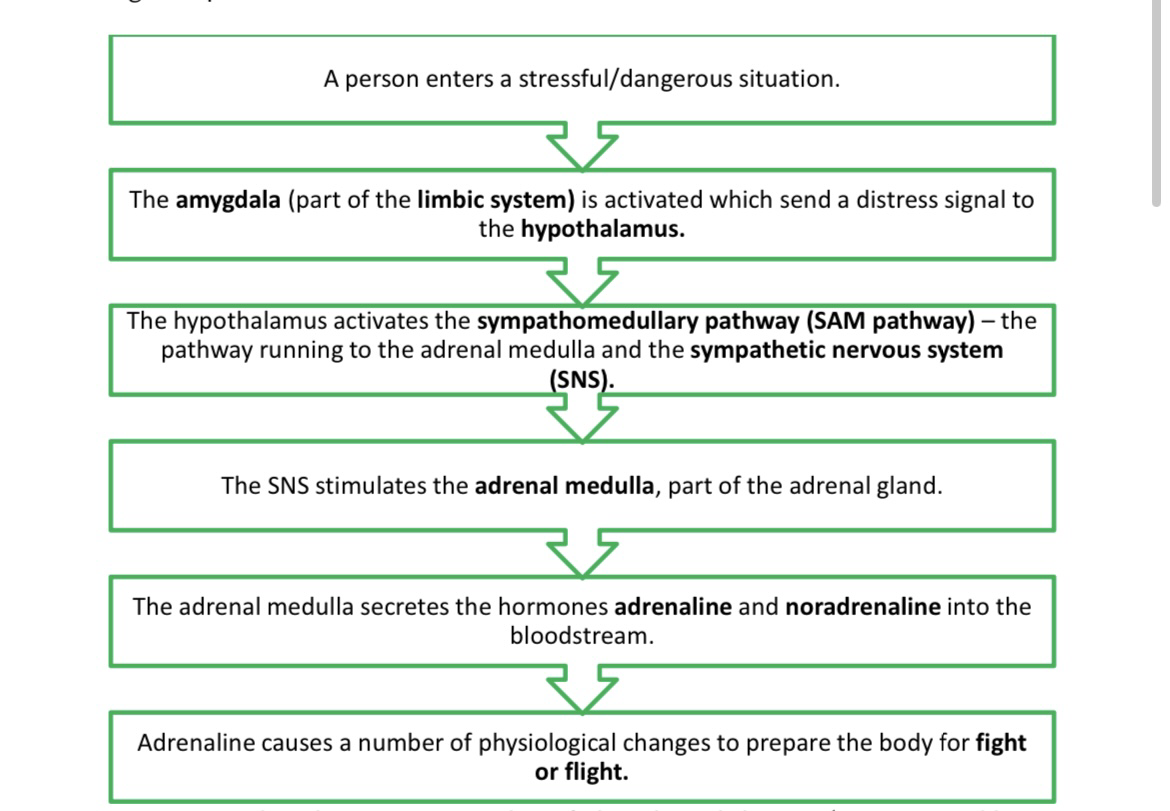
-
Adrenaline is a hormone that will prepare your body for reacting to a stressful situation. This reaction is often called the "fight or flight" response It is the effects of adrenaline that lead to the typical symptoms we experience during stressful situations such as:
-
increased heart rate
-
increased sweating
-
Decreased digestion
-
Decreased salivation (dry mouth)
Evaluation:
1.
Note
P: Not all people react with a fight or flight response when faced with danger
Note
E: This is because some people freeze instead, whilst contemplating what to do in the situation
Note
E: Therefore, our reaction to danger is not limited to the fight or flight response, as some humans face an initial "freeze response"
2.
Note
P: Most early research into the fight or flight response was conducted on men
Note
E: This was assumed to be generalisable to women, making the research androcentric
Note
E: This is a weakness as women may potentially act differently in situations of danger to men, highlighting beta bias in this area of psychology
3.
Note
P: The fight or flight response can be seen as deterministic
Note
E: This is because it: States that a certain sequence of events (e.g. the hypothalamus triggering the adrenal gland to release adrenaline), will lead to the fight/flight response, which will cause someone to feel fear, whilst also ignoring psychological processes that occur between this
Note
E: Therefore, making the explanation reductionist and deterministic