Osmosis (AQA GCSE Biology Combined Science): Revision Notes
📚Revision Notes
1.3.4 Osmosis
Note
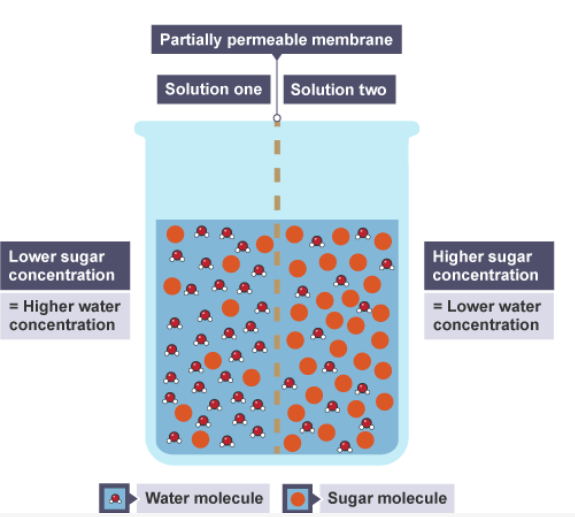
Water is able to move across cell membranes by osmosis- the movement of water from a less concentrated solution to a more concentrated one through a partially permeable membrane.
A dilute solution of sugar has a high concentration of water (and therefore a high water potential).
A concentrated solution of sugar has a low concentration of water (and therefore a low water potential).
Water moves from a dilute solution to a concentrated solution because it moves from an area of high water potential to low water potential- down the concentration gradient. It is passive (does not use energy).
The cytoplasm of a cell contains salts and sugars, so therefore when a cell is placed in a dilute solution, water will move in.
→ This situation can be modelled with a partially permeable membrane bag containing sugar molecules, with a glass tube placed in it with the top out of the water
→ This can be placed in solutions of varying concentrations in order to observe the movement of water in and out by looking at the level of the water in the tube
- If the concentration of sugar in external solution is the same as the internal, there will be no movement and the solution is said to be isotonic to the cell
- If the concentration of sugar in external solution is higher than the internal, water moves out, and the solution is said to be hypertonic to the cell
- If the concentration of sugar in external solution is lower than the internal, water moves in, and the solution is said to be hypotonic to the cell
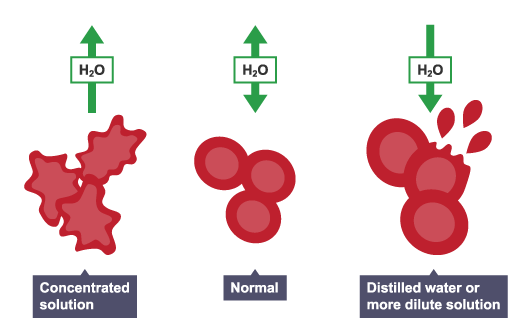
Osmosis in animals:
- If the external solution is more dilute (higher water potential), it will move into animal cells causing them to burst.
- On the other hand, if the external solution is more concentrated (lower water potential), excess water will leave the cell causing it to become shrivelled.
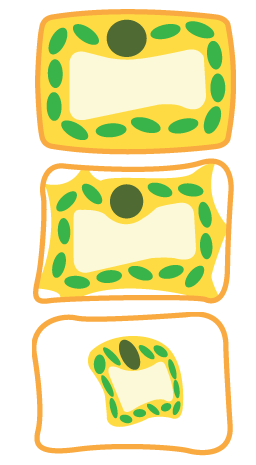
Osmosis in plants:
- If the external solution is more dilute, water will move into the cell and into the vacuole, causing it to swell, resulting in pressure called turgor (essential in keeping the leaves and stems of plants rigid).
- If the external solution is less dilute, water will move out of the cell and they will become soft. Eventually, the cell membrane will move away from the cell wall (called plasmolysis) and it will die.