Interactions of Limiting Factors (AQA GCSE Biology): Revision Notes
📚Revision Notes
4.1.3 Interactions of Limiting Factors
Limiting Factors in Photosynthesis:
- A limiting factor is an environmental condition that restricts the rate of photosynthesis when it is in short supply, even if other factors are in abundance. Examples include light intensity, carbon dioxide concentration, and temperature.
- Graphical Representation:
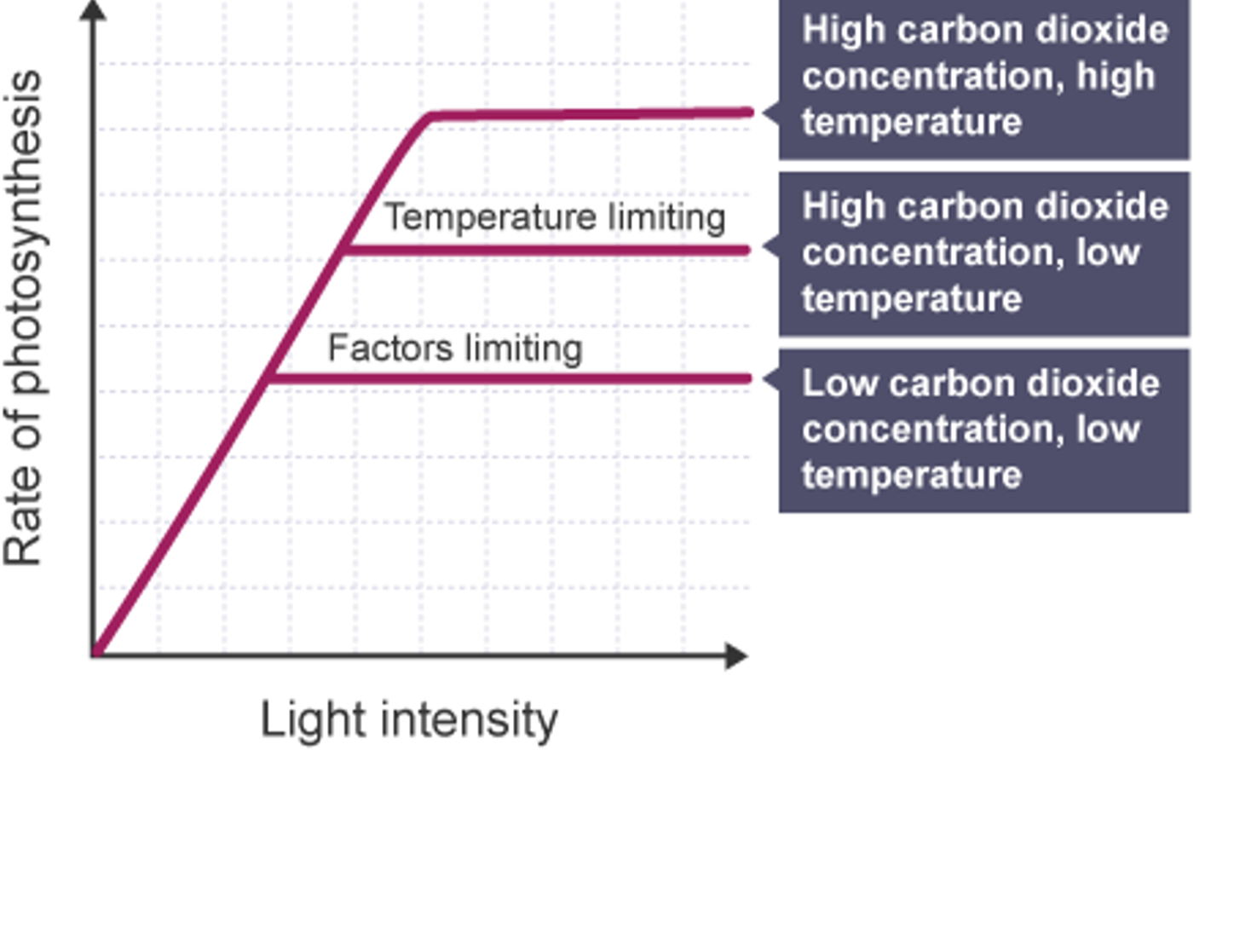
- A graph showing the rate of photosynthesis against one factor, such as light intensity, will show a line that initially increases but then levels off when another factor becomes limiting.
- A graph with two or three lines may represent experiments with different levels of a second or third factor, helping to identify which factor is limiting at different points.
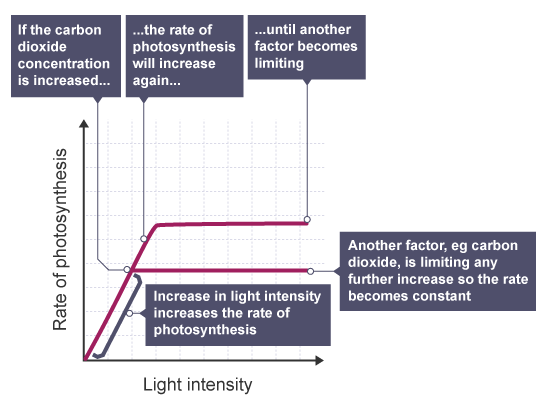
For example, if light intensity is the limiting factor, increasing it will raise the rate of photosynthesis until another factor, such as temperature, becomes limiting. This is often depicted as the curve flattening out on a graph.
Applications in Agriculture:
- Greenhouse Management: Farmers can use knowledge of limiting factors to optimise conditions in greenhouses, such as increasing light intensity, CO₂ levels, and maintaining optimal temperatures. This boosts the rate of photosynthesis, leading to faster plant growth and higher yields, ultimately increasing profits.
Inverse Square Law:
- Inverse Proportion: Light intensity is inversely proportional to the square of the distance from the light source, described by the inverse square law.
- This means that as the distance between the light source and the plant doubles, the light intensity falls to a quarter of its original value.
Note
For example, if a lamp is 2 metres away from a plant, the light intensity is reduced to 1/4 of its original value:
Note
Understanding the inverse square law is important for managing light conditions in growing environments, ensuring plants receive adequate light for optimal photosynthesis.