The Eye (AQA GCSE Biology): Revision Notes
📚Revision Notes
5.1.5 The Eye
Note
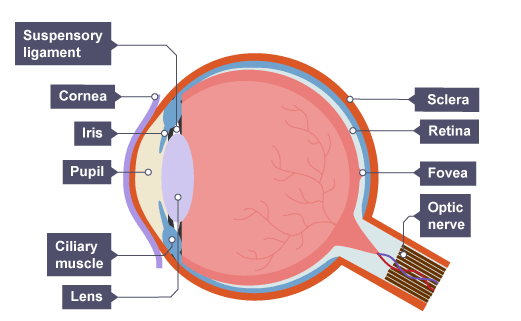
The eye is a sense organ containing receptors sensitive to light intensity and colour. It has many different structures within it. They are adapted to allow the eye to change its shape in order to focus on near or distant objects (a process called accommodation), and to dim light.
Definitions
-
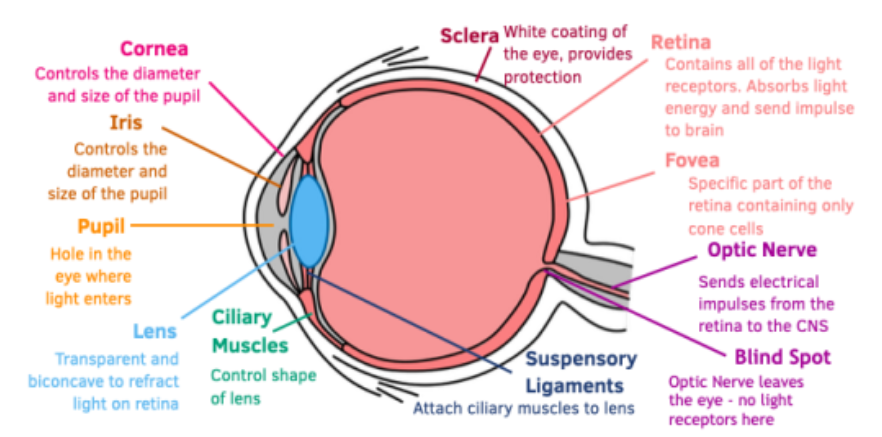
Retina: Layer of light sensitive cells found at the back of the eye. When light hits this, the cells are stimulated. Impulses are sent to the brain, which interprets the information to create an image.
-
Optic nerve: A nerve that leaves the eye and leads to the brain. It carries the impulses from the retina to the brain to create an image.
-
Sclera: White outer layer which supports the structures inside the eye. It is strong to prevent some damage to the eye.
-
Cornea: The see-through layer at the front of the eye. It allows light through and the curved surface bends and focuses light onto the retina.
-
Iris: Muscles that surround the pupil They contract or relax to alter the size of the pupil. In bright light, the circular muscles contract and radial muscles relax to make the pupil smaller- avoiding damage to the retina.
In dim light, the circular muscles relax and the radial muscles contract to make the pupil larger- so more light can enter to create a better image.
- Ciliary muscles and suspensory ligaments: Hold the lens in place They control its shape.
The process of accommodation:
To focus on a near object:
-
The ciliary muscles contract
-
The suspensory ligaments loosen
-
The lens is then thicker and more curved- this refracts the light more To focus on a distant object
-
The ciliary muscles relax
-
The suspensory ligaments tighten
-
The lens then becomes thinner- light is refracted less
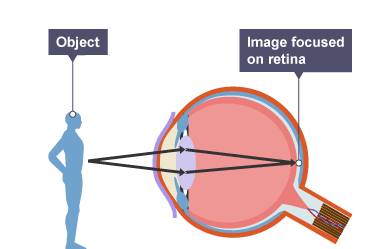
The lens changes shape to focus on near and distant objects
Eye defects occur when light cannot focus on the retina.
- Short sightedness is called myopia .
- The lens is too curved, so distant objects appear blurry.
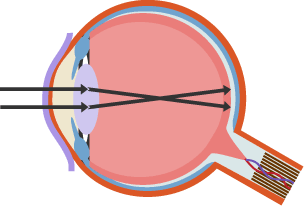
- Long sightedness is called hyperopia .
- The lens is too flat, so it cannot refract light enough.
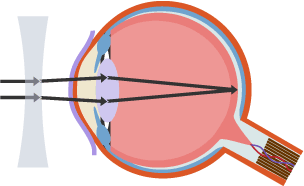
There are a number of treatment methods:
- They can be treated with spectacle lenses concave lenses to spread out the light to treat myopia and convex lenses to bring the rays together to treat hyperopia
- Contact lenses work in the same way as glasses but allow activities such as sport to be carried out, hard or soft contact lenses last for different lengths of time
- Laser eye surgery lasers can be used to either reduce the thickness of the cornea (so it refracts light less) to treat myopia or change its curvature (so it refracts light more strongly) to treat hyperopia
- Replacement lens Hyperopia can be treated by replacing the lens with an artificial one made of clear plastic (or adding the plastic on top of the natural lens). The risks include damage to retina or cataracts developing.