Group 1: The Alkali Metals (AQA GCSE Chemistry Combined Science): Revision Notes
📚Revision Notes
1.2.5 Group 1: The Alkali Metals
Physical and Chemical Properties
Physical Properties:
- All metals look dull on the outside due to the formation of a layer of oxide.
- Over time, this layer of oxide makes the metal look dull.
- The inside of every metal is shiny.
- It is possible to cut every metal with a knife.
- Alkali metals are kept in oil to prevent them from reacting with oxygen and moisture in the air.
- They have low density, so most alkali metals float.
- Their boiling point and melting point are lower than many other metals.
Reactivity:
- All Group 1 metals have 1 electron in their outer shell, making them very reactive as they bond by losing this electron.
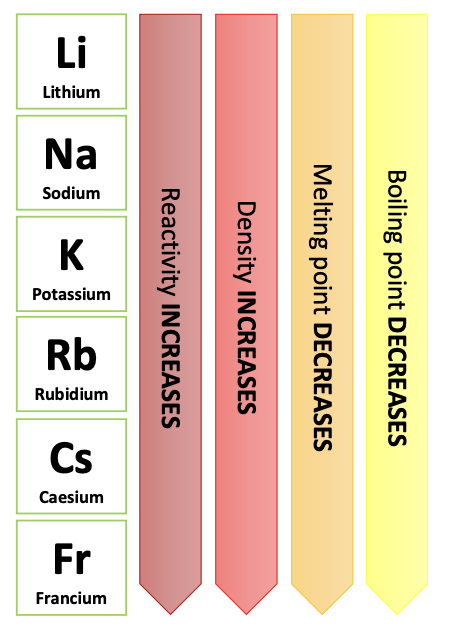
- Reactivity increases down the group because the outer electron is more easily lost, as it's further from the nucleus.
Trends in Group 1:
- Reactivity INCREASES down the group.
- Density INCREASES down the group.
- Melting point DECREASES down the group.
- Boiling point DECREASES down the group.
Chemical Properties
Note
Reaction with Oxygen to Form Oxides:
Example (Potassium):
The oxide layer that makes the metal look dull forms more quickly as you move down the group.
Note
Reaction with Water to Form Hydroxides (Alkalis):
Example (Lithium):
- The metals create an alkali as they react with water (e.g., turning purple with a universal indicator).
- The reaction produces hydrogen gas.
- The metal floats, moves, and fizzes on the water's surface.
- Sodium: Moves quicker and forms a ball shape.
- Potassium: Moves quickly and has a lilac flame.