Covalent bonding (AQA GCSE Chemistry Combined Science): Revision Notes
📚Revision Notes
2.1.4 Covalent bonding
Covalent Bonds
Formation:
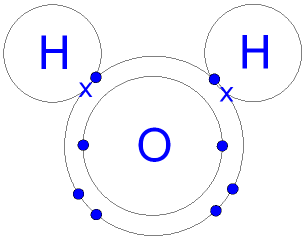
Covalent bonds form when two non-metal atoms share electrons to achieve a full outer shell.
Example
Example: In a molecule of water (H₂O), each hydrogen atom shares one electron with the oxygen atom, forming covalent bonds.
Bonding:
The shared electrons spend time in the outer shells of both atoms, creating a strong bond between them. Covalent bonds result in the formation of molecules.
Properties:
- Covalent compounds have lower melting and boiling points compared to ionic compounds.
- They are often insoluble in water.
- Covalent compounds do not conduct electricity because they do not have free-moving charged particles (ions or electrons).