Greenhouse Gases (AQA GCSE Chemistry Combined Science): Revision Notes
📚Revision Notes
9.2.1 Greenhouse Gases
Note
Greenhouse gases have played a crucial role in the development and sustenance of life on Earth. These gases help maintain temperatures that are warm enough to support life. However, modern human activities are disrupting the stability of the climate by intensifying the greenhouse effect, leading to rising global temperatures. To address this issue, it is important for individuals and societies to work towards reducing their carbon footprint.
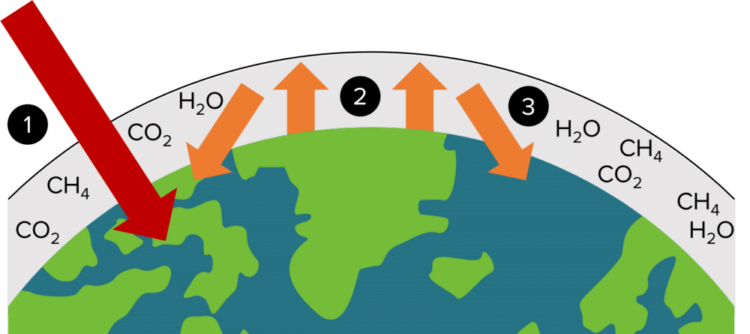
The Greenhouse Effect
The greenhouse effect is essential for maintaining the warm temperatures of Earth's surface, which allows life to thrive. Due to the greenhouse effect, the average temperature on Earth is approximately 15°C. Without it, Earth would be much colder. For example, Mercury, which lacks a greenhouse effect, experiences extreme temperatures, with night-time temperatures dropping as low as −180°C.
Note
How the Greenhouse Effect Works The greenhouse effect operates in three key stages:
- Absorption of Solar Radiation:
- Shortwave solar radiation travels from the Sun to Earth.
- This radiation passes through the atmosphere and is absorbed by the Earth's surface, warming it.
- Emission of Thermal Radiation:
- The warmed surface of the Earth emits longwave thermal radiation back into the atmosphere.
- Greenhouse gases in the atmosphere, such as carbon dioxide (CO₂), water vapour (H₂O), and methane (CH₄), absorb this longwave radiation, preventing it from escaping into space.
- Re-radiation of Heat:
- The greenhouse gases then re-radiate the absorbed longwave radiation back towards the Earth's surface.
- This process traps heat in the atmosphere, raising the average surface temperature of the Earth.
Note
Key Greenhouse Gases
- Carbon dioxide (CO₂): Released by burning fossil fuels, deforestation, and other industrial processes.
- Water vapour (H₂O): The most abundant greenhouse gas, which increases as the Earth's atmosphere warms.
- Methane (CH₄): Emitted from sources such as livestock digestion, rice paddies, and the decay of organic waste in landfills.
Human Impact on the Greenhouse Effect
While the greenhouse effect has been vital for life on Earth, human activities are now amplifying this effect to dangerous levels. The increased emission of greenhouse gases is causing global temperatures to rise, leading to climate change. If left unchecked, this could have severe consequences for ecosystems, weather patterns, and human societies.
Note
Reducing the emission of greenhouse gases is essential to mitigate the impact of climate change and preserve the stability of Earth's climate for future generations.