Fractional Distillation & Petrochemicals (AQA GCSE Chemistry): Revision Notes
📚Revision Notes
7.1.2 Fractional Distillation & Petrochemicals
Fractional Distillation and Crude Oil
Note
Fractional distillation is a process used to separate a mixture into its components based on their different boiling points.
Crude oil is a complex mixture of hydrocarbons extracted from the ground. In its raw state, crude oil isn't very useful because it contains a wide variety of hydrocarbons with different properties. -
- To make crude oil useful, it is separated into simpler mixtures called fractions. Each fraction contains hydrocarbons with similar carbon chain lengths and properties.
Note
Since the hydrocarbons in crude oil have different boiling points, we can separate them through fractional distillation. By breaking down crude oil into these fractions, we can isolate the hydrocarbons needed for various products, making use of their unique properties.
The Process of Fractional Distillation with Crude Oil
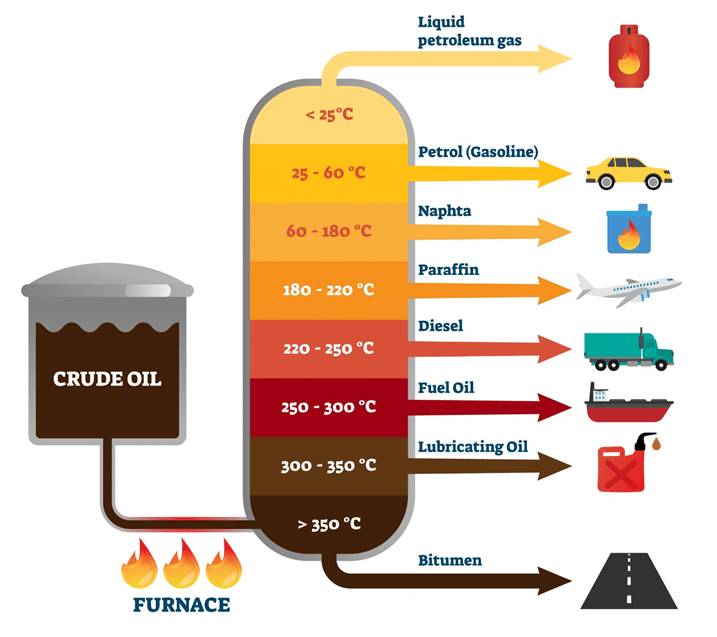
- Heating: Crude oil is heated and enters the fractionating column at the bottom. The column is hottest at the bottom and cools as you move up.
- Condensation: As the vapours rise through the column, hydrocarbons with higher boiling points condense into liquids lower in the column where the temperature is higher.
- Separation: Hydrocarbons with lower boiling points continue to rise higher up the column.
- Fraction Collection: Different hydrocarbons condense at different heights, forming separate fractions. These liquid fractions are then drawn off at various points in the column.
Petrochemicals
Note
Petrochemicals are substances that we get from crude oil. These raw materials, known as feedstocks, are used by the petrochemical industry to create a variety of products, such as:
- Solvents
- Lubricants
- Detergents
- Polymers