Cracking & Alkenes (AQA GCSE Chemistry): Revision Notes
📚Revision Notes
7.1.4 Cracking & Alkenes
Note
Crude oil is a complex mixture of hydrocarbons called alkanes and alkenes.
- Alkanes are saturated hydrocarbons, which means that there are no double bonds in the structure. There are only single covalent bonds between the carbon atoms. The general formula for alkanes is CnH2n+2
- Alkenes are unsaturated hydrocarbons, which means they have at least one double bond between two carbon atoms. The general formula for alkenes is CnH2n Shorter hydrocarbons are generally more useful, so longer ones undergo cracking, a process that breaks them down into shorter, more useful molecules. For example, decane can be cracked into octane and ethene.
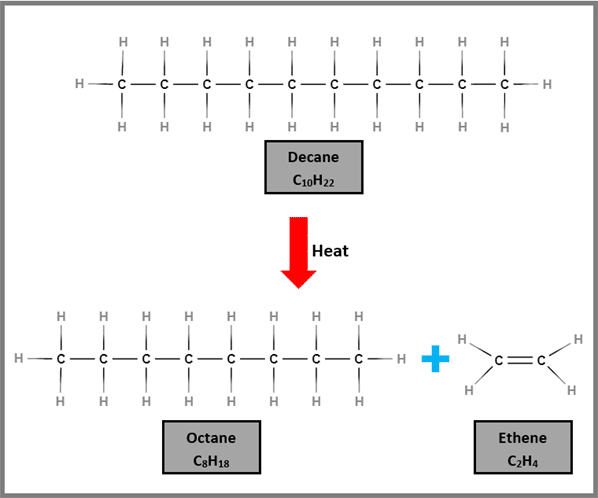
Two methods for carrying out cracking
- Catalytic cracking – This involves using a high temperature and a catalyst to speed up the reaction.
- Steam cracking – In this method, hydrocarbons are mixed with steam and heated to a high temperature, but without the use of a catalyst. Cracking is essential because there's a higher demand for shorter-chain hydrocarbons. These shorter hydrocarbons are more flammable and make better fuels, like those needed for cars to quickly change speeds.