Alkenes (AQA GCSE Chemistry): Revision Notes
📚Revision Notes
7.2.1 Alkenes
Note
Alkenes are a type of hydrocarbon, meaning they are made up of only carbon and hydrogen atoms. They are a homologous series of unsaturated hydrocarbons that can be identified by the 'ene' at the end of their name, such as ethene.
Note
All alkenes have carbon-to-carbon double bonds, which are represented as C=C.
Note
The general formula for alkenes is:
- 'n' is the number of carbon atoms in the molecule
Because alkenes have a double bond between carbon atoms, they are generally more reactive than alkanes, which only have single bonds. This double bond is the functional group of alkenes and plays a key role in determining their chemical properties.
Let's look at the molecular formulae and structures of the first two alkenes:
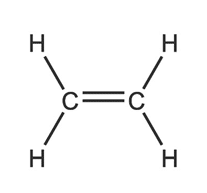
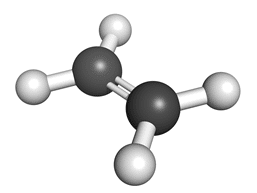
Ethene
Number of carbon atoms = 2
Molecular formula = C2H4
Structural formula:
Ball + stick diagram:
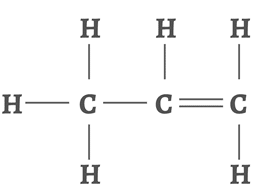
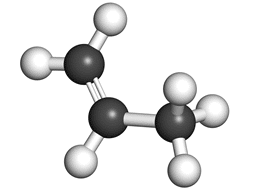
Propene
Number of carbon atoms = 3
Molecular formula = C3H6
Structural formula:
Ball + stick diagram:
Note
As the number of carbon atoms in an alkene molecule increases, its physical properties, like boiling points, gradually change.
Alkenes have two fewer hydrogen atoms than their corresponding alkanes, making them unsaturated. The carbon-to-carbon double bond in alkenes can break open to form additional single bonds. This allows each carbon atom to form four single bonds instead of one double bond and two single bonds.
Note
This difference in bonding is what makes alkenes more reactive than alkanes.