Addition Reactions of Alkenes (AQA GCSE Chemistry): Revision Notes
📚Revision Notes
7.2.3 Addition Reactions of Alkenes
Note
All alkenes in the alkene homologous series have the same functional group. This means they all have at least one C=C double bond, which makes them react in similar ways. In a reaction, this double bond can break open, allowing the carbon atoms to attach to something new. This type of reaction is called an addition reaction because something is added to the alkene.
- No other products are formed during this process.
Hydrogenation
Note
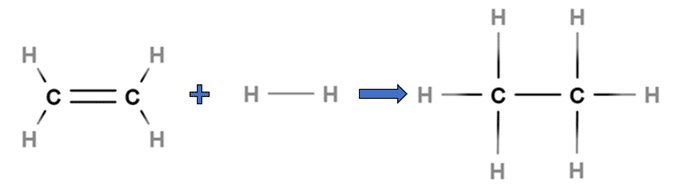
Alkenes can react with hydrogen to form an alkane, in a process called hydrogenation Alkene + Hydrogen → Alkane
Note
These reactions require a catalyst. An example of a hydrogenation reaction is: Ethene + Hydrogen → Ethane
Hydration
Note
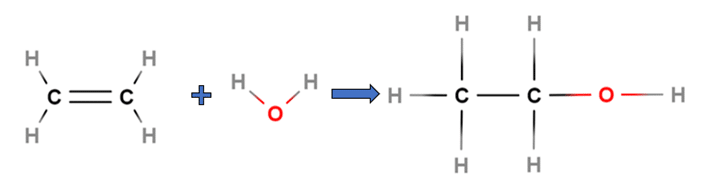
In the presence of heat, alkenes can react with steam to form an alcohol in a process called hydration
Note
These reactions require a temperature of around 300°C, a pressure of around 60 – 70 atm and a catalyst.
Note
An example of a hydration reaction is:
Afterwards, the water and ethanol are separated by fractional distillation.
Halogenation
Note
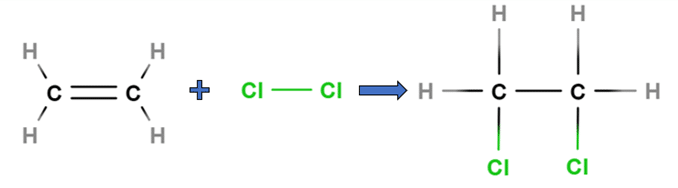
Alkenes can also react with halogens, such as chlorine, in a process called halogenation:
Note
An example of a halogenation reaction is: