Alcohols (AQA GCSE Chemistry): Revision Notes
📚Revision Notes
7.2.4 Alcohols
Note
Alcohols are a group of compounds that come from hydrocarbons. They can be identified by the 'ol' ending in their names (e.g., ethanol).
The defining feature of alcohols is the hydroxyl group (OH), which influences their chemical reactions. Some alcohols have more than one hydroxyl group:
Note
Alcohols with two hydroxyl groups are called diols.
Note
Alcohols with three hydroxyl groups are called triols.
The general formula for alcohols is CnH2n+1OH, where 'n' represents the number of carbon atoms. For example, with four carbon atoms, the formula is C4H9OH, which is butanol.
Alcohols can also be represented by the formula R−OH, where R is a hydrocarbon chain. The number of carbon atoms in this chain can vary, which results in differences in the physical properties of alcohols. However, they share similar chemical properties.
Let's take a look at the molecular formulae and structures of the first three alcohols:
Methanol
- Number of carbon atoms = 1
- Molecular formula = CH3OH Structural formula
Ball and stick diagram
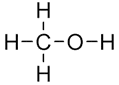
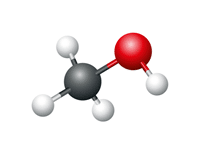
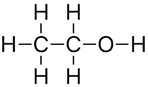
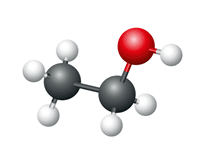
Ethanol
- Number of carbon atoms = 2
- Molecular formula = C2H5OH
Structural formula
Ball and stick diagram
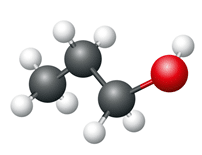
Propanol
- Number of carbon atoms = 3
- Molecular formula = C3H7OH Structural formula
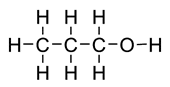
Ball and stick diagram
Note
These alcohols differ from each other in the number of CH2 units in their molecular formula structures, which leads to variations in their physical properties. Nonetheless, they share the same functional group (hydroxyl) and exhibit similar chemical behaviours.