The work of other companies (AQA GCSE Design and Technology): Revision Notes
📚Revision Notes
The work of other companies
Why study other companies?
Understanding how successful design companies operate is essential for developing your own research and design skills. By examining established companies, you can learn about different design approaches, business strategies, and innovation methods that have proven successful in various markets. This knowledge helps inform your own design decisions and gives you insights into professional practice.
Note
When researching companies, you should focus on several key areas: when they were established, their underlying design principles, what products they're particularly known for, and the significant people who shaped their development.
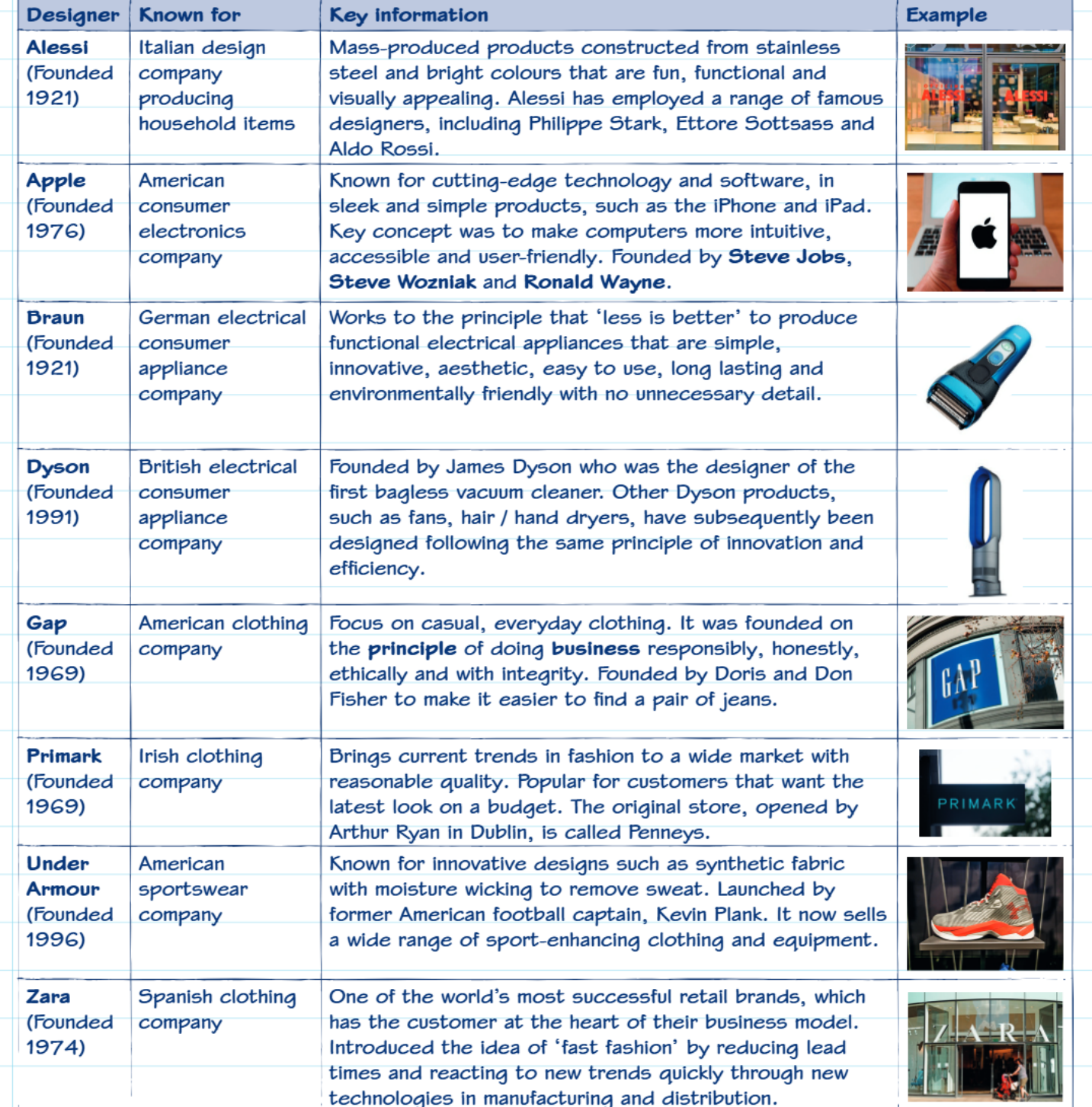
Major design companies and their approaches
Technology and innovation leaders
Apple represents a landmark approach to technology design that has influenced countless other companies. Founded in 1976 by Steve Jobs, Steve Wozniak, and Ronald Wayne, Apple built its reputation on creating cutting-edge technology housed in sleek, simple products. Their design philosophy centres on making complex technology more intuitive, accessible, and user-friendly. Products like the iPhone and iPad demonstrate how sophisticated functionality can be presented through clean, minimal interfaces that regular consumers can easily understand and use.
Household goods and appliances
Alessi has been transforming everyday household items since 1921, turning functional objects into desirable design pieces. This Italian company specialises in mass-produced products made from stainless steel, focusing on creating items that are simultaneously fun, functional, and visually appealing. Alessi has collaborated with famous designers including Philippe Stark, Ettore Sottsass, and Aldo Rossi, showing how established companies can maintain innovation by working with external creative talent.
Example
Design Philosophy in Practice: Braun's "Less is Better"
Braun exemplifies how a clear design philosophy shapes all product decisions. Founded in Germany in 1921, their "less is better" approach focuses on:
- Simple, innovative design
- Aesthetic appeal without unnecessary details
- Easy-to-use functionality
- Long-lasting, environmentally friendly products
This philosophy eliminates clutter while maintaining visual appeal through clean, uncluttered design.
Dyson demonstrates how individual innovation can transform entire product categories. Founded by James Dyson in 1991, the company began with his invention of the first bagless vacuum cleaner. Dyson's approach emphasises continuous innovation and efficiency improvements, with subsequent products like fans and hair dryers following the same principle of reimagining how familiar appliances can work better through creative engineering solutions.
Fashion and clothing companies
The clothing industry showcases diverse approaches to design and market positioning, from budget-conscious fast fashion to premium performance wear.
Gap has positioned itself as a provider of casual, everyday clothing since 1969. Founded by Doris and Don Fisher, Gap built its business model on principles of responsibility, honesty, ethical practices, and integrity. Their approach focuses on making it easier for customers to find well-fitting jeans and casual wear, demonstrating how understanding customer needs can drive business success.
Primark represents the fast fashion approach, bringing current fashion trends to a wide market with reasonable quality at budget prices. Founded in Ireland in 1969 and originally called Penneys, Primark's business model focuses on making fashionable clothing accessible to customers who want current styles without premium pricing.
Under Armour shows how innovation can create new market categories within established industries. Founded in 1996 by former American football captain Kevin Plank, Under Armour introduced innovative designs like synthetic fabrics with moisture-wicking properties to remove sweat. This focus on performance-enhancing technology helped establish the company in the competitive sportswear market.
Example
Business Model Innovation: Zara's Fast Fashion Revolution
Zara revolutionised fashion retail by introducing the concept of "fast fashion." Founded in Spain in 1974, their approach includes:
Step 1: Rapid trend identification - Using new technologies to monitor fashion trends
Step 2: Quick response manufacturing - Reducing lead times through efficient systems
Step 3: Customer-focused distribution - Putting customers at the heart of the business model
This system allows Zara to react quickly to changing fashion preferences and become one of the world's most successful retail brands.
Key research considerations
Important
When studying other companies' work, you need to gather comprehensive information about their background and approach. Essential research areas include:
- The company's establishment date and founding circumstances
- Their underlying design principles and philosophy
- The specific products or services they're most recognised for
- The significant individuals who have shaped the organisation's development and success
This research helps you understand how different companies have found success through various approaches - some through technological innovation, others through design excellence, cost efficiency, or customer focus. By analysing these different strategies, you can better understand the range of approaches available in professional design practice.
Summary
Key Points to Remember:
- Design philosophy matters - Each successful company has clear principles that guide their design decisions, whether it's Apple's user-friendly approach or Braun's "less is better" philosophy
- Innovation takes many forms - Companies can innovate through technology (Dyson), materials (Under Armour), business models (Zara), or design aesthetics (Alessi)
- Market positioning is crucial - Companies succeed by clearly understanding their target customers, from Primark's budget-conscious shoppers to Apple's technology enthusiasts
- Historical context provides insight - Understanding when and why companies were founded helps explain their design approaches and market strategies
- Collaboration drives creativity - Many successful companies work with external designers and innovators to maintain fresh perspectives and creative solutions