Dual in-line packages and microcontrollers (AQA GCSE Design and Technology): Revision Notes
📚Revision Notes
Stock forms - dual in-line packages and microcontrollers
Introduction to integrated circuits
Electronic components have become incredibly small through advances in technology. Modern silicon chips contain all the components needed to perform specific functions, including tiny resistors, diodes, and transistors that are etched directly onto the silicon surface.
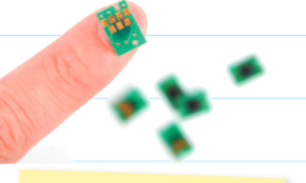 Integrated circuits represent a revolutionary advancement in electronics technology, combining multiple components into a single, compact unit.
Note
Integrated circuits offer significant advantages over using separate components:
- Take up much less space on circuit boards
- Typically more reliable than discrete components
- Cost less to manufacture since many components can be produced together in one process
- Reduce the complexity of circuit design and assembly
Understanding dual in-line packages
Since silicon chips are extremely small and delicate, they need protective housing to be usable in electronic circuits. This is where dual in-line packages (DILs or DIPs) come into play.
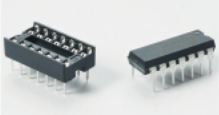 A DIP consists of a rectangular plastic or ceramic casing that protects the silicon chip inside. The most distinctive feature is the two parallel rows of metal pins that extend from opposite sides of the package. These pins are precisely spaced millimetres apart, which is a standard measurement in electronics.
Note
Why mm spacing?
This measurement equals exactly 0.1 inches, making it compatible with standard breadboards and perfboards used in electronics prototyping. This standardisation ensures that components from different manufacturers can be used interchangeably.
The number of pins varies depending on the complexity of the integrated circuit inside. Simple circuits might only need 6 pins, while more complex ones can require up to 40 pins. The pins always come in pairs, with one pin on each side of the package directly opposite each other.
Pin numbering system
Understanding how pins are numbered is crucial for correctly connecting DIL packages in circuits. There's a standardised system that helps identify which pin is which.
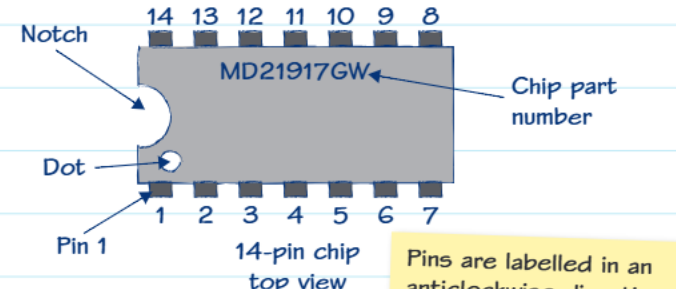 Every DIL package has identification markers - either a small notch cut into one end or a dot marked near one corner. Pin 1 is always located next to this notch or dot. From pin 1, the numbering continues in a counter-clockwise direction around the chip when viewed from above.
Important
Critical Connection Rule
This numbering system is essential because chips must be inserted correctly for circuits to function properly. Most pins serve specific purposes, and connecting them incorrectly can prevent the circuit from working or even damage the components. Always double-check pin identification before making connections.
DIP sockets and their advantages
Rather than soldering DIL packages directly to circuit boards, many designers use DIP sockets. These black plastic sockets have spring-loaded contacts that grip the pins of the integrated circuit.
Note
Benefits of Using DIP Sockets:
- Prevents heat damage during soldering process (socket is soldered first, chip inserted later)
- Allows easy removal and replacement of chips without desoldering
- Simplifies troubleshooting and maintenance procedures
- Enables quick testing of different chips in the same circuit
- Protects expensive or sensitive integrated circuits
Microcontrollers and programmable interface controllers
Microcontrollers, often called PICs (Programmable Interface Controllers), represent a more advanced type of integrated circuit. Unlike simple logic chips that perform fixed functions, microcontrollers contain complete computer systems in miniature form.
Inside a microcontroller, you'll find a processor that can execute programmed instructions, memory for storing both the programme and data, and multiple input and output connections. This combination allows them to control complex sequences of operations and respond to changing conditions.
Key features of microcontrollers
One of the most valuable features of microcontrollers is their flash memory. This type of memory retains all stored information even when power is removed, which means the programmed instructions remain intact. When power returns, the microcontroller can immediately resume its programmed operations.
Note
Microcontroller Capabilities
Microcontrollers can perform functions that would previously require many separate integrated circuits:
- Process sensor inputs and analogue signals
- Make decisions based on programmed logic
- Control outputs like motors, lights, and displays
- Communicate with other electronic devices
- Store and retrieve data from memory
- Execute complex timing sequences
Applications in everyday products
Microcontrollers form the central processing unit in countless household devices. You'll find them controlling washing machines, managing the display and timing functions in radios, and operating the various features in modern appliances. Their programmability means manufacturers can create sophisticated products while keeping costs relatively low.
The ability to reprogram microcontrollers also means that products can be updated with new features or bug fixes, similar to updating software on a computer or smartphone. This flexibility has revolutionised product development and maintenance.
Connecting microcontrollers
When microcontrollers need to interface with multiple other components, ribbon cables often provide a practical solution. These flat cables contain many individual wires arranged side by side, allowing multiple connections to be made with a single cable assembly.
Ribbon cables are particularly useful when connecting DIL packages or microcontrollers to other circuit boards or components, as they can carry all the necessary signals in an organised, compact format. This approach reduces wiring complexity and improves signal integrity.
Summary
Key Points to Remember:
- Integrated circuits combine many electronic components onto a single silicon chip, making products smaller, cheaper, and more reliable
- DIL packages protect delicate chips with rectangular plastic housings and standardised pin spacing of mm
- Pin numbering starts from the notch or dot and continues counter-clockwise around the package
- DIP sockets allow easy chip replacement without soldering, preventing heat damage and simplifying maintenance
- Microcontrollers are programmable mini-computers with processors, memory, and I/O capabilities that can control complex electronic systems