Mechanical (AQA GCSE Design and Technology): Revision Notes
📚Revision Notes
Stock forms - mechanical
Understanding mechanical stock forms
Mechanical stock forms are standardised components and systems that engineers use to save time and reduce costs in manufacturing. Instead of creating custom parts from scratch, these ready-made components can be combined to create mechanical systems that control movement and transmit forces effectively.
Note
The use of mechanical stock forms is a key function of efficient engineering design, allowing for faster prototyping and reduced manufacturing costs while maintaining reliability and performance standards.
Chain and sprocket systems
Chain and sprocket mechanisms are excellent for transmitting rotary motion between two points. You'll commonly see these systems on bicycles and motorbikes, where they transfer power from the pedals or engine to the wheels.
 The key advantages of chain and sprocket systems include their strength and reliability compared to other transmission methods. When the input sprocket rotates, it drives the chain, which then turns the output sprocket in the same direction. This makes them particularly useful when you need to maintain the direction of rotation.
Note
Advantages of Chain and Sprocket Systems:
- Superior strength compared to belt systems
- Maintain rotational direction (no slip)
- Reliable power transmission over long distances
- Suitable for high-torque applications
The velocity ratio of a chain and sprocket system depends on the relationship between the number of teeth on the driving and driven sprockets. A smaller driving sprocket connected to a larger driven sprocket will reduce speed but increase torque, while the opposite arrangement increases speed but reduces torque.
Pulleys as lifting systems
Pulleys serve a dual purpose in mechanical systems - they can both transmit rotary motion and provide mechanical advantage in lifting applications. A simple single pulley system allows you to change the direction of force needed to lift a load, but it doesn't reduce the effort required.
Important
The main cause of confusion with pulley systems is thinking that a single pulley reduces effort. A single pulley only changes the direction of force - the real mechanical advantage comes from using multiple pulleys together.
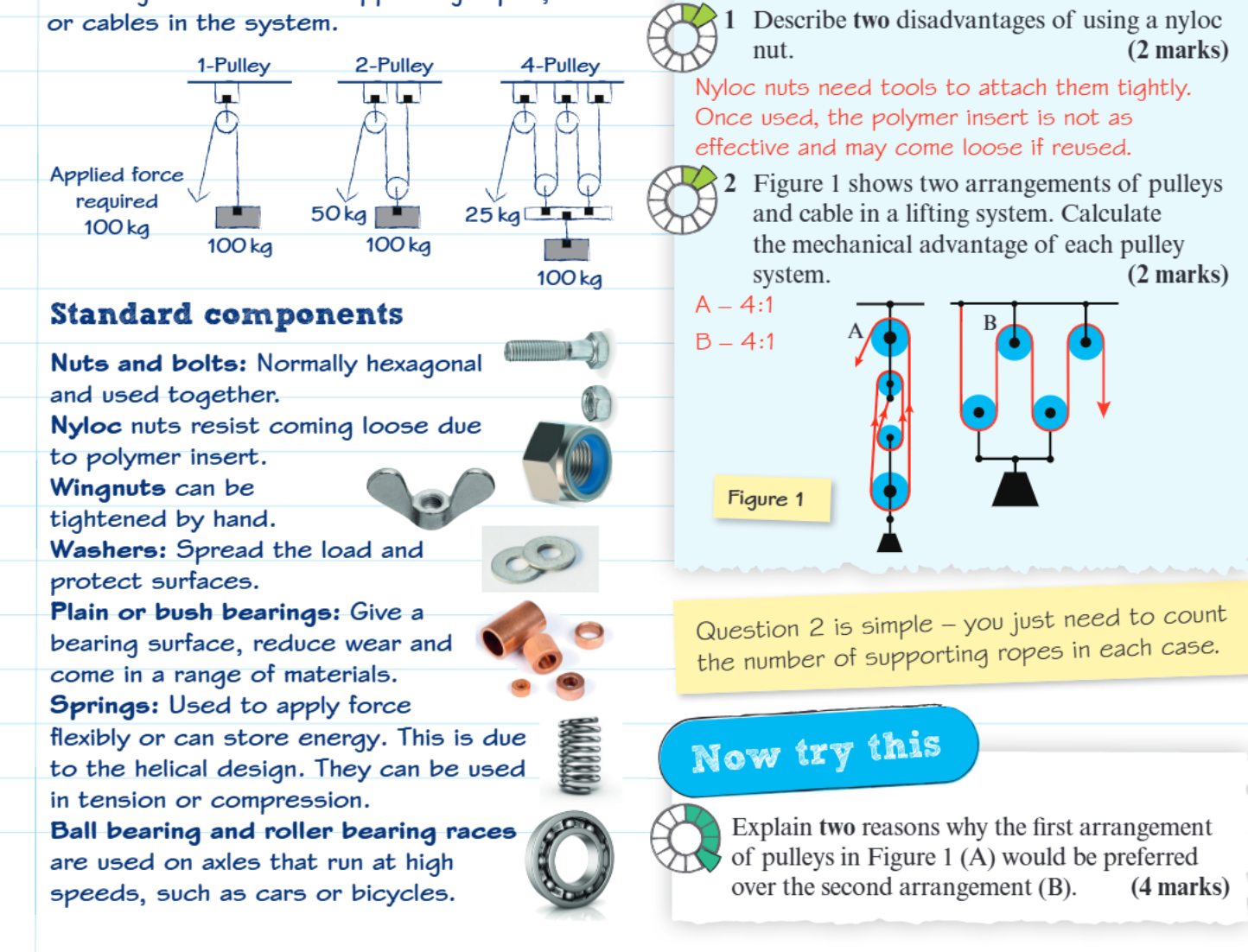
The real power of pulley systems becomes apparent when you use multiple pulleys together. By increasing the number of pulleys and supporting ropes, you can significantly reduce the effort needed to lift heavy loads, though you'll need to pull the rope through a greater distance.
Calculating mechanical advantage
Mechanical advantage (MA) tells you how much a system multiplies your input force. For pulley systems, calculating this is straightforward - you simply count the number of ropes or cables that directly support the load.
Example
Worked Example: Calculating Mechanical Advantage
Single Pulley System:
- Number of supporting ropes: 1
- Mechanical advantage:
- Force required: Full weight of load
Two-Pulley System:
- Number of supporting ropes: 2
- Mechanical advantage:
- Force required: of load weight
- Rope distance: lift distance
Four-Pulley System:
- Number of supporting ropes: 4
- Mechanical advantage:
- Force required: of load weight
- Rope distance: lift distance
A four-pulley system with four supporting ropes provides a mechanical advantage of , allowing you to lift heavy loads with just a quarter of the force needed without the pulley system.
Standard mechanical components
Nuts and bolts
Hexagonal nuts and bolts are the most common fastening components in mechanical systems. Their six-sided design allows for secure tightening with standard tools. They work together to create strong, removable connections between parts.
Nyloc nuts feature a special polymer insert that prevents them from loosening due to vibration. While they provide excellent security, they require proper tools for installation and the polymer insert can become less effective after repeated use.
Important
Common Mistake: Reusing Nyloc nuts multiple times can compromise their effectiveness. The polymer insert loses its grip after several uses, potentially leading to loosening under vibration.
Wingnuts offer the convenience of hand-tightening without tools, making them ideal for applications where frequent assembly and disassembly is needed.
Washers and load distribution
Washers play a crucial role in spreading loads across surfaces and protecting materials from damage during fastening. They help prevent nuts and bolts from pulling through thinner materials and can also provide spacing between components.
Bearing systems
Plain and bush bearings provide smooth surfaces for rotating components, reducing friction and wear. They're commonly made from materials like bronze or plastic and are suitable for lower-speed applications.
Ball bearing and roller bearing races are designed for high-speed, high-load applications such as car wheels and bicycle hubs. The rolling elements (balls or rollers) dramatically reduce friction compared to sliding surfaces.
Note
Bearing Selection Criteria:
- Speed requirements: Ball and roller bearings for high-speed applications
- Load capacity: Roller bearings typically handle higher loads than ball bearings
- Precision needs: Ball bearings generally offer better precision
- Cost considerations: Plain bearings are more economical for simple applications
Springs and energy storage
Springs serve multiple functions in mechanical systems. They can apply consistent force over a range of motion, store energy when compressed or extended, and return to their original shape when the load is removed. Their helical design allows them to work effectively in both tension and compression applications.
Summary
Key Points to Remember:
- Mechanical stock forms save time and money by providing standardised, ready-to-use components
- Chain and sprocket systems are stronger than belts and maintain rotational direction
- Mechanical advantage in pulley systems equals the number of ropes supporting the load
- Different fasteners serve different purposes - choose based on accessibility, vibration, and security needs
- Bearing selection depends on speed, load, and precision requirements