Deforming and reforming (AQA GCSE Design and Technology): Revision Notes
📚Revision Notes
Deforming and reforming
When working with papers and boards, there are several important techniques used to shape and modify materials to create functional products like packaging, books, and containers. These processes allow designers to transform flat sheets into three-dimensional objects that serve specific purposes.
Perforating
Perforating is a technique that creates intentional weak points in paper or board materials. This process involves using a specialised toothed cutting tool that makes a series of small cuts along a predetermined line. The cuts don't go completely through the material but create enough weakness to allow easy tearing.
This technique is commonly used in everyday items where you need to separate parts cleanly. You'll find perforating used in postage stamps, where it allows individual stamps to be removed from a sheet without scissors. It's also used in books and notebooks to create tear-out sections that can be removed neatly along a straight line.
Note
The perforating process is carefully controlled to ensure the right balance between strength and tearability. Too little perforation and the material won't tear cleanly, while too much can weaken the product during handling and transportation.
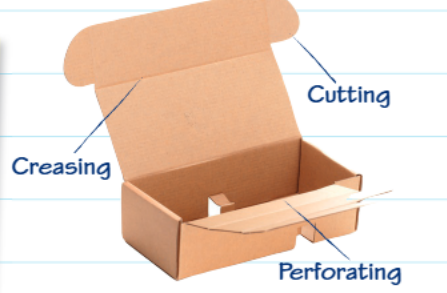 The combination of different techniques like cutting, creasing, and perforating allows manufacturers to create complex packaging solutions that are both functional and user-friendly.
Scoring and creasing
Scoring and creasing are similar techniques that prepare paper and board materials for clean, precise folding. Unlike cutting, which removes material, these processes compress and weaken the fibres without breaking through completely.
The key difference between scoring and cutting is the amount of pressure applied and the type of tool used. Scoring tools are deliberately blunt rather than sharp, which means they crush the paper fibres instead of slicing through them. This creates a controlled weak line that acts as a hinge when the material is folded.
Important
Critical Technique Difference: Never confuse scoring with cutting! Scoring uses blunt tools to compress fibres, while cutting uses sharp tools to slice through material. Using the wrong technique can result in torn edges, uneven folds, or packaging that fails during assembly.
This technique is essential for creating professional-looking boxes, greeting cards, and brochures. When done properly, creasing ensures that folds are straight, clean, and positioned exactly where needed. The process can be done by hand using simple tools or by machine for mass production.
Securing folded paper and board
Once paper and board materials have been shaped and folded, they need to be secured in their final form. There are several methods used to achieve this, depending on the intended use and permanence required.
Tucks and flaps represent one approach to securing packaging. These are carefully designed extensions of the material that can be folded and inserted into slots or pockets. This creates a mechanical connection that holds the package closed without requiring additional materials like glue or tape.
Adhesives offer another solution for joining folded materials. These can be applied to create either permanent bonds or temporary connections that can be opened and resealed. The choice of adhesive depends on factors like the materials being joined, environmental conditions, and whether the package needs to be recyclable.
Note
Modern packaging often combines multiple securing methods for optimal performance. For example, a cereal box might use both mechanical tucks for the main closure and adhesive strips for tamper-evident sealing.
Many modern packaging designs combine both mechanical fastening and adhesives to create secure, professional-looking products that meet specific functional requirements.
Moulded pulp
While most paper products start as flat sheets, pulp can also be shaped into three-dimensional forms while it's still wet. This process, known as moulded pulp manufacturing, creates packaging solutions that are both functional and environmentally responsible.
Example
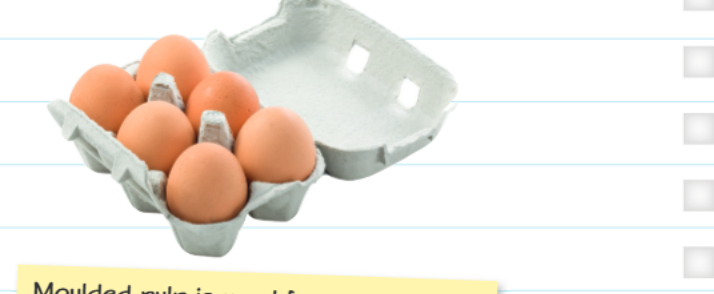
Process Example: Creating Egg Cartons
Step 1: Wet pulp is prepared from recycled newspaper and waste paper Step 2: The pulp slurry is pumped into specially designed moulds Step 3: Suction removes excess water while pressing the pulp into shape Step 4: Heat drying solidifies the final three-dimensional form Step 5: The finished product is removed, ready for use
The process involves pumping wet pulp into specially designed moulds, then pressing and drying it to create the final shape. This technique is particularly useful for creating protective packaging for fragile items like electronics or food products such as eggs.
Moulded pulp offers several environmental advantages over alternative packaging materials. The pulp is typically made from recycled newspaper and other waste paper, which means it diverts material from landfills. Additionally, the finished products are completely biodegradable and can be recycled again at the end of their useful life.
Compared to expanded polystyrene foam, moulded pulp is significantly less expensive to produce and much better for the environment. This makes it an increasingly popular choice for companies looking to reduce their environmental impact while maintaining effective packaging.
Summary
Key Points to Remember:
- Perforating creates tear lines using toothed cutters, perfect for stamps and tear-out sections
- Scoring and creasing use blunt tools to create clean fold lines without cutting through the material completely
- Mechanical fastening through tucks and flaps can secure packaging without additional adhesives
- Moulded pulp transforms wet pulp into 3D shapes, offering an eco-friendly alternative to plastic packaging
- Environmental benefits make moulded pulp increasingly popular - it's recyclable, biodegradable, and cost-effective