Geometric proof (AQA GCSE Further Maths): Revision Notes
📚Revision Notes
Geometric proof
What is geometric proof?
Geometric proof is a method of demonstrating that mathematical statements about shapes, angles, and lines are always true. When constructing formal proofs, you must state all geometric properties using correct mathematical notation and vocabulary. This ensures your reasoning is clear and can be understood by others.
The key to successful geometric proof is building a logical chain of reasoning. Each step must follow from the previous one using established geometric rules and theorems. You'll often find that there are several different ways to prove the same statement - this flexibility is one of the strengths of geometric reasoning.
Note
The beauty of geometric proof lies in its logical structure. Each statement must be justified by a previous statement or a known theorem, creating an unbreakable chain of reasoning that leads to your conclusion.
Essential geometric theorems for proofs
Understanding these fundamental theorems will help you construct clear proofs:
Important
Triangle properties:
- In an isosceles triangle, the base angles (angles opposite the equal sides) are always equal
- The sum of all angles in any triangle equals 180°
- An exterior angle of a triangle equals the sum of the two interior angles that are not adjacent to it
Line properties:
- Adjacent angles on a straight line sum to 180°
- When parallel lines are crossed by a transversal, alternate angles are equal
- When parallel lines are crossed by a transversal, corresponding angles are equal
Circle properties:
- The angle at the circumference is half the angle at the centre when both subtend the same arc
- The angle at the circumference is half the angle at the centre when both subtend the same arc
- Opposite angles in a cyclic quadrilateral sum to 180°
- The alternate segment theorem states that the angle between a tangent and chord equals the angle in the alternate segment
Worked example: Isosceles triangle proof
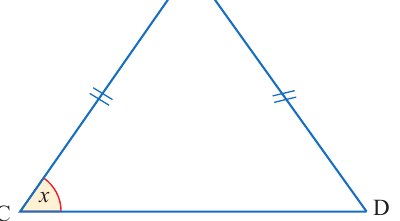
Let's examine how to prove angle relationships in an isosceles triangle. Consider triangle BCD where BC = BD and ABC is a straight line.
Example
Worked Example: Proving Angle Relationships in Isosceles Triangles
Given information:
- Triangle BCD with BC = BD (isosceles triangle)
- ABC is a straight line
- Need to prove that angle ABD = 2x
Method 1 - Using angle sum properties:
We start by recognising that since BC = BD, triangle BCD is isosceles. This means the base angles are equal, so angle CDB = x.
Next, we use the angle sum property of triangles. In triangle BCD: angle CBD = (since the angles must sum to )
Finally, since ABC is a straight line, angles CBD and ABD are adjacent angles on a straight line: angle ABD =
Method 2 - Using exterior angle theorem:
We again start with angle CDB = x (base angles of isosceles triangle).
Now we apply the exterior angle theorem: angle ABD is an exterior angle of triangle BCD, so it equals the sum of the two non-adjacent interior angles: angle ABD = angle CDB + angle BCD =
Both methods lead to the same conclusion, demonstrating that there are often multiple valid approaches to geometric proof.
Worked example: Tangent and parallel lines
This example demonstrates how tangent properties combine with parallel line theorems.
Example
Worked Example: Combining Tangent and Parallel Line Properties
Given information:
- AP is tangent to the circle at point P
- AP is parallel to QR
- Need to prove triangle PQR is isosceles
Solution approach:
We use alternate angles and the alternate segment theorem. Since AP is parallel to QR, we know that angle APQ = angle PQR (alternate angles).
The alternate segment theorem tells us that angle APQ = angle PRQ (angle between tangent and chord equals angle in alternate segment).
Therefore, angle PQR = angle PRQ, which means triangle PQR has two equal angles and is therefore isosceles.
Worked example: Cyclic quadrilateral proof
Cyclic quadrilaterals (four-sided shapes inscribed in circles) have special angle properties that are useful in proofs.
Example
Worked Example: Cyclic Quadrilateral Angle Relationships
Given information:
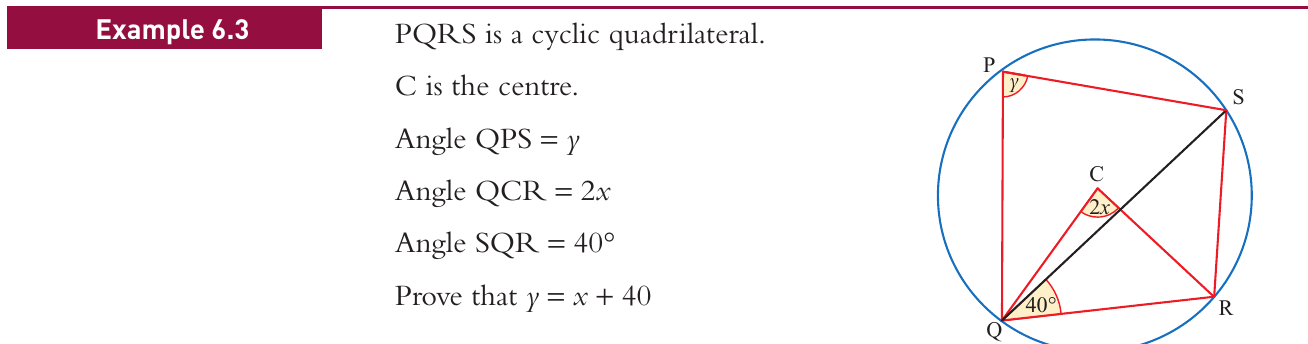
- PQRS is a cyclic quadrilateral with centre C
- Angle QPS = y
- Angle QCR = 2x
- Angle SQR = 40°
- Need to prove y = x + 40
Solution approach:
We use the relationship between angles at the circumference and angles at the centre. The angle at the circumference is half the angle at the centre when both subtend the same arc.
So angle QSR = x (since angle QCR = 2x, and angle at circumference is half the angle at centre).
In triangle QRS, we can use the angle sum property:
Rearranging this equation:
Therefore, , which completes our proof.
Strategies for geometric proof success
Developing effective strategies will significantly improve your proof-writing abilities:
Note
Plan your approach: Before writing your proof, identify what theorems and properties you can use. Look for special triangles (isosceles, right-angled), parallel lines, or circle properties.
Note
Use clear notation: Always state your reasons clearly. Common abbreviations include "base ∠s of isos. triangle" or "∠ sum of triangle", but make sure your meaning is unambiguous.
Note
Consider multiple methods: As shown in the examples, there are often several ways to prove the same statement. If one approach seems complex, try a different theorem or property.
Note
Work systematically: Build your proof step by step, ensuring each statement follows logically from the previous ones and your given information.
Common exam techniques
Important
Key Exam Strategies for Geometric Proof:
- Always start by marking the given information clearly on your diagram
- Look for angle relationships first - these often provide the quickest route to a solution
- If the question involves a circle, consider which circle theorems might apply
- For parallel lines, check for alternate angles, corresponding angles, or co-interior angles
- When dealing with isosceles triangles, remember that equal sides create equal angles
Summary
Key Points to Remember:
- Geometric proof requires logical reasoning using established theorems and properties
- Always state your reasons clearly using correct mathematical vocabulary
- There are often multiple valid methods to prove the same geometric statement
- Key theorems include angle properties of triangles, parallel lines, and circles
- Practice identifying which geometric properties apply to each situation - this skill improves with experience