Trigonometric identities (AQA GCSE Further Maths): Revision Notes
📚Revision Notes
Trigonometric identities
What are trigonometric identities?
Trigonometric identities are mathematical equations involving trigonometric functions that remain true for all possible values of the variables involved. These powerful relationships allow us to transform complex trigonometric expressions into simpler forms and solve equations that would otherwise be very difficult.
The beauty of trigonometric identities lies in their universal truth - they work for any angle, whether it's measured in degrees or radians. Understanding these identities is crucial for solving advanced trigonometric problems and forms the foundation for many areas of higher mathematics.
Note
Trigonometric identities are different from regular equations because they are true for ALL values of the variable, not just specific solutions. This is why we often use the equivalence symbol (≡) instead of the equals sign (=).
The fundamental identities
The Pythagorean identity
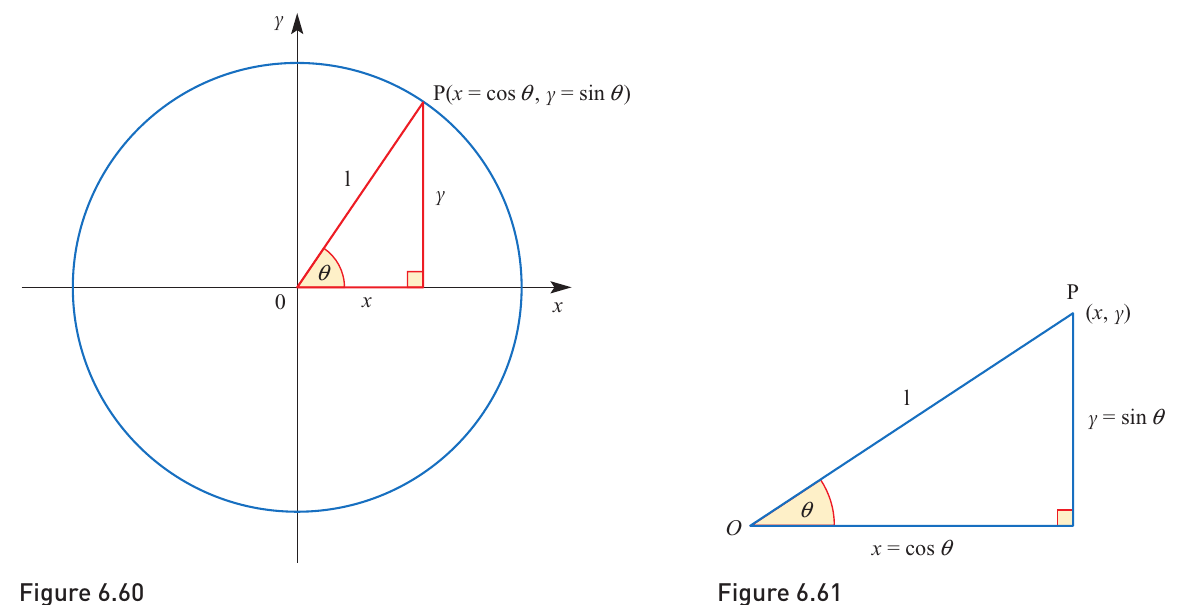
The most important trigonometric identity comes directly from Pythagoras' theorem applied to the unit circle. When we consider a point P with coordinates on a circle of radius 1, we can see that:
Important
This identity is incredibly versatile because it can be rearranged into different forms depending on what we need:
These rearranged forms are particularly useful when we need to eliminate one trigonometric function in favour of another.
The tangent identity
The second fundamental identity defines tangent in terms of sine and cosine:
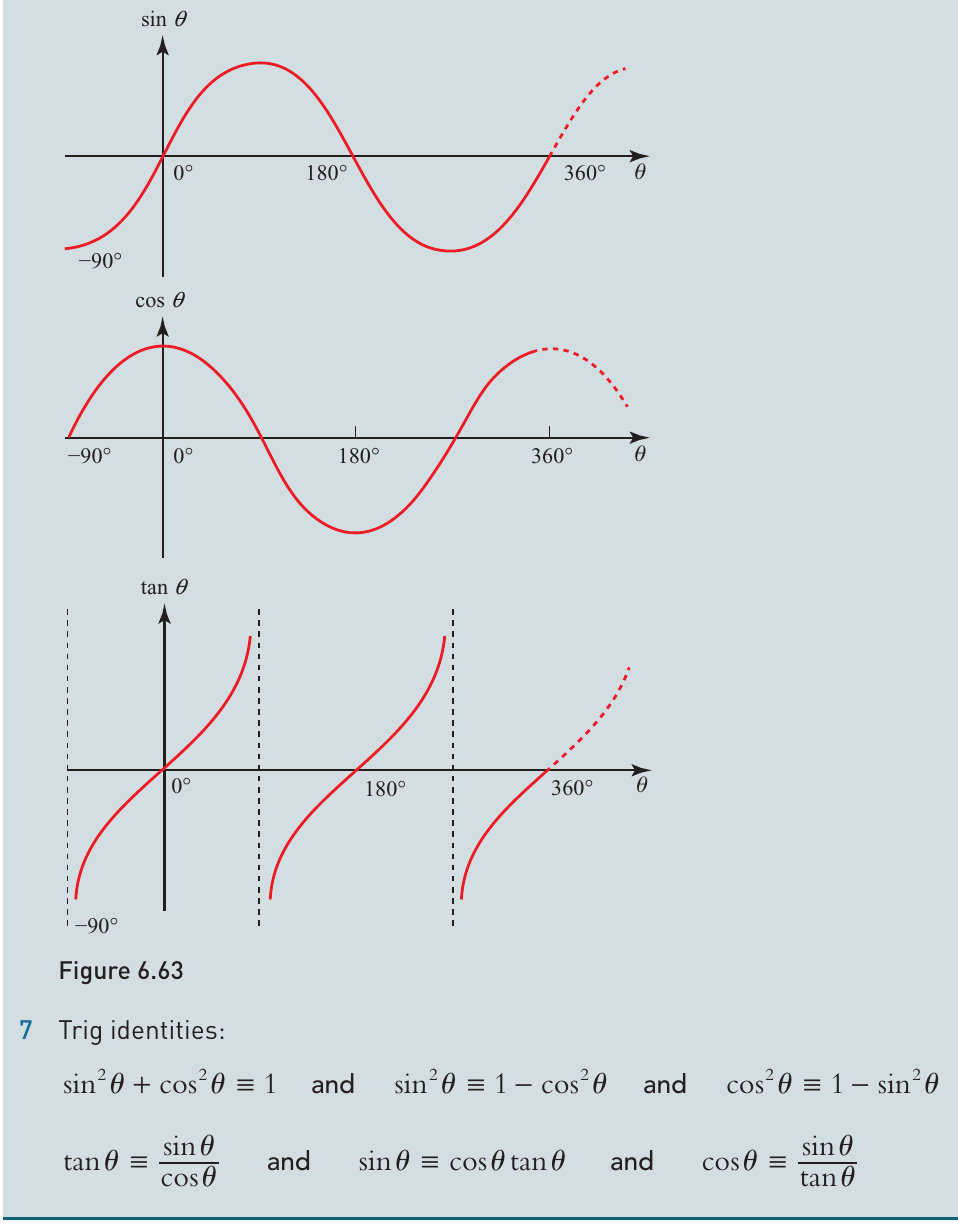
This relationship is essential for converting between different trigonometric functions and simplifying expressions. From this identity, we can also derive:
Using identities to solve equations
Trigonometric identities become powerful tools when solving equations. The key strategy is to use identities to rewrite equations so they involve only one trigonometric function, making them much easier to solve.
Example
Worked Example: Mixed Function Equation
Let's solve the equation: for values of between 0° and 360°.
Step 1: Use the Pythagorean identity to eliminate Since , we can substitute:
Step 2: Expand and rearrange
Step 3: Factor the quadratic expression This factors as:
Step 4: Solve each factor Either or This gives us , or
This example shows how the Pythagorean identity transforms a complex mixed equation into a simple quadratic that we can solve using factorisation.
Proving trigonometric identities
When proving identities, we need to show that one side of an equation can be transformed into the other through valid algebraic steps. The key is to work with one side at a time and use known identities to simplify.
Example
Worked Example: Double Angle Proof
Let's prove that
Starting with the left side:
Using the Pythagorean identity ():
This matches the right side, proving the identity. The equivalence symbol (≡) indicates this relationship is true for all values of .
Example
Worked Example: Complex Fraction Simplification
Let's show that simplifies to 1.
Step 1: Use the tangent identity
Step 2: Simplify the denominator using the Pythagorean identity
Step 3: Complete the simplification
Special angle values
Certain angles have exact trigonometric values that you should memorise, as they appear frequently in problems:
For 30° ( radians):
For 45° ( radians):
For 60° ( radians):
Note
These values come from the ratios in 30-60-90 and 45-45-90 right triangles, and knowing them will save you significant time in examinations.
Key exam techniques
Strategy for solving trigonometric equations
The following systematic approach will help you tackle any trigonometric equation:
- Identify the functions present - Look for sine, cosine, and tangent terms
- Choose your target function - Decide which single function to express everything in terms of
- Apply appropriate identities - Use the Pythagorean or tangent identities to eliminate unwanted functions
- Solve the resulting equation - This often becomes a quadratic equation in your chosen function
- Find all solutions in the given range - Remember that trigonometric functions are periodic
Strategy for proving identities
Important
Key Steps for Proving Identities:
- Work with one side only - Never manipulate both sides simultaneously
- Start with the more complex side - This usually gives you more options for simplification
- Look for opportunities to use fundamental identities - The Pythagorean identity is often key
- Factor when possible - Factorisation often reveals the path to the solution
- Check your final result - Ensure both sides are identical
Common exam traps to avoid
Important
Warning: Common Mistakes to Avoid
- Don't divide by trigonometric functions without checking they're not zero
- Remember the range restrictions - Solutions must fall within the specified interval
- Watch out for extraneous solutions - Always verify your answers in the original equation
- Be careful with square roots - Remember that , not necessarily
Summary
Key Points to Remember:
- The Pythagorean identity is your most powerful tool for eliminating one trigonometric function in favour of another
- The tangent identity allows you to convert between tangent and the other functions
- When solving equations, aim to express everything in terms of a single trigonometric function
- For proving identities, work with one side at a time and use algebraic manipulation to transform it into the other side
- Memorise the exact values for 30°, 45°, and 60° - they appear constantly in examinations