Congruent Shapes (AQA GCSE Maths): Revision Notes
📚Revision Notes
Congruent shapes
What does congruent mean?
Don't let the fancy mathematical terminology fool you! Congruence might sound complicated, but it's actually a straightforward concept. When two shapes are congruent, they are identical in both size and shape. Think of it like this: if you could cut out one shape and place it perfectly on top of another, covering it completely, then those shapes are congruent.
Note
The key thing to remember is that congruent shapes can be flipped (reflected) or turned (rotated) and still remain congruent. So even if a triangle is upside down or facing the opposite direction, it can still be congruent to another triangle as long as all corresponding measurements match up.
Proving triangles are congruent
When working with triangles, you don't need to measure every single side and angle to prove they're congruent. Instead, mathematicians have identified four specific conditions that, when met, guarantee that two triangles are congruent. You only need to prove that ONE of these conditions is satisfied.
The four conditions for triangle congruence
Understanding these four conditions is essential for solving congruence problems effectively:
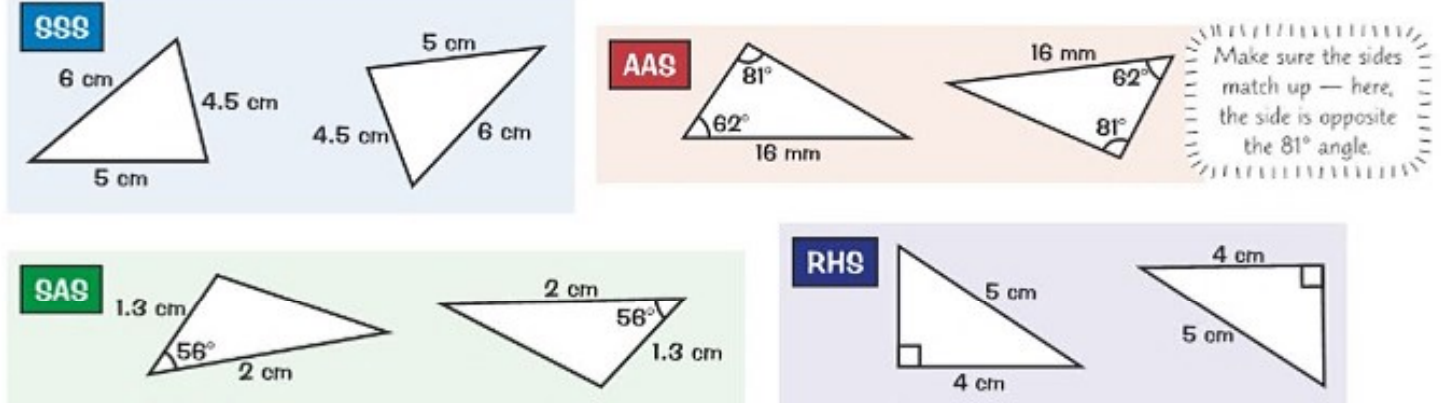
1. SSS (Side-Side-Side) This condition requires all three sides of one triangle to match the corresponding three sides of another triangle. If every side length is identical, then the triangles must be congruent.
2. AAS (Angle-Angle-Side) Here you need two angles and one corresponding side to match up between the triangles. The corresponding side must be opposite one of the equal angles.
3. SAS (Side-Angle-Side) This condition requires two sides and the angle between them to be identical in both triangles. The angle must be sandwiched between the two matching sides.
4. RHS (Right-angle-Hypotenuse-Side) This special condition applies only to right-angled triangles. You need to show that both triangles have a right angle, their hypotenuses are equal, and one other corresponding side is equal.
Important
The hypotenuse is particularly important in right-angled triangles because it's always the longest side and sits opposite the right angle.
Example
Worked Example: Identifying Congruence Conditions
These diagrams show practical examples of each condition in action:
- SSS: All three sides match (e.g., 5cm, 4cm, 3cm)
- AAS: Two angles and corresponding side match
- SAS: Two sides with the angle between them match
- RHS: Right angle + hypotenuse + one other side match
Each set of triangles demonstrates how specific measurements prove congruence using different conditions.
Problem-solving strategy
When tackling congruence problems, the most effective approach is to systematically work through what information you have available. Start by writing down all the sides and angles you can identify or calculate from the given information. Then examine which of the four conditions best fits your available data.
Note
Be particularly careful with problems involving parallel lines or circle theorems, as these often provide additional relationships between angles and sides that can help you establish congruence.
Advanced applications
Congruence proofs can become more sophisticated when combined with other mathematical concepts. For example, when dealing with circles, you might use the fact that tangent lines create right angles with radii, or that radii of the same circle are equal lengths. These properties can help you establish the conditions needed for triangle congruence.
In problems involving tangents to circles, you might find that the RHS condition becomes particularly useful, as the tangent-radius relationship automatically provides you with right angles.
Summary
Key Points to Remember:
- Congruent shapes are identical in size and shape, but can be reflected or rotated
- You only need to prove ONE of the four conditions (SSS, AAS, SAS, or RHS) to establish triangle congruence
- The hypotenuse is the longest side of a right-angled triangle, opposite the right angle
- Always write down all known information before deciding which condition to use
- Watch out for parallel lines and circle theorems that might provide additional angle or side relationships