Geometry Problems (AQA GCSE Maths): Revision Notes
📚Revision Notes
Geometry problems
Solving geometry problems can seem daunting at first, but with the right approach and systematic thinking, you can tackle even complex angle calculations confidently. The key is to work methodically and use all the geometric rules you know.
General approach to solving geometry problems
When faced with a geometry problem, don't focus immediately on the specific angle you need to find. Instead, use this systematic approach that will help you work through any geometric challenge:
Important
Find ALL angles in whatever order they become obvious
This means looking at the entire diagram and calculating any angles you can work out, even if they're not the final answer. Each angle you find will help you discover others, eventually leading to the solution.
Understanding angle notation
Before diving into problems, make sure you're comfortable with three-letter angle notation. This notation system is essential for clear communication in geometry problems.
Note
Angle Notation Rules:
- means "the angle formed at point B" (B is always the middle letter)
- and both refer to angles at point B
- Sometimes you might see this written as just B for simplicity
Worked example 1: Finding angles in triangles and quadrilaterals
Let's work through a problem involving an isosceles triangle and a quadrilateral to demonstrate the systematic approach:
Example
Worked Example: Finding angles in triangles and quadrilaterals
Given information:
- Triangle ABD is isosceles
- We need to find angles x and y in the figure
Step-by-step solution:
-
Use the isosceles triangle property: In triangle ABD, since it's isosceles, the base angles are equal:
-
Find the third angle in the triangle: The angles in triangle ABD sum to , so
-
Use the right angle: Since is a right angle (), we can find angle x:
-
Apply the quadrilateral angle sum: In quadrilateral ABCD, all angles sum to . So: , which gives us
Worked example 2: Using parallel lines and triangles
This more complex example demonstrates how parallel lines and triangle properties work together to solve challenging problems:
Example
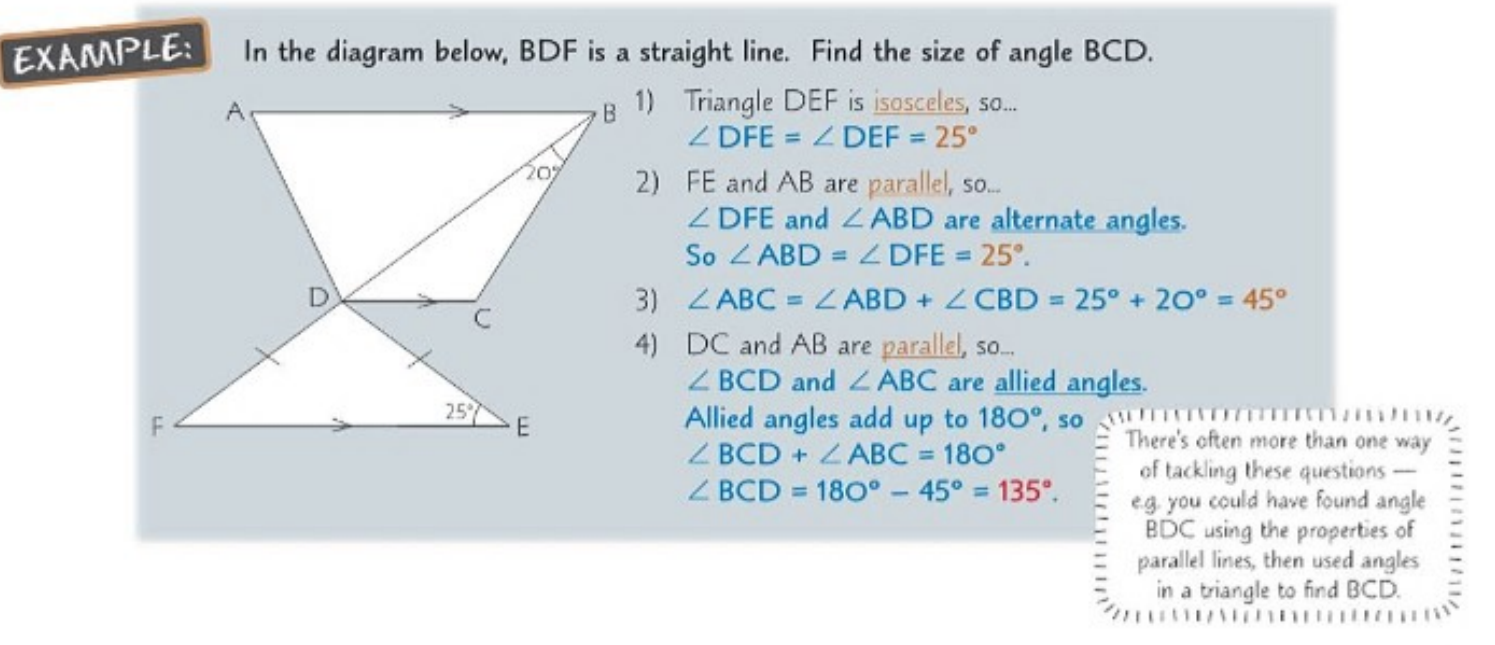
Worked Example: Using parallel lines and triangles
Given information:
- BDF is a straight line
- We need to find angle BCD
Step-by-step solution:
-
Identify the isosceles triangle: Triangle DEF is isosceles, so the base angles are equal:
-
Use parallel line properties: Since FE and AB are parallel, and are alternate angles, so
-
Calculate angle ABC:
-
Apply allied angles: Since DC and AB are parallel, and are allied angles (they add up to ). Therefore: , so
Key geometric principles to remember
Understanding these fundamental principles is essential for solving geometry problems effectively. These rules form the foundation of most geometric problem-solving:
Important
Essential Rules to Master:
Triangle properties:
- Angles in a triangle sum to
- In an isosceles triangle, the base angles are equal
- Right angles measure
Parallel line properties:
- Alternate angles are equal
- Allied angles (also called co-interior angles) sum to
Quadrilateral properties:
- Angles in a quadrilateral sum to
Problem-solving tips
Developing effective problem-solving strategies will help you approach geometry problems with confidence. These techniques have proven helpful for many students:
Note
Effective Problem-Solving Strategies:
- Look for hidden patterns: Watch out for parallel lines and isosceles triangles - they often provide the key to solving problems
- Write down everything you know: Don't just focus on what you're asked to find
- Work systematically: Calculate angles in whatever order becomes obvious
- Use all available information: Every given angle or line property is there for a reason
- Don't panic: Geometry problems often look more complex than they actually are
Summary
Key Points to Remember:
- Use the systematic approach: find ALL angles in whatever order they become obvious
- Master angle notation - the middle letter is always the vertex of the angle
- Key angle sums: triangles = , quadrilaterals =
- Parallel lines give you alternate angles (equal) and allied angles (sum to )
- Look for isosceles triangles and parallel lines - they're often the key to solving complex problems