Loci and Construction — Worked Examples (AQA GCSE Maths): Revision Notes
📚Revision Notes
Loci and construction — Worked examples
Understanding loci and construction problems
When you encounter loci problems in your exam, you'll often need to find regions that satisfy multiple conditions at once. The key approach is to draw each individual locus first, then identify the area where all conditions overlap.
Note
Understanding loci problems becomes much easier when you visualise them step by step. Think of each condition as creating a separate "zone" on your diagram, and your final answer is where these zones intersect.
Finding a locus that satisfies multiple rules
In exam questions, you might be presented with a situation involving several different conditions, and you'll need to find the region that meets all of them simultaneously. The most effective strategy is to construct each locus separately, then determine which area satisfies your requirements.
Important
Common Mistake to Avoid: Never try to draw all conditions at once. This leads to confusion and errors. Always work through each condition individually before finding the overlap.
Example 1: Square with vertex and diagonal constraints
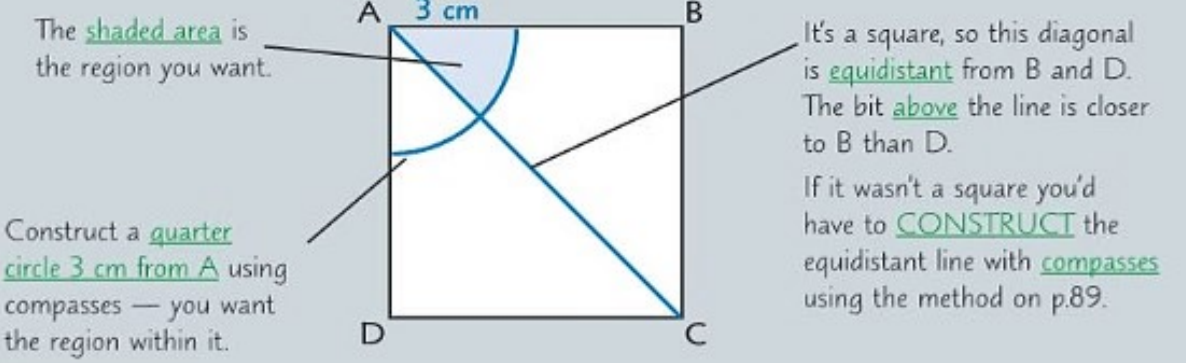
Let's work through a problem where you need to shade the region that is within 3 cm of vertex A and closer to vertex B than vertex D.
Example
Worked Example: Square with Multiple Constraints
Problem: Shade the region that is within 3 cm of vertex A and closer to vertex B than vertex D.
Step 1: Create the quarter circle Use your compasses to draw a quarter circle with a 3 cm radius from point A. This shows all points within 3 cm of vertex A.
Step 2: Find the equidistant line Since this is a square, the diagonal from A to C is equidistant from points B and D. The area above this diagonal line is closer to B than to D.
Step 3: Identify the overlap The shaded region represents where both conditions are met - it's within the quarter circle and above the diagonal line.
If you weren't working with a square, you'd need to construct the equidistant line using compasses and the perpendicular bisector method.
Example 2: Ice cream van route planning
This example involves a more complex real-world scenario with multiple constraints.
Example
Worked Example: Ice Cream Van Route Planning
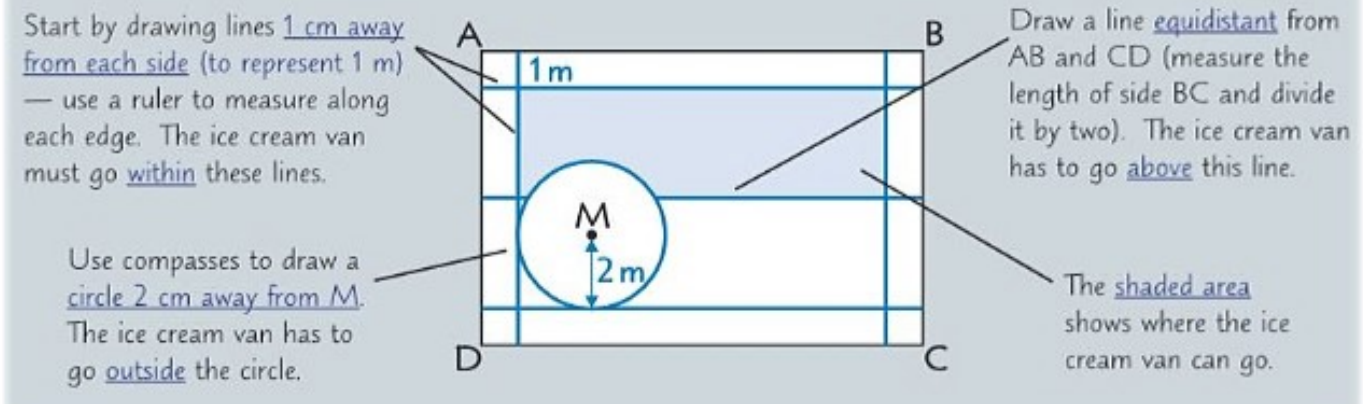
Problem: The ice cream van must be:
- At least 1 m away from each edge of the rectangular field
- At least 2 m away from the central point M
- Closer to side AB than to side CD
Step 1: Draw boundary lines Use a ruler to draw lines 1 cm away from each side of the rectangle (remembering the 1 cm = 1 m scale).
Step 2: Create the exclusion circle Use compasses to draw a circle 2 cm away from point M, representing the 2 m exclusion zone.
Step 3: Find the equidistant line Draw a line equidistant from sides AB and CD by measuring the length of side BC and dividing it by two.
Step 4: Identify the valid area The shaded region shows where the ice cream van can travel, satisfying all constraints.
Construction techniques and tools
Using compasses effectively
Compasses are essential for creating circles and arcs. When the question asks you to "leave your construction lines clearly visible," make sure you don't erase the compass marks, as these demonstrate your method.
Note
Your compass marks are like showing your working in algebra - they prove you used the correct mathematical method to arrive at your answer.
Using a ruler for measurements
When lines are at right angles to each other, you can often use a ruler for measurements rather than construction with compasses. However, always check what the question specifically asks for.
Important
Critical Point: Some exam questions specifically require compass construction methods. Using a ruler when compasses are required will lose you marks, even if your final answer is correct.
Practical exam tips
Reading wordy problems
Sometimes you'll encounter problems presented as word problems rather than geometric diagrams. Take time to work out what you're being asked to find, then draw the situation clearly before attempting to solve it.
Scale drawings
Pay careful attention to scale information. In the practice questions, you might see scales like 1 cm = 2 m, which means every centimetre on your drawing represents 2 metres in real life.
Note
Scale Conversion Tip: Always write the scale clearly at the top of your diagram. This helps you stay consistent with measurements throughout your solution and makes it easier for examiners to follow your work.
Construction accuracy
When working with loci problems, precision is crucial. Use your mathematical instruments properly and ensure your constructions are accurate, as small errors can lead to incorrect final answers.