More Enlargements and Projections (AQA GCSE Maths): Revision Notes
📚Revision Notes
More enlargements and projections
Understanding how enlargements affect different properties of shapes and how to represent 3D objects in 2D views are essential skills in geometry. Let's explore these concepts in detail.
Note
Mastering these concepts will help you solve complex geometry problems involving scale factors and 3D visualisation more confidently.
How enlargement affects area and volume
When you enlarge a shape using a scale factor, different properties of the shape change by different amounts. This is a crucial concept that many students find tricky, but once you understand the pattern, it becomes much clearer.
Understanding scale factors
A scale factor tells you how much bigger the new shape is compared to the original. If you have a scale factor of 2, it means the new shape is twice as big in each direction. However, this doesn't mean everything doubles - different properties change by different amounts.
The mathematical relationship
For any scale factor , there's a clear pattern:
Important
Critical Scale Factor Rules:
- Linear measurements (like length, width, height) increase by times
- Area measurements (like surface area) increase by times
- Volume measurements increase by times
This makes sense when you think about it. If you double the length and width of a rectangle, you actually get four times the area (). Similarly, if you double all three dimensions of a cube, you get eight times the volume ().
Working with the formulas
You can express these relationships using formulas:
Note
Scale Factor Formulas:
Let's say you have a scale factor of 2. This means lengths are 2 times bigger, areas are times bigger, and volumes are times bigger. The ratios become 1:2 for length, 1:4 for area, and 1:8 for volume.
Practical example
Example
Worked Example: Finding Scale Factor from Surface Area
Consider two similar cylinders where cylinder B is an enlargement of cylinder A. If cylinder A has a surface area of cm² and cylinder B has a surface area of cm², you can find the scale factor by calculating:
Step 1: Use the area relationship
Step 2: Find the scale factor
Step 3: Apply to find volume If cylinder A has a volume of cm³, then cylinder B will have a volume of: cm³
Projections show a 3D shape from different viewpoints
Projections are 2D representations of 3D objects viewed from specific directions. They help us understand and communicate the shape of three-dimensional objects on paper.
The three types of projections
There are three main types of projections you need to know:
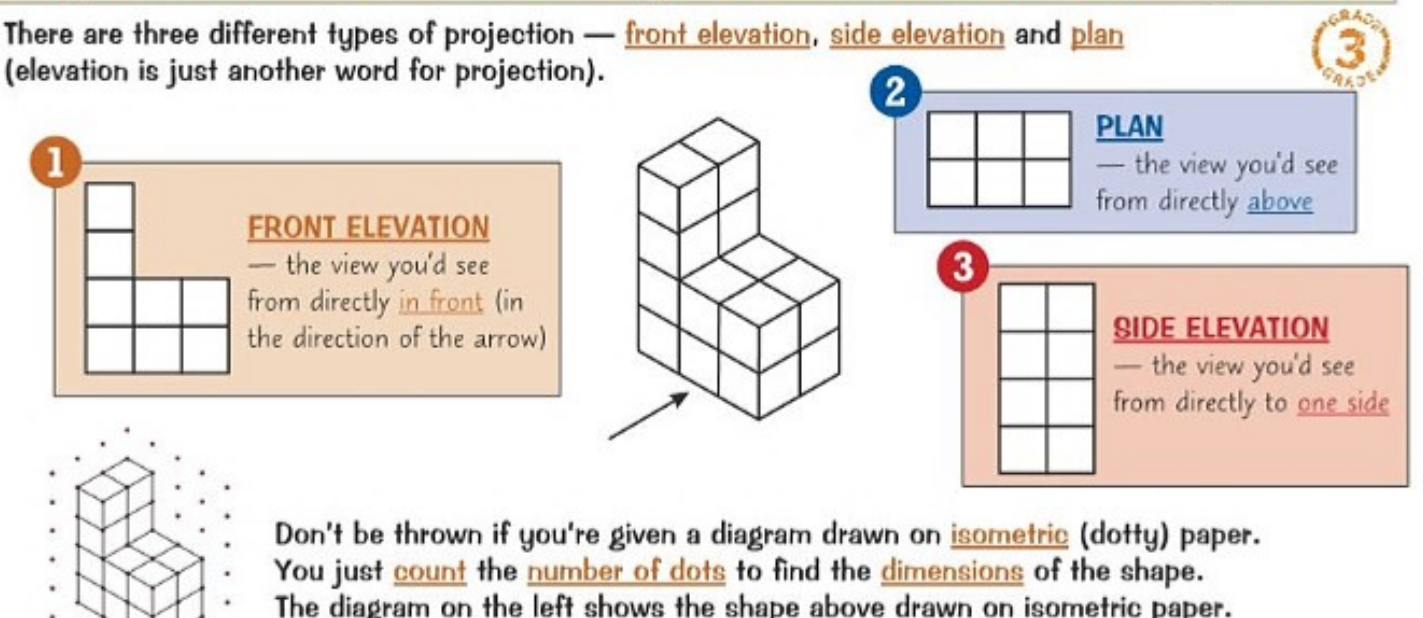
- Front elevation: This shows what you would see if you looked at the object straight from the front
- Side elevation: This shows what you would see if you looked at the object from directly to one side
- Plan view: This shows what you would see if you looked at the object from directly above
Note
Each projection gives you different information about the shape, and together they provide a complete understanding of the 3D object.
Working with isometric paper
Sometimes you'll encounter diagrams drawn on isometric paper, which has a dotted pattern. Don't be put off by this - it's actually quite helpful. You can count the number of dots to work out the dimensions of the shape. The dots are arranged in a triangular pattern that makes it easier to draw 3D shapes accurately.
Reading projections
When you're given projection views, you need to visualise how they relate to the original 3D shape. The front elevation shows the outline you'd see from the front, the side elevation shows the outline from the side, and the plan shows the outline from above. By combining these three views, you can reconstruct the complete 3D shape in your mind.
Important
Common Mistake to Avoid: Don't try to interpret projections in isolation. Always consider how all three views work together to represent the complete 3D object.
Summary
Key Points to Remember:
- Scale factors affect different properties differently: lengths by , areas by , and volumes by
- A scale factor of 2 means lengths double, areas become 4 times bigger, and volumes become 8 times bigger
- There are three main types of projections: front elevation, side elevation, and plan view
- Projections help us represent 3D objects in 2D format from different viewpoints
- Don't be intimidated by isometric paper - just count the dots to find dimensions