Parallel Lines (AQA GCSE Maths): Revision Notes
📚Revision Notes
GCSE Geometry and Measures: Parallel lines
What are parallel lines?
Parallel lines are straight lines that run alongside each other and never meet, no matter how far they extend. They maintain the same distance apart throughout their length. In geometry problems, parallel lines are typically shown with small arrows pointing in the same direction to indicate they are parallel.
Angle properties with parallel lines
When a straight line (called a transversal) cuts through two parallel lines, it creates some very useful angle relationships. Understanding these patterns is essential for solving geometry problems.
Basic angle facts
Note
When a transversal intersects two parallel lines, several important things happen:
- The transversal creates two identical groups of angles at each intersection point
- Within each group, there are actually only two different angle sizes (let's call them 'a' and 'b')
- These two angles always add up to because they form a straight line
- Vertically opposite angles (angles directly across from each other) are always equal
The three main angle relationships
There are three key angle relationships you need to master when working with parallel lines. Each has a distinctive pattern that helps you identify them quickly.
Alternate angles
Alternate angles are equal in size and can be spotted by looking for a 'Z' pattern. When you trace from one angle to its alternate partner, your finger creates a Z-shape (or sometimes a backwards Z).
Important
Key fact: Alternate angles are identical in size.
These angles appear on opposite sides of the transversal and are positioned alternately - one above the first parallel line and one below the second parallel line.
Allied angles (co-interior angles)
Allied angles (also called co-interior angles) always add up to and can be identified by their 'C' or 'U' shape pattern. These angles are found on the same side of the transversal, with one between the parallel lines and one outside them.
Important
Key fact: Allied angles sum to .
Think of these angles as "allies working together" - they cooperate to make a straight line when added together.
Corresponding angles
Corresponding angles are equal in size and create an 'F' pattern when you trace between them. These angles are in matching positions relative to their intersection points.
Important
Key fact: Corresponding angles are identical in size.
You can think of corresponding angles as being in "corresponding positions" - they're like mirror images of each other at each intersection.
Recognising the patterns
Note
The key to success with parallel lines is quickly spotting these letter patterns:
- Z-shape = Alternate angles (equal)
- C or U-shape = Allied angles (add to )
- F-shape = Corresponding angles (equal)
It's perfectly acceptable to use the letters Z, C, U, and F to help identify these relationships during your working, but remember to use the proper mathematical names (alternate, allied, corresponding) in your final answers.
Worked example
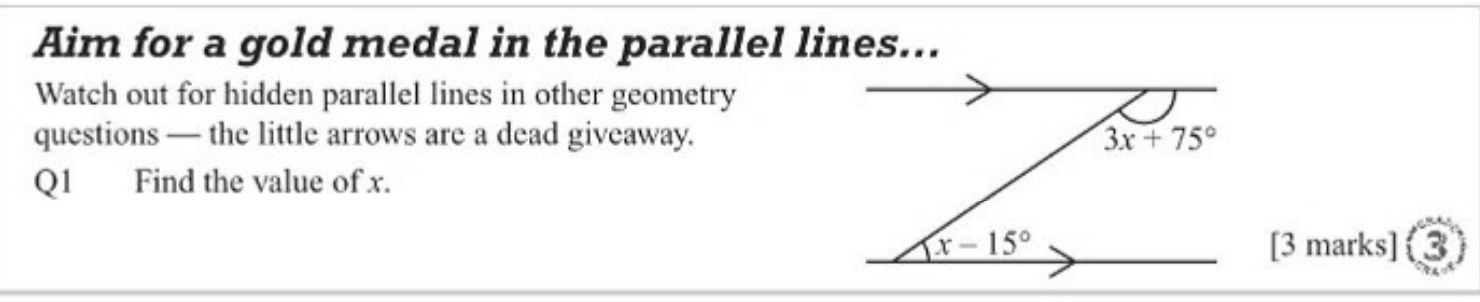
Example
Worked Example: Finding the value of x
In this problem, we have two parallel lines (shown by the arrows) cut by a transversal. The angles marked are and .
Step 1: Identify the angle relationship Looking at the diagram, these two angles form a C-shape pattern, which means they are allied angles.
Step 2: Apply the rule Since allied angles add up to , we can write:
Step 3: Solve the equation Simplifying:
Summary
Key Points to Remember:
- Parallel lines never meet and are marked with arrows in the same direction
- Alternate angles (Z-pattern) are equal
- Allied angles (C/U-pattern) add up to
- Corresponding angles (F-pattern) are equal
- Learn to spot the letter patterns quickly - they're your key to identifying which rule to use