Triangle Construction (AQA GCSE Maths): Revision Notes
📚Revision Notes
Triangle construction
Creating triangles accurately requires different methods depending on the information you have available. The approach you choose depends on whether you know the lengths of sides, the sizes of angles, or a combination of both.
Note
The construction method you select is determined by the specific information given in your problem. Each method produces a unique triangle when the correct information is provided.
Three sides construction (SSS)
When you know all three side lengths, you can build a triangle using only a ruler and compasses. This method creates precise triangles through the intersection of arcs.
 The SSS method is particularly useful because it requires no angle measurements and relies entirely on the geometric properties of circles and arcs.
Example
Worked Example: Constructing a Triangle with SSS
To construct a triangle when you know all three sides:
-
Sketch and plan your triangle - Draw a rough outline first so you understand what you're aiming for. It doesn't matter which side you choose as your starting base.
-
Create the base line - Use your ruler to draw one side accurately. Mark the endpoints clearly with letters.
-
Set your compasses - Adjust your compasses to match the length of the second side. Place the compass point at one end of your base line and draw an arc above it.
-
Draw the second arc - Reset your compasses to the third side length. Place the compass point at the other end of your base line and draw another arc that intersects with the first.
-
Complete the triangle - The point where the two arcs cross becomes your third vertex. Use a ruler to connect this point to both ends of your base line.
Important
Remember to leave your construction marks visible as they demonstrate your method and can earn you valuable marks in examinations.
Two sides and included angle (SAS)
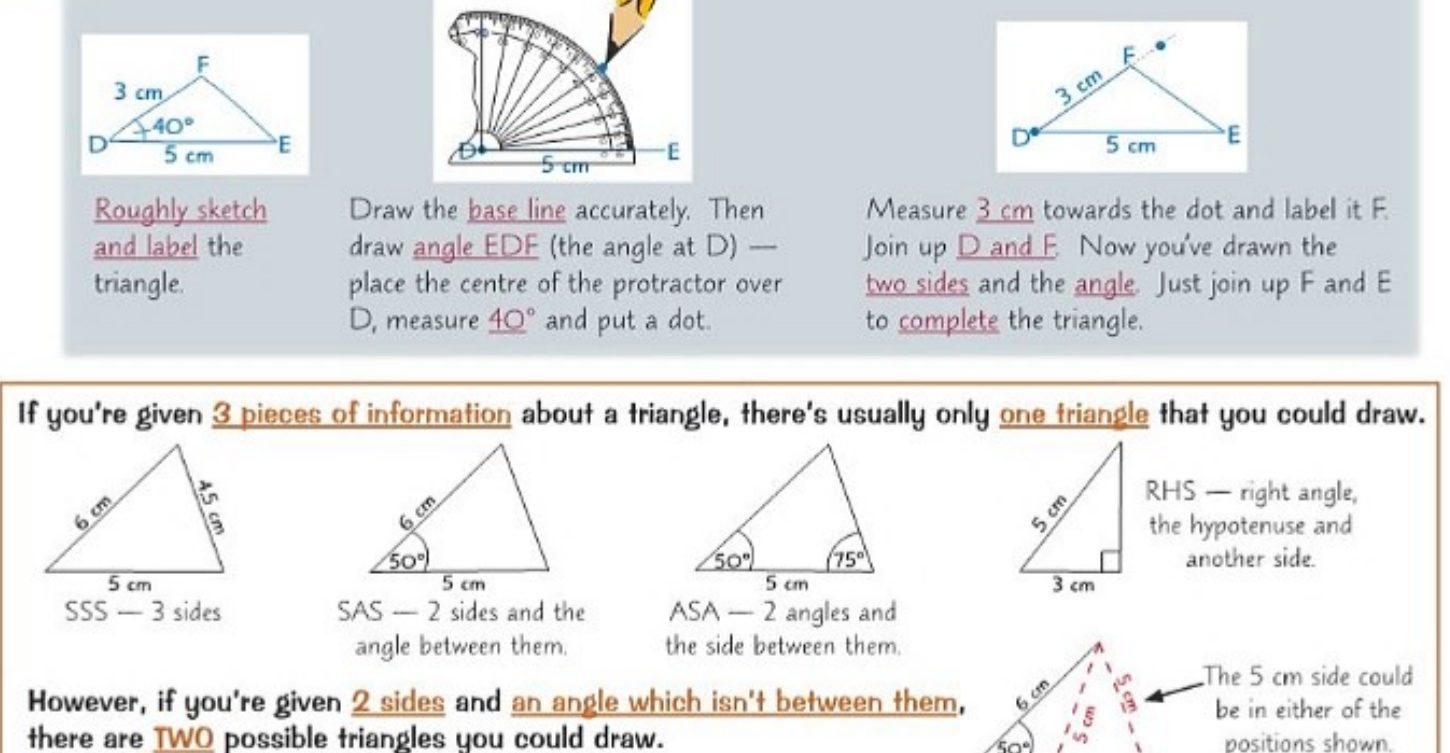
When you have two sides and the angle between them, you'll need both a ruler and protractor to create an accurate triangle.
The SAS method combines linear measurement with angular measurement, making it essential to be precise with both your ruler and protractor techniques.
Example
Worked Example: Constructing a Triangle with SAS
To construct using the SAS method:
-
Sketch your triangle - Create a rough outline showing the two known sides and the angle between them.
-
Draw the base line precisely - Use your ruler to create one of the known sides with accurate length.
-
Measure the angle - Place your protractor at one end of the base line. Mark the required angle and draw a line from this point.
-
Measure the second side - Use your ruler to measure the correct distance along the angled line you just drew. Mark this point clearly.
-
Join the vertices - Connect your marked point back to the other end of the base line to complete your triangle.
Two angles and included side (ASA)
With two angles and the side between them, you can create a unique triangle using a ruler and protractor.
The ASA method requires careful angle measurement at both ends of the known side, with the intersection point determining the final vertex.
Example
Worked Example: Constructing a Triangle with ASA
For ASA construction:
-
Draw the known side - Start by creating the side you know with accurate measurement.
-
Create the first angle - Use your protractor at one end of the side to measure and mark the first angle.
-
Create the second angle - Move to the other end of your known side and use the protractor to measure and mark the second angle.
-
Extend the angle lines - Draw lines from both angle marks until they meet. The intersection point becomes your third vertex.
Right angle, hypotenuse and one side (RHS)
This special case applies only to right triangles where you know the hypotenuse and one other side.
The construction follows similar principles to other methods but always includes a 90-degree angle as one of your starting points.
Note
The RHS method is specifically designed for right triangles and cannot be used for any other type of triangle construction.
The ambiguous case
Usually, when you have three pieces of information about a triangle, only one triangle is possible. However, there's an important exception to remember.
Important
When you're given two sides and an angle that isn't between them, you might be able to construct two different triangles. This happens because the third vertex could be positioned in two different locations while still satisfying the given measurements.
This ambiguous situation doesn't occur with the other construction methods (SSS, SAS, ASA, or RHS) - they each produce exactly one unique triangle.
Equipment for triangle construction
Always bring the right tools to ensure accurate constructions. The quality of your construction depends heavily on using the appropriate equipment correctly.
Note
Essential Construction Equipment:
- Pencil - For drawing lines and marking points
- Ruler - For measuring and drawing straight lines
- Compasses - Essential for creating arcs and circles
- Protractor - Needed for measuring and creating angles
Summary
Key Points to Remember:
- SSS method: Use compasses to create intersecting arcs from known side lengths
- SAS method: Combine ruler and protractor when you have two sides and the angle between them
- ASA method: Use protractor for both angles and ruler for the included side
- RHS method: Special case for right triangles with hypotenuse and one side
- Ambiguous case: Two sides and a non-included angle can sometimes create two different triangles
- Leave construction marks visible: They show your working method and can earn you marks