Triangles and Quadrilaterals (AQA GCSE Maths): Revision Notes
📚Revision Notes
Triangles and quadrilaterals
Understanding the properties of triangles and quadrilaterals is essential for GCSE geometry. These shapes form the foundation of many geometric concepts and appear frequently in exam questions. Let's explore each type systematically, focusing on their key characteristics and properties.
Note
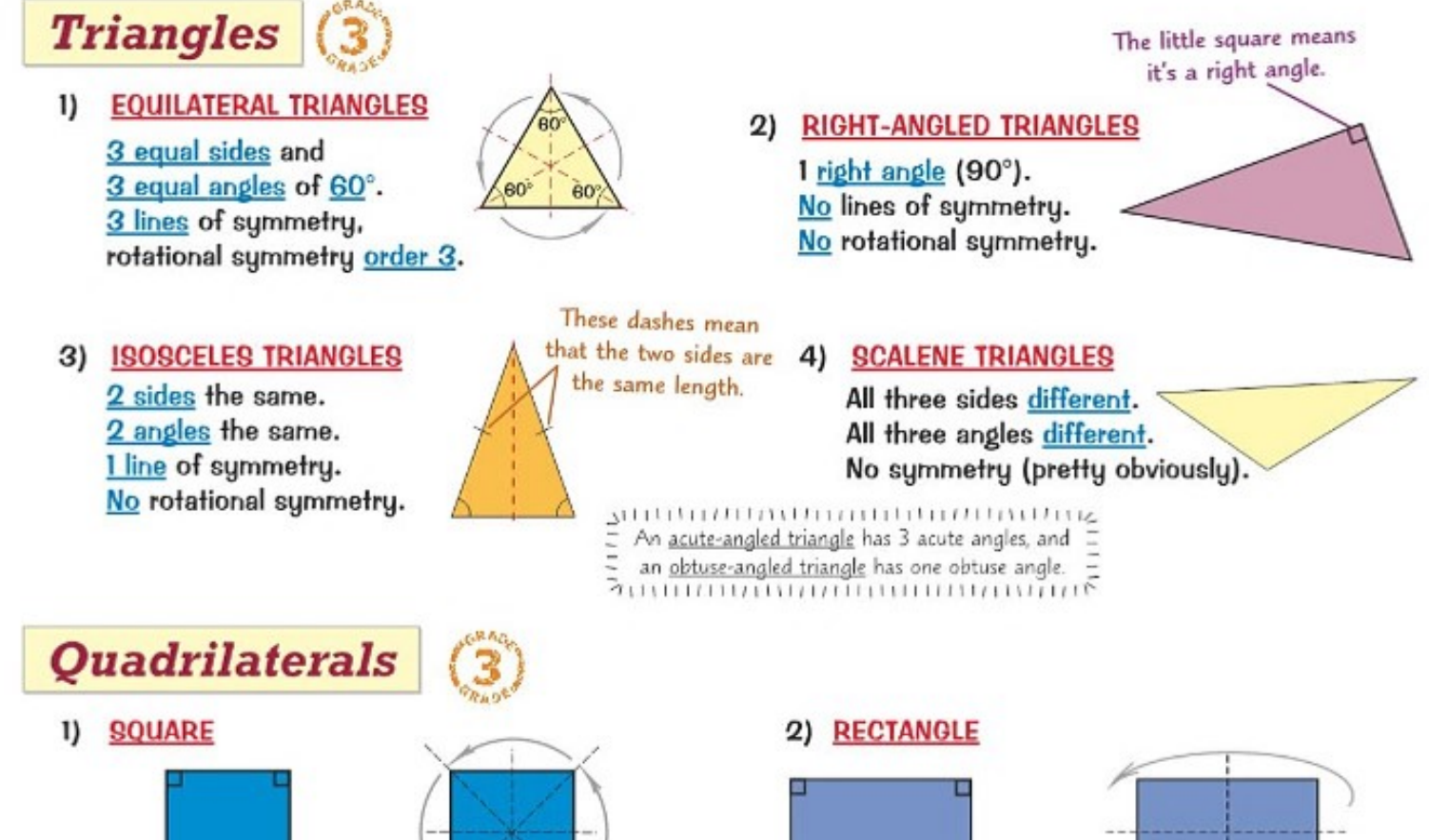
The image below shows various examples of triangles and quadrilaterals that we'll be studying in this section.
Triangles
Triangles are three-sided polygons that can be classified according to their side lengths and angles. Each type has distinct properties that make them unique and useful in different geometric situations.
Important
Triangle Classification Methods:
- By sides: Equilateral, isosceles, scalene
- By angles: Acute, right-angled, obtuse
Equilateral triangles
An equilateral triangle is perfectly balanced, with all three sides being exactly the same length. This uniformity extends to the angles as well - each interior angle measures precisely 60°. Due to this perfect symmetry, equilateral triangles have three lines of symmetry (each line passes through a vertex and the midpoint of the opposite side) and rotational symmetry of order 3, meaning the triangle looks identical when rotated by 120° or 240°.
Note
The perfect symmetry of equilateral triangles makes them particularly useful in geometric proofs and constructions.
Right-angled triangles
Right-angled triangles contain one angle that measures exactly 90°. This right angle is typically marked with a small square symbol in diagrams. Unlike equilateral triangles, right-angled triangles have no lines of symmetry and no rotational symmetry, making them less symmetrical but extremely useful in practical applications and trigonometry.
Important
Always look for the small square symbol (∟) in diagrams to identify right angles - this is the standard notation used in GCSE mathematics.
Isosceles triangles
An isosceles triangle has exactly two sides of equal length, which means it also has two equal angles. These equal angles are always opposite the equal sides. The triangle has one line of symmetry that runs from the vertex between the two equal sides to the midpoint of the opposite side. Like right-angled triangles, isosceles triangles have no rotational symmetry.
Example
Worked Example: Identifying Isosceles Properties
If an isosceles triangle has two sides of length 5 cm and angles of 70°, 70°, and 40°:
- The equal sides are opposite the equal angles (70°)
- The line of symmetry passes through the 40° angle vertex
- The base angles are both 70°
Scalene triangles
Scalene triangles are the most irregular type, with all three sides having different lengths and all three angles being different. This irregularity means they have no lines of symmetry and no rotational symmetry whatsoever. Despite their lack of symmetry, scalene triangles are commonly encountered in real-world geometric problems.
Additional triangle classifications
Triangles can also be classified by their angles. An acute-angled triangle has all three angles less than 90°, while an obtuse-angled triangle contains one angle greater than 90°. These classifications can overlap with the side-based classifications above.
Note
Remember that these angle classifications can combine with side classifications - for example, you can have an obtuse isosceles triangle or an acute scalene triangle.
Quadrilaterals
Quadrilaterals are four-sided polygons with varying properties depending on their specific type. Understanding their characteristics helps in solving problems involving area, perimeter, and geometric transformations.
Square
A square is the most regular quadrilateral, with four equal sides and four right angles (90° each). Its high degree of symmetry gives it four lines of symmetry - two passing through opposite vertices and two through the midpoints of opposite sides. The rotational symmetry is of order 4, meaning the square looks identical when rotated by 90°, 180°, or 270°. The diagonals of a square are equal in length and intersect at right angles.
Example
Worked Example: Square Properties
For a square with side length 4 cm:
- All sides = 4 cm
- All angles = 90°
- Diagonal length = cm (using Pythagoras)
- Area = cm²
Rectangle
A rectangle has four right angles like a square, but only opposite sides are equal in length. This gives it two lines of symmetry (through the midpoints of opposite sides) and rotational symmetry of order 2. The diagonals are equal in length but don't necessarily intersect at right angles unless the rectangle is actually a square.
Rhombus
A rhombus can be thought of as a square that has been "pushed over" while maintaining equal side lengths. All four sides are equal, and it has two pairs of equal angles (opposite angles are equal). The rhombus has two lines of symmetry (along its diagonals) and rotational symmetry of order 2. Its diagonals intersect at right angles, but unlike a square, they may not be equal in length.
Parallelogram
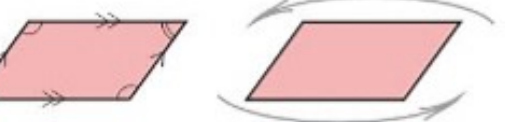
A parallelogram is like a rectangle that has been "pushed over" - it has two pairs of equal sides with each pair being parallel. It also has two pairs of equal angles, where opposite angles are equal and neighbouring angles add up to 180°. Despite having equal opposite sides and angles, a parallelogram has no lines of symmetry but does have rotational symmetry of order 2. The diagonals intersect at right angles but are not necessarily equal in length.
Important
Key Property: In any parallelogram, opposite sides are not only equal in length but also parallel. This is what defines the shape.
Trapezium
A trapezium (called a trapezoid in American English) has exactly one pair of parallel sides. In an isosceles trapezium, the non-parallel sides are equal in length, giving it one line of symmetry. However, a general trapezium has no lines of symmetry and no rotational symmetry, making it one of the less symmetrical quadrilaterals.
Note
The term "trapezium" is used in UK mathematics, while "trapezoid" is the American term for the same shape.
Kite
A kite has two pairs of equal sides, where each pair consists of adjacent sides rather than opposite sides. This creates one pair of equal angles and gives the kite exactly one line of symmetry. Like most irregular quadrilaterals, kites have no rotational symmetry. The diagonals of a kite intersect at right angles, with one diagonal bisecting the other.
Summary
Key Points to Remember:
- Triangle classification: Triangles can be classified by sides (equilateral, isosceles, scalene) or by angles (acute, right, obtuse)
- Symmetry patterns: More regular shapes have more lines of symmetry and higher orders of rotational symmetry
- Quadrilateral hierarchy: Squares are special rectangles, rectangles are special parallelograms, and parallelograms are special quadrilaterals
- Parallel sides: Squares, rectangles, rhombuses, and parallelograms all have two pairs of parallel sides, while trapeziums have only one pair
- Right angles: Squares and rectangles always have four right angles, while other quadrilaterals may have none