Estimation (AQA GCSE Maths): Revision Notes
📚Revision Notes
Estimation
What is estimation?
Estimation is a method used to find approximate answers to calculations quickly and easily. You can use estimation to check your answers or to work out calculations on non-calculator exam papers. This technique helps you get close to the correct answer without doing complex arithmetic.
Note
Estimation is particularly useful in exam situations where you need to:
- Check if your calculator answer seems reasonable
- Work through problems on non-calculator papers
- Save time on complex calculations when an approximate answer is sufficient
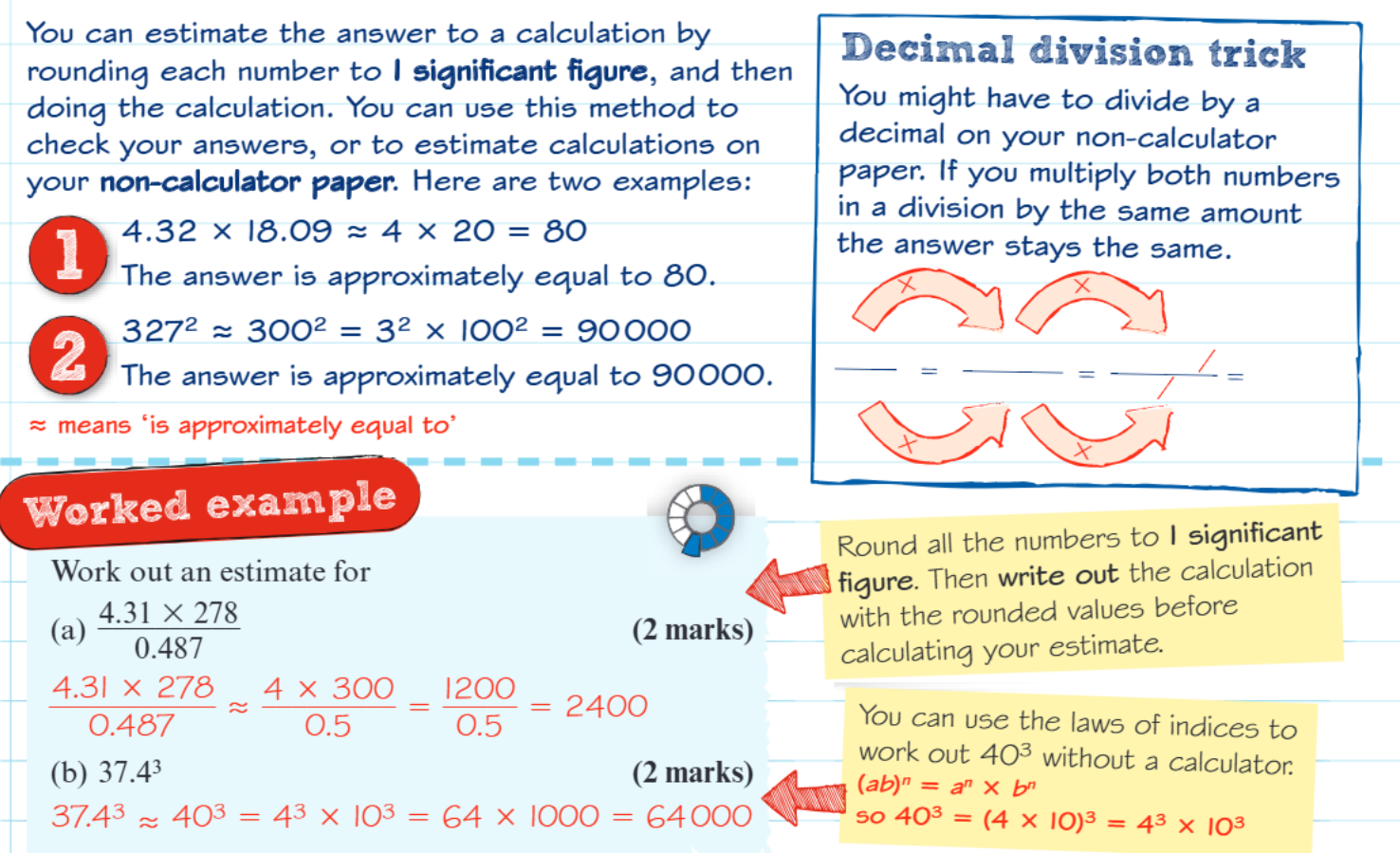
Basic estimation method
The key to good estimation is rounding each number to 1 significant figure before doing the calculation. This makes the numbers much easier to work with and gives you a reasonable approximation.
The symbol ≈ means "is approximately equal to" and is used when writing estimations.
Simple examples
Here are two straightforward examples of how estimation works:
Example
Worked Example: Basic Multiplication
Original calculation:
Step 1: Round to 1 significant figure: Step 2: Calculate the estimate: Result:
Example
Worked Example: Squaring Numbers
Original calculation:
Step 1: Round to 1 significant figure: Step 2: Calculate the estimate: Result:
Working through complex calculations
For more complicated calculations, it's important to follow a systematic approach that ensures accuracy in your estimation.
Important
Essential Steps for Complex Estimations:
- Round all numbers to 1 significant figure first
- Write out the calculation with rounded values
- Calculate your estimate step by step
Example
Worked Example: Mixed Operations
Calculate an estimate for:
Step 1: Round to 1 significant figure
Step 2: Write the calculation
Step 3: Calculate
Decimal division trick
When working on non-calculator papers, you might need to divide by a decimal. Use this helpful technique to make calculations easier.
Important
Decimal Division Trick: If you multiply both numbers in a division by the same amount, the answer stays the same.
This allows you to convert difficult decimal divisions into simple whole number divisions.
Example
Worked Example: Removing Decimals
Instead of calculating :
- Multiply both by 10:
- This is much easier to calculate without a calculator!
Using laws of indices
You can use the laws of indices to work out powers without a calculator. This is particularly useful for estimations involving cubes or higher powers.
Note
Key Law of Indices for Estimation:
This can be reversed to break down complex powers:
Example
Worked Example: Estimating Cubes
Calculate an estimate for
Step 1: Round to 1 significant figure:
Step 2: Use laws of indices to break down
Result:
Working with formulae
When exam questions involve formulae, you'll often be given the formula you need. Understanding how to apply estimation techniques to these formulae is crucial for success.
Note
Common Sphere Formulae:
- Surface area of sphere:
- Volume of sphere:
On non-calculator papers, use , then round to 1 significant figure to make your estimate.
Example
Worked Example: Formula Estimation
For a sphere with radius 2.35cm, estimate the surface area:
Step 1: Use the formula: Step 2: Substitute and round: cm²
Result: Surface area cm²
Overestimate or underestimate?
Sometimes you need to determine whether your estimate is higher or lower than the actual answer. This skill is often tested in exams.
Important
Method for Determining Over/Underestimate:
- Look at how you rounded each number
- If you rounded up more than down, your estimate is likely an overestimate
- If you rounded down more than up, your estimate is likely an underestimate
Example
Worked Example: Analysis of Estimation Accuracy
For our sphere calculation:
- : we rounded down to 3
- : we rounded down to 2
- Since we rounded both numbers down, our answer is an underestimate
Exam tips
Understanding how to apply estimation effectively in exam conditions can significantly improve your performance and confidence.
Summary
Key Exam Strategies:
- Always show your working - you get marks for the method even if your final answer is slightly wrong
- Round to 1 significant figure first - this is usually what examiners expect
- Use the ≈ symbol to show you're estimating
- Be prepared to use problem-solving skills throughout your exam
- Check whether your estimate seems reasonable for the context
Summary
Essential Points to Remember:
- Round to 1 significant figure before calculating to make estimation easier
- Use ≈ symbol to show your answer is an approximation
- Decimal division trick: multiply both numbers by the same amount to remove decimals
- Laws of indices help break down difficult powers into manageable calculations
- Always show your working in exam questions - method marks are available even if your final answer isn't perfect