Operations on decimals (AQA GCSE Maths): Revision Notes
📚Revision Notes
Operations on decimals
When working with decimal numbers, you need to master three key operations: adding and subtracting, multiplying, and dividing. Each operation has its own specific method to ensure you get the correct answer.
Adding and subtracting decimals
Adding and subtracting decimal numbers requires careful attention to place value alignment. The most important rule is to line up the decimal points correctly.
Method:
- Write the numbers vertically, ensuring all decimal points are aligned in the same column
- Line up digits according to their place value (units under units, tenths under tenths, etc.)
- Add or subtract as normal
- Place the decimal point in your answer directly below the decimal points in the calculation
Note
You can add zeros to the end of decimal numbers to help with alignment. For example, 0.75 + 1.6 becomes 0.75 + 1.60. When subtracting, remember that 3.5 - 0.21 becomes 3.50 - 0.21 to make the calculation clearer.
Example
Worked Example: Adding Decimals
Calculate: 12.75 + 8.6
Step 1: Align the decimal points and add zeros for clarity
  12.75
+  8.60
-------
Step 2: Add as normal from right to left
  12.75
+  8.60
-------
  21.35
Answer: 21.35
Multiplying decimals
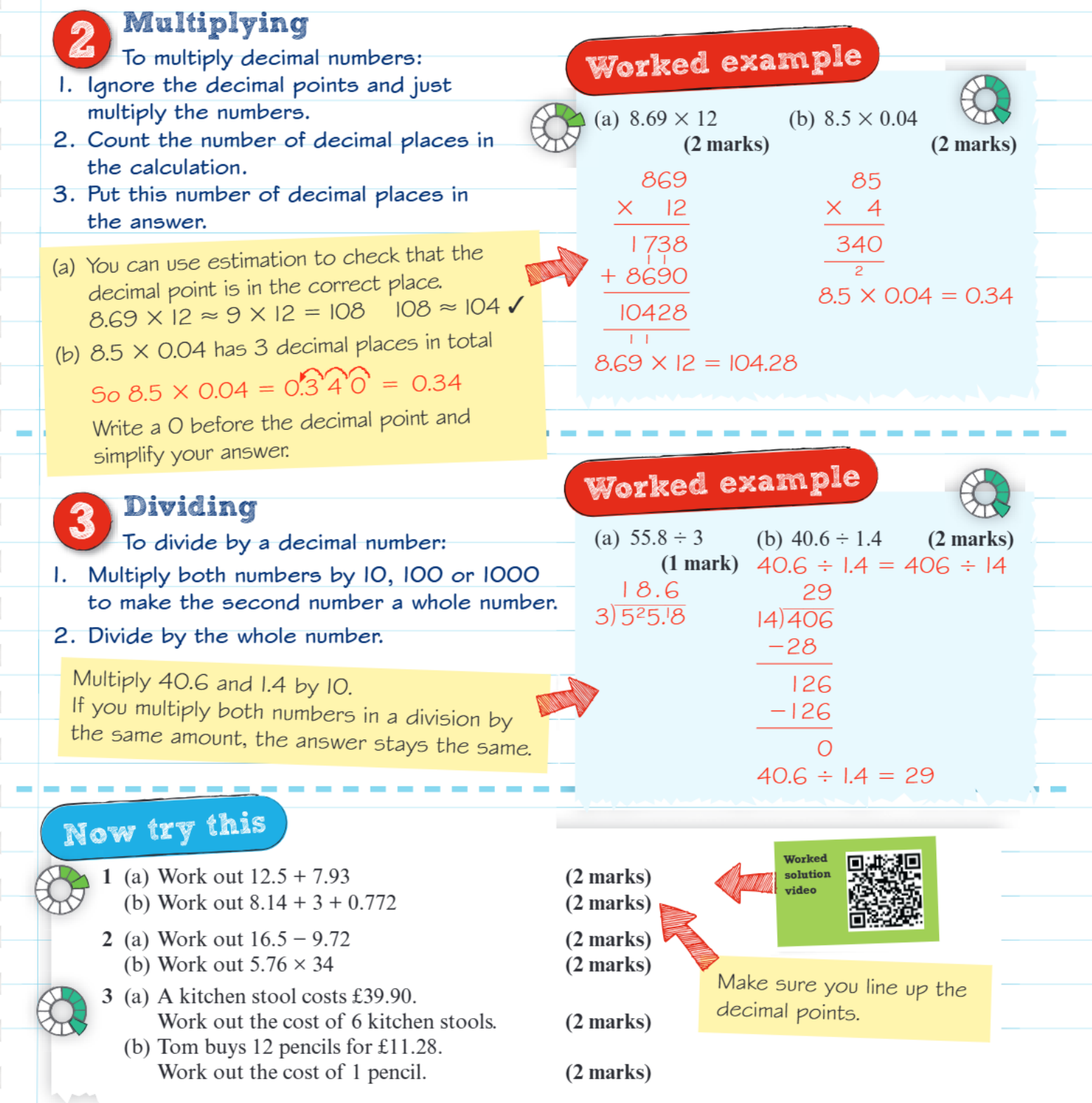
Multiplying decimal numbers is different from addition and subtraction because you ignore the decimal points during the calculation, then apply them at the end.
Method:
- Multiply the numbers as if they were whole numbers, ignoring all decimal points
- Count the total number of decimal places in both numbers you're multiplying
- Place this same number of decimal places in your final answer
Example
Worked Example: Multiplying Decimals
Calculate: 8.69 × 12
Step 1: Multiply ignoring decimal points 869 × 12 = 10,428
Step 2: Count decimal places
- 8.69 has 2 decimal places
- 12 has 0 decimal places
- Total: 2 decimal places
Step 3: Apply decimal places to answer Answer: 104.28
Note
Checking your work: Use estimation to verify your answer makes sense. For 8.69 × 12, estimate 9 × 12 = 108, so 104.28 is reasonable.
Dividing by decimals
Division by decimal numbers requires an extra step to make the calculation manageable. The key is to convert the divisor into a whole number.
Method:
- Multiply both the dividend (number being divided) and divisor (number you're dividing by) by 10, 100, or 1000
- Choose the multiplier that makes the divisor a whole number
- Perform the division using the new numbers
Example
Worked Example: Dividing by Decimals
Calculate: 40.6 ÷ 1.4
Step 1: Make the divisor a whole number Multiply both numbers by 10: 406 ÷ 14
Step 2: Perform the division 406 ÷ 14 = 29
Answer: 29
Important
If you multiply both numbers in a division by the same amount, the answer remains unchanged. This is a fundamental principle that makes decimal division possible.
Exam tips and common mistakes
Important
Critical Points to Avoid Common Mistakes:
- Always line up decimal points when adding or subtracting
- Count decimal places carefully when multiplying
- Convert the divisor to a whole number before dividing
- Use estimation to check if your answers are reasonable
- Write zeros where needed to help with alignment
- Double-check your decimal point placement in the final answer
Summary
Key Points to Remember:
- Line up decimal points vertically for addition and subtraction
- Count decimal places in multiplication and apply to your final answer
- Make the divisor a whole number when dividing by decimals
- Always check your answers using estimation
- Take extra care with decimal point placement in your final answer